

u
Ed
ie
ird
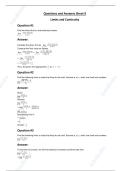
uB Questions and Answers Sheet 9
Limits and Continuity
Ed
Question #1
Find the limits (that is, end behaviors) below.
−5𝑥(𝑥−9)(𝑥+6)
lim
𝑥→−∞ 6−8𝑥 3
Answer:
−5𝑥(𝑥−9)(𝑥+6)
Consider the given limit as lim
𝑥→−∞ 6−8𝑥 3
Compute the limit value as follows.
9 6
−5𝑥(𝑥−9)(𝑥+6) −5𝑥 3 (1−𝑥)(1+𝑥)
lim = lim 6
𝑥→−∞ 6−8𝑥 3 𝑥→−∞ 𝑥 3 ( 3 −8)
𝑥
9 6
−5(1−𝑥)(1+𝑥)
= lim 6
𝑥→−∞ ( 3 −8)
𝑥
−5(1−0)(1+0) 5
= (0−8)
=
8
5
Thus, the given limit approaches as 𝑥 → −∞.
8
Question #2
Find the following limits or state that they do not exist. Assume a, b, c, and k are fixed real numbers.
ie
ie
√16 + ℎ − 4
ird
ird
lim
ℎ→0 ℎ
uB
uB
Answer:
Ed
Given
√16+ℎ−4
lim
ℎ→0 ℎ
Solution
√16+ℎ−4
lim
ℎ→0 ℎ
√16+ℎ−4 √16+ℎ+4
= lim ( ⋅ )
ℎ→0 ℎ √16+ℎ+4
1
lim
ℎ→0 √16+ℎ+4
Substituting 0 for h
1
=
√16+0+4
1
=
8
1
Answer:
8
Question #3
Find the following limits or state that they do not exist. Assume a, b, c, and k are fixed real numbers.
3𝑡 2 −7𝑡+2
lim
𝑡→2 2−𝑡
Answer:
ie
To find limit of function, we will first factorize numerator and then take limit
3𝑡 2 −7𝑡+2
rd
lim
ie
𝑡→2 2−𝑡
3𝑡 2 −6𝑡−𝑡+2
i
= lim
uB
rd
𝑡→2 2−𝑡
Bi
Ed
du
, u
Ed
ie
ird
3𝑡(𝑡−2)−1(𝑡−2)
= lim
𝑡→2 2−𝑡
uB = lim
(3𝑡−1)(𝑡−2)
𝑡→2 −(𝑡−2)
= lim − −(3𝑡 − 1)
Ed
𝑡→2
= −[3(2) − 1]
=-(6-1)
=-5
Hence, limit exists and limit is -5
Question #4
Find the following limits or state that they do not exist. Assume a, b, c, and k are fixed real numbers.
sin 2𝑥
lim
𝑥→0 sin 𝑥
Answer:
We first try to find the limit by substitution
sin(2𝑥)
lim
𝑥→0 sin(𝑥)
sin(2(0))
=
sin(0)
sin(0)
=
sin(0)
0
=
0
Since it is in the 0/0 form, so we can use L'Hospital's rule.
sin(2𝑥)
lim
ie
ie
𝑥→0 sin(𝑥)
2 cos(2𝑥)
ird
ird
= lim
𝑥→0 cos(𝑥)
2 cos(2(0))
=
uB
uB
cos(0)
2 cos(0)
=
cos(0)
Ed
2(1)
= (1)
=2
Answer: 2
Question #5
Find the following limits or state that they do not exist. Assume a, b, c, and k are fixed real numbers.
√𝑥−3
lim
𝑥→9 𝑥−9
Answer:
√𝑥−3
To find lim
𝑥→9 𝑥−9
We rationalize the numerator as
√𝑥−3 √𝑥+3
lim ×
𝑥→9 𝑥−9 √𝑥+3
𝑥+3√𝑥−3√𝑥−9
= lim
𝑥→9 (𝑥−9)(√𝑥+3)
𝑥−9
= lim (𝑥−9)(
𝑥→9 √𝑥+3)
1
= lim
𝑥→9 √𝑥+3
1
=
ie
√9+3
1
=
rd
6
ie
√𝑥−3 1
Therefore, lim =
i
𝑥→9 𝑥−9 6
uB
rd
Bi
Ed
du
Ed
ie
ird
uB Questions and Answers Sheet 9
Limits and Continuity
Ed
Question #1
Find the limits (that is, end behaviors) below.
−5𝑥(𝑥−9)(𝑥+6)
lim
𝑥→−∞ 6−8𝑥 3
Answer:
−5𝑥(𝑥−9)(𝑥+6)
Consider the given limit as lim
𝑥→−∞ 6−8𝑥 3
Compute the limit value as follows.
9 6
−5𝑥(𝑥−9)(𝑥+6) −5𝑥 3 (1−𝑥)(1+𝑥)
lim = lim 6
𝑥→−∞ 6−8𝑥 3 𝑥→−∞ 𝑥 3 ( 3 −8)
𝑥
9 6
−5(1−𝑥)(1+𝑥)
= lim 6
𝑥→−∞ ( 3 −8)
𝑥
−5(1−0)(1+0) 5
= (0−8)
=
8
5
Thus, the given limit approaches as 𝑥 → −∞.
8
Question #2
Find the following limits or state that they do not exist. Assume a, b, c, and k are fixed real numbers.
ie
ie
√16 + ℎ − 4
ird
ird
lim
ℎ→0 ℎ
uB
uB
Answer:
Ed
Given
√16+ℎ−4
lim
ℎ→0 ℎ
Solution
√16+ℎ−4
lim
ℎ→0 ℎ
√16+ℎ−4 √16+ℎ+4
= lim ( ⋅ )
ℎ→0 ℎ √16+ℎ+4
1
lim
ℎ→0 √16+ℎ+4
Substituting 0 for h
1
=
√16+0+4
1
=
8
1
Answer:
8
Question #3
Find the following limits or state that they do not exist. Assume a, b, c, and k are fixed real numbers.
3𝑡 2 −7𝑡+2
lim
𝑡→2 2−𝑡
Answer:
ie
To find limit of function, we will first factorize numerator and then take limit
3𝑡 2 −7𝑡+2
rd
lim
ie
𝑡→2 2−𝑡
3𝑡 2 −6𝑡−𝑡+2
i
= lim
uB
rd
𝑡→2 2−𝑡
Bi
Ed
du
, u
Ed
ie
ird
3𝑡(𝑡−2)−1(𝑡−2)
= lim
𝑡→2 2−𝑡
uB = lim
(3𝑡−1)(𝑡−2)
𝑡→2 −(𝑡−2)
= lim − −(3𝑡 − 1)
Ed
𝑡→2
= −[3(2) − 1]
=-(6-1)
=-5
Hence, limit exists and limit is -5
Question #4
Find the following limits or state that they do not exist. Assume a, b, c, and k are fixed real numbers.
sin 2𝑥
lim
𝑥→0 sin 𝑥
Answer:
We first try to find the limit by substitution
sin(2𝑥)
lim
𝑥→0 sin(𝑥)
sin(2(0))
=
sin(0)
sin(0)
=
sin(0)
0
=
0
Since it is in the 0/0 form, so we can use L'Hospital's rule.
sin(2𝑥)
lim
ie
ie
𝑥→0 sin(𝑥)
2 cos(2𝑥)
ird
ird
= lim
𝑥→0 cos(𝑥)
2 cos(2(0))
=
uB
uB
cos(0)
2 cos(0)
=
cos(0)
Ed
2(1)
= (1)
=2
Answer: 2
Question #5
Find the following limits or state that they do not exist. Assume a, b, c, and k are fixed real numbers.
√𝑥−3
lim
𝑥→9 𝑥−9
Answer:
√𝑥−3
To find lim
𝑥→9 𝑥−9
We rationalize the numerator as
√𝑥−3 √𝑥+3
lim ×
𝑥→9 𝑥−9 √𝑥+3
𝑥+3√𝑥−3√𝑥−9
= lim
𝑥→9 (𝑥−9)(√𝑥+3)
𝑥−9
= lim (𝑥−9)(
𝑥→9 √𝑥+3)
1
= lim
𝑥→9 √𝑥+3
1
=
ie
√9+3
1
=
rd
6
ie
√𝑥−3 1
Therefore, lim =
i
𝑥→9 𝑥−9 6
uB
rd
Bi
Ed
du

