Social interactions
Strategic interaction: Two or more people engaged in something and
their actions affect each other. They are all aware of this and thus, don’t
consider their actions independently.
Components of a game:
• Players.
• Strategies – moves.
• Information.
• Pay offs – final outcomes.
Simultaneous game: All players move at the same time or without
knowledge of other players’ moves.
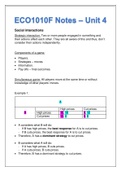
Example 1:
A
High prices Cut prices
B High prices 10, 10 4, 12
Cut prices 12, 4 6, 6
• A considers what B will do:
- If B has high prices, the best response for A is to cut prices.
- If B cuts prices, the best response for A is to cut prices.
• Therefore, A has a dominant strategy to cut prices.
• B considers what A will do:
- If A has high prices, B cuts prices.
- If A cuts prices, B cuts prices.
• Therefore, B has a dominant strategy to cut prices.
Strategic interaction: Two or more people engaged in something and
their actions affect each other. They are all aware of this and thus, don’t
consider their actions independently.
Components of a game:
• Players.
• Strategies – moves.
• Information.
• Pay offs – final outcomes.
Simultaneous game: All players move at the same time or without
knowledge of other players’ moves.
Example 1:
A
High prices Cut prices
B High prices 10, 10 4, 12
Cut prices 12, 4 6, 6
• A considers what B will do:
- If B has high prices, the best response for A is to cut prices.
- If B cuts prices, the best response for A is to cut prices.
• Therefore, A has a dominant strategy to cut prices.
• B considers what A will do:
- If A has high prices, B cuts prices.
- If A cuts prices, B cuts prices.
• Therefore, B has a dominant strategy to cut prices.