

Escrito por estudiantes que aprobaron Inmediatamente disponible después del pago Leer en línea o como PDF ¿Documento equivocado? Cámbialo gratis 4,6 TrustPilot
logo-home
Document preview thumbnail
Vista previa 2 fuera de 13 páginas
Examen

NUR 6001 Exam 2 2026 – 85+ Practice Questions on Gastrointestinal, Respiratory & Cardiovascular Assessment | NUR 6001 Advanced Health Assessment

Document preview thumbnail
Vista previa 2 fuera de 13 páginas

This comprehensive NUR 6001 Exam 2 study guide contains more than 85 high-yield practice questions and answers focused on advanced health assessment concepts commonly tested in graduate and upper-division nursing programs. The resource provides a detailed review of gastrointestinal, respiratory, and cardiovascular assessment techniques, integrating physical examination findings, clinical interpretation, and diagnostic reasoning to support examination success and clinical competence. Students will develop a strong understanding of abdominal assessment by reviewing solid and hollow organ characteristics, abnormal odors associated with gastrointestinal pathology, bowel sound interpretation, liver and spleen percussion techniques, bladder assessment, and evidence-based evaluation of ascites using the fluid wave and shifting dullness tests. The guide also examines classic abdominal signs associated with acute conditions, including Murphy's sign, McBurney's point tenderness, Rovsing's sign, rebound tenderness, obturator testing, Grey Turner's sign, Cullen's sign, abdominal aortic aneurysm assessment, and Lloyd's punch for renal pathology. Respiratory assessment content includes sputum characteristics, breathing pattern abnormalities such as Kussmaul respirations, Cheyne-Stokes respirations, Biot respirations, and hyperpnea, as well as thoracic abnormalities including pectus carinatum and pectus excavatum. Learners will review thoracic expansion techniques, tactile fremitus, diaphragmatic excursion, normal and adventitious breath sounds, amphoric and cavernous breath sounds, Hamman's sign, and succession splashes, strengthening their ability to differentiate normal from pathological findings during pulmonary examinations. Cardiovascular concepts are explored extensively through the interpretation of heart sounds, electrocardiographic components, murmurs, clicks, snaps, and jugular venous pulse waveforms. The material reviews S1 through S4 heart sounds, physiologic splitting of S2, systolic and diastolic murmurs, pericardial friction rubs, mitral and tricuspid valvular findings, aortic and pulmonic pathology, and the clinical significance of ejection sounds. Students also gain practical insight into electrocardiographic interpretation through detailed coverage of P waves, PR intervals, QRS complexes, ST segments, T waves, U waves, depolarization, and repolarization. The guide further addresses specialized assessment findings relevant to diverse populations, including pregnancy-related cardiovascular adaptations such as aortocaval syndrome and appendiceal assessment considerations. The question-and-answer format promotes active recall, strengthens clinical reasoning, and prepares students to apply examination findings to real-world patient scenarios encountered in both academic testing and clinical practice. This document is especially valuable for Master of Science in Nursing (MSN) students, Doctor of Nursing Practice (DNP) students, Family Nurse Practitioner (FNP) students, Adult-Gerontology Nurse Practitioner (AGNP) students, Acute Care Nurse Practitioner (ACNP) students, advanced health assessment students enrolled in NUR 6001 courses, registered nurses advancing their education, physician assistant students, and healthcare professionals preparing for graduate nursing examinations and certification review. The content aligns with evidence-based assessment principles and authoritative clinical references, including: Jarvis, C. (2024). Physical Examination and Health Assessment (9th ed.). Elsevier. Bickley, L. S. (2024). Bates' Guide to Physical Examination and History Taking (14th ed.). Wolters Kluwer. Weber, J., & Kelley, J. (2022). Health Assessment in Nursing (7th ed.). Wolters Kluwer. Hinkle, J. L., & Cheever, K. H. (2021). Brunner & Suddarth's Textbook of Medical-Surgical Nursing (15th ed.). Wolters Kluwer. American Heart Association. (2025). Clinical standards and recommendations for cardiovascular assessment and interpretation. Designed as both an intensive review resource and a rapid-reference study aid, this exam guide enhances diagnostic confidence, reinforces advanced physical assessment skills, and supports academic achievement in graduate-level nursing education and board examination preparation. Keywords: NUR 6001, NUR 6001 Exam 2, Advanced health assessment, Health assessment practice questions, Graduate nursing exam questions, Gastrointestinal assessment, Abdominal assessment, Solid organs, Hollow organs, Liver percussion, Spleen percussion, Bladder percussion, Fluid wave test, Shifting dullness test, Ascites assessment, Murphy's sign, McBurney's sign, Rovsing's sign, Rebound tenderness, Obturator test, Abdominal aortic aneurysm, AAA assessment, Grey Turner's sign, Cullen's sign, Lloyd's punch, Intussusception, Respiratory assessment, Breath sounds, Tactile fremitus, Thoracic expansion, Diaphragmatic excursion, Kussmaul respirations, Cheyne-Stokes respirations, Biot respirations, Hyperpnea, Pectus carinatum, Pectus excavatum, Amphoric breath sounds, Cavernous breath sounds, Hamman's sign, Succession splash, Cardiovascular assessment, Heart sounds, S1, S2, S3, S4, Electrocardiogram interpretation, ECG review, P wave, PR interval, QRS complex, ST segment, T wave, U wave, Physiologic splitting, Pericardial friction rub, Systolic murmurs, Diastolic murmurs, Mitral regurgitation, Mitral stenosis, Aortic stenosis, Aortic regurgitation, Pulmonic stenosis, Pulmonic regurgitation, Jugular venous pulse, JVP waveform, Pregnancy assessment, Aortocaval syndrome, Nurse practitioner exam preparation, MSN nursing review, DNP exam study guide

Vista previa del contenido

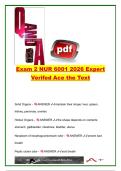
Exam 2 NUR 6001 2026 Expert
Verifed Ace the Text


Solid Organs - ANSWER ✔✔maintain their shape: liver, spleen,

kidney, pancreas, ovaries


Hollow Organs - ANSWER ✔✔the shape depends on contents:

stomach, gallbladder, intestines, bladder, uterus


Neoplasm of esophagus/stomach odor - ANSWER ✔✔severe bad

breath


Peptic ulcers odor - ANSWER ✔✔acid breath

, Hepatic failure odor - ANSWER ✔✔sickly sweet odor


Esophageal diverticulum odor - ANSWER ✔✔odor of decay


Severe bowel obstruction odor - ANSWER ✔✔odor of feces


Cirrhosis with portal shunting odor - ANSWER ✔✔odor of rotten eggs

and garlic


increased lunula size - ANSWER ✔✔indicates hyperthyroid, leprosy,

and scleroderma


Normal bowel sounds for small intestine - ANSWER ✔✔high-pitched,

gurgling


Normal bowel sounds for colon - ANSWER ✔✔low-pitched, rumbling


Liver percussion - ANSWER ✔✔begins at abdomen just below the

umbilicus at the right midclavicular line, percuss upward until dullness is

heard


Spleen percussion - ANSWER ✔✔lie supine, breathe normally,

percuss in the lowest intercostal space in the left anterior axillary line,

beginning at an area of lung resonance

Información del documento

Subido en
11 de junio de 2026
Número de páginas
13
Escrito en
2025/2026
Tipo
Examen
Contiene
Preguntas y respuestas
$18.99

¿Documento equivocado? Cámbialo gratis Dentro de los 14 días posteriores a la compra y antes de descargarlo, puedes elegir otro documento. Puedes gastar el importe de nuevo.
Escrito por estudiantes que aprobaron
Inmediatamente disponible después del pago
Leer en línea o como PDF

Seller avatar
Los indicadores de reputación están sujetos a la cantidad de artículos vendidos por una tarifa y las reseñas que ha recibido por esos documentos. Hay tres niveles: Bronce, Plata y Oro. Cuanto mayor reputación, más podrás confiar en la calidad del trabajo del vendedor.
PROFFKERRYMARTIN
3.4
(54)
Vendido
273
Seguidores
9
Artículos
10961
Última venta
1 día hace


Por qué los estudiantes eligen Stuvia

Creado por compañeros estudiantes, verificado por reseñas

Calidad en la que puedes confiar: escrito por estudiantes que aprobaron y evaluado por otros que han usado estos resúmenes.

¿No estás satisfecho? Elige otro documento

¡No te preocupes! Puedes elegir directamente otro documento que se ajuste mejor a lo que buscas.

Paga como quieras, empieza a estudiar al instante

Sin suscripción, sin compromisos. Paga como estés acostumbrado con tarjeta de crédito y descarga tu documento PDF inmediatamente.

Student with book image

“Comprado, descargado y aprobado. Así de fácil puede ser.”

Alisha Student

Preguntas frecuentes
