

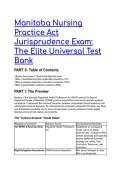
Manitoba Nursing
Practice Act
Jurisprudence Exam:
The Elite Universal Test
Bank
PART 0: Table of Contents
*(#part-i-the-preview) *(#part-ii-the-elite-test-bank)
*(#tier-1-foundational-syntax--application-questions-115)
*(#tier-2-complex-application--simulation-questions-1635)
*(#tier-3-grandmaster-synthesis-questions-3660)
PART I: The Preview
Mastery of the Manitoba Regulated Health Professions Act (RHPA) and the College of
Registered Nurses of Manitoba (CRNM) practice expectations transcends passive regulatory
compliance; it represents the structural boundary between unassailable clinical leadership and
catastrophic licensure exposure. By internalizing this exhaustive diagnostic test bank, you forge
your theoretical knowledge into an active clinical shield, ensuring decisions remain legally
flawless across all high-stakes environments.
The "Critical Axioms" Cheat Sheet
Regulatory Framework Statutory Source Key Operational Mandates
The RHPA & Reserved Acts Regulated Health Professions Establishes an overlapping
Act model. Out of 21 global
reserved acts, 14 apply to RNs.
Certain advanced acts explicitly
require Additional Education
meeting four criteria: Plan,
Curriculum, Resources, and
Evaluation.
Rigid Delegation Boundaries CRNM General Regulation RNs cannot delegate to other
RNs or professionals.
,Regulatory Framework Statutory Source Key Operational Mandates
Delegation of a reserved act to
an Unregulated Care Provider
(UCP) must be client-specific,
employer-supported, and
strictly exclude the nursing
process.
The PHIA Privacy Mandate Personal Health Information Act Aggressively penalizes
unauthorized access to health
records. Snooping into a chart
without clinical justification
triggers personal individual
fines of up to $50,000.
Unauthorized Practice CRNM Policy AA-20 Practicing without a valid
certificate triggers immediate
cease-and-desist orders and a
strict financial penalty of $1,500
plus GST for RNs, and $2,000
plus GST for RN(NP)s.
Mandatory Misconduct RHPA Section 168(2) Employers must report the
Reporting suspension or termination of an
RN for misconduct,
incompetence, or incapacity to
the CRNM CEO/Registrar
immediately.
Self-Employed Practice CRNM Practice Direction Independent aesthetic or
Limits clinical practice requires a
baseline of 2,015 hours of
Canadian RN practice.
Advertising must be factual,
without guarantees, and cannot
utilize the CRNM logo.
PART II: The Elite Test Bank
Tier 1: Foundational Syntax & Application (Questions 1–15)
Q1: The Manitoba Regulated Health Professions Act (RHPA) transitioned the province away
from exclusive professional scopes of practice. Under the RHPA framework, which statement
regarding "Reserved Acts" is the MOST ACCURATE? A) Reserved acts are exclusive,
proprietary procedures restricted to a single regulated health profession to ensure public safety.
B) The RHPA identifies 21 reserved acts globally, 14 of which apply to RNs, allowing for
overlapping scopes of practice among different professions. C) Registered nurses may only
perform reserved acts if a physician formally delegates the authority in writing. D) Unregulated
Care Providers (UCPs) are legally barred from performing any reserved act under any
circumstance.
● The Answer: B (The RHPA identifies 21 reserved acts globally, 14 of which apply to RNs,
allowing for overlapping scopes of practice among different professions.)
, ● Distractor Analysis:
○ A is incorrect: The RHPA intentionally moved away from exclusive, monopolistic
scopes to an overlapping framework to enhance interprofessional collaboration.
○ C is incorrect: RNs are independently authorized to perform their designated
reserved acts under the RHPA; they do not require physician delegation.
○ D is incorrect: UCPs may perform exempted reserved acts or accept properly
delegated reserved acts from an RN, provided strict delegation protocols are met.
The Mentor's Analysis: The RHPA fundamentally restructured healthcare in Manitoba by
replacing isolated silos with an overlapping reserved acts model. This ensures that while
multiple professions might share a reserved act, they execute it according to the depth and
breadth of their specific professional education. Professional/Academic Intuition: Reserved
acts are high-risk clinical activities shared across professions, not monopolies owned by
one.
Q2: A Registered Nurse intends to perform a reserved act that has been designated by the
CRNM as requiring Additional Education. According to the Practice Direction, which four
mandatory criteria must this additional education program fulfill to be approved? A) Didactic
theory, clinical simulation, standardized testing, and annual recertification. B) Physician
authorization, risk management review, regional health board approval, and peer assessment.
C) Plan, Curriculum, Resources, and Evaluation. D) Foundational syntax, cognitive mapping,
psychomotor repetition, and independent audit.
● The Answer: C (Plan, Curriculum, Resources, and Evaluation.)
● Distractor Analysis:
○ A is incorrect: While testing and theory are components of learning, these do not
represent the specific statutory criteria established by the CRNM Council.
○ B is incorrect: Additional education approval is a regulatory function of the CRNM,
not individual physicians or regional health boards.
○ D is incorrect: This is a fabricated distractor using pedagogical terminology rather
than the legal regulatory criteria.
The Mentor's Analysis: When a reserved act requires competencies beyond entry-level, the
CRNM strictly regulates how that knowledge is acquired to protect the public. The four-pillar
framework standardizes the development of these advanced skills. Professional/Academic
Intuition: Any educational program expanding an RN's authorized reserved acts must
meet the CRNM's immutable four-pillar criteria: Plan, Curriculum, Resources, and
Evaluation.
Q3: To maintain a valid Certificate of Practice in Manitoba, an RN must fulfill the annual
requirements of the Continuing Competency Program (CCP). Which of the following accurately
describes the THREE mandatory components of the CCP? A) Minimum 1,125 practice hours,
CPR recertification, and a peer feedback review. B) A jurisprudence learning module, a
self-assessment process, and a self-development/learning plan. C) 450 practice hours, criminal
background check, and a multi-source feedback loop. D) Employer performance appraisal, a
jurisprudence exam, and an advanced clinical skills audit.
● The Answer: B (A jurisprudence learning module, a self-assessment process, and a
self-development/learning plan.)
● Distractor Analysis:
○ A is incorrect: While 1,125 hours in 5 years is a practice requirement for renewal , it
is distinct from the three operational mechanisms of the CCP itself.
○ C is incorrect: Background checks are periodically required for renewal , but are not
part of the annual CCP pedagogical structure.
, ○ D is incorrect: The CCP is a self-directed quality assurance tool, not an
employer-driven performance appraisal.
The Mentor's Analysis: The CCP is the cornerstone of professional self-regulation. It requires
RNs to proactively identify their own knowledge gaps and address them, ensuring continuous
evolution of clinical competence. Professional/Academic Intuition: Self-regulation relies on
self-reflection; the CCP demands self-assessment, a concrete learning plan, and current
jurisprudential awareness.
Q4: An RN working in an emergency department decides to look up the electronic patient
record (EPR) of a high-profile community member who is being treated in the intensive care
unit. The RN is not assigned to this patient's care. Under the Personal Health Information Act
(PHIA), what is the potential maximum personal financial penalty for this specific offense? A)
$1,500 plus GST. B) $10,000. C) $50,000. D) $100,000.
● The Answer: C ($50,000.)
● Distractor Analysis:
○ A is incorrect: $1,500 is the penalty for unauthorized nursing practice (lapsed
license) , not a PHIA privacy breach.
○ B is incorrect: This is an arbitrary figure representing older privacy paradigms.
○ D is incorrect: The statutory maximum for an individual under PHIA is strictly
capped at $50,000 per offense.
The Mentor's Analysis: The law views "snooping" as a profound violation of public trust. The
Manitoba Ombudsman aggressively prosecutes unauthorized access to personal health
information, utilizing severe financial penalties to enforce deterrence. Professional/Academic
Intuition: Under PHIA, clinical curiosity without a clinical relationship is illegal;
unauthorized access carries a personal fine of up to $50,000.
Q5: An RN fails to complete their registration renewal by the December 1 deadline but
continues to work scheduled shifts in January. According to CRNM policy AA-20, what is the
immediate regulatory consequence for this individual? A) The RN must complete double the
required CCP hours for the following year. B) The RN will be subject to an unauthorized practice
penalty fee of $1,500 plus GST and an immediate demand to cease practice. C) The RN will
permanently lose their capacity to practice in Manitoba. D) The RN's employer will be fined
$50,000 for allowing an unregistered nurse to work.
● The Answer: B (The RN will be subject to an unauthorized practice penalty fee of $1,500
plus GST and an immediate demand to cease practice.)
● Distractor Analysis:
○ A is incorrect: Punitive continuing education is not the statutory mechanism for
addressing a lapsed license.
○ C is incorrect: Unauthorized practice does not permanently bar reinstatement; the
RN can regain licensure after paying penalties and meeting requirements.
○ D is incorrect: $50,000 is the penalty for a PHIA violation, not an employer fine for
unauthorized practice.
The Mentor's Analysis: Registration deadlines are absolute. Operating without a valid
Certificate of Practice constitutes unauthorized practice, directly threatening the College's
mandate to protect the public. Professional/Academic Intuition: Lapsing on registration
invalidates your legal authority to work; continuing to practice triggers an immediate
$1,500 penalty and a cease-and-desist order.
Q6: Under the CRNM General Regulation, delegation of a reserved act to an Unregulated Care
Provider (UCP) is permitted under highly specific conditions. Which of the following statements
regarding this delegation is MOST ACCURATE? A) An RN may delegate a reserved act broadly
Practice Act
Jurisprudence Exam:
The Elite Universal Test
Bank
PART 0: Table of Contents
*(#part-i-the-preview) *(#part-ii-the-elite-test-bank)
*(#tier-1-foundational-syntax--application-questions-115)
*(#tier-2-complex-application--simulation-questions-1635)
*(#tier-3-grandmaster-synthesis-questions-3660)
PART I: The Preview
Mastery of the Manitoba Regulated Health Professions Act (RHPA) and the College of
Registered Nurses of Manitoba (CRNM) practice expectations transcends passive regulatory
compliance; it represents the structural boundary between unassailable clinical leadership and
catastrophic licensure exposure. By internalizing this exhaustive diagnostic test bank, you forge
your theoretical knowledge into an active clinical shield, ensuring decisions remain legally
flawless across all high-stakes environments.
The "Critical Axioms" Cheat Sheet
Regulatory Framework Statutory Source Key Operational Mandates
The RHPA & Reserved Acts Regulated Health Professions Establishes an overlapping
Act model. Out of 21 global
reserved acts, 14 apply to RNs.
Certain advanced acts explicitly
require Additional Education
meeting four criteria: Plan,
Curriculum, Resources, and
Evaluation.
Rigid Delegation Boundaries CRNM General Regulation RNs cannot delegate to other
RNs or professionals.
,Regulatory Framework Statutory Source Key Operational Mandates
Delegation of a reserved act to
an Unregulated Care Provider
(UCP) must be client-specific,
employer-supported, and
strictly exclude the nursing
process.
The PHIA Privacy Mandate Personal Health Information Act Aggressively penalizes
unauthorized access to health
records. Snooping into a chart
without clinical justification
triggers personal individual
fines of up to $50,000.
Unauthorized Practice CRNM Policy AA-20 Practicing without a valid
certificate triggers immediate
cease-and-desist orders and a
strict financial penalty of $1,500
plus GST for RNs, and $2,000
plus GST for RN(NP)s.
Mandatory Misconduct RHPA Section 168(2) Employers must report the
Reporting suspension or termination of an
RN for misconduct,
incompetence, or incapacity to
the CRNM CEO/Registrar
immediately.
Self-Employed Practice CRNM Practice Direction Independent aesthetic or
Limits clinical practice requires a
baseline of 2,015 hours of
Canadian RN practice.
Advertising must be factual,
without guarantees, and cannot
utilize the CRNM logo.
PART II: The Elite Test Bank
Tier 1: Foundational Syntax & Application (Questions 1–15)
Q1: The Manitoba Regulated Health Professions Act (RHPA) transitioned the province away
from exclusive professional scopes of practice. Under the RHPA framework, which statement
regarding "Reserved Acts" is the MOST ACCURATE? A) Reserved acts are exclusive,
proprietary procedures restricted to a single regulated health profession to ensure public safety.
B) The RHPA identifies 21 reserved acts globally, 14 of which apply to RNs, allowing for
overlapping scopes of practice among different professions. C) Registered nurses may only
perform reserved acts if a physician formally delegates the authority in writing. D) Unregulated
Care Providers (UCPs) are legally barred from performing any reserved act under any
circumstance.
● The Answer: B (The RHPA identifies 21 reserved acts globally, 14 of which apply to RNs,
allowing for overlapping scopes of practice among different professions.)
, ● Distractor Analysis:
○ A is incorrect: The RHPA intentionally moved away from exclusive, monopolistic
scopes to an overlapping framework to enhance interprofessional collaboration.
○ C is incorrect: RNs are independently authorized to perform their designated
reserved acts under the RHPA; they do not require physician delegation.
○ D is incorrect: UCPs may perform exempted reserved acts or accept properly
delegated reserved acts from an RN, provided strict delegation protocols are met.
The Mentor's Analysis: The RHPA fundamentally restructured healthcare in Manitoba by
replacing isolated silos with an overlapping reserved acts model. This ensures that while
multiple professions might share a reserved act, they execute it according to the depth and
breadth of their specific professional education. Professional/Academic Intuition: Reserved
acts are high-risk clinical activities shared across professions, not monopolies owned by
one.
Q2: A Registered Nurse intends to perform a reserved act that has been designated by the
CRNM as requiring Additional Education. According to the Practice Direction, which four
mandatory criteria must this additional education program fulfill to be approved? A) Didactic
theory, clinical simulation, standardized testing, and annual recertification. B) Physician
authorization, risk management review, regional health board approval, and peer assessment.
C) Plan, Curriculum, Resources, and Evaluation. D) Foundational syntax, cognitive mapping,
psychomotor repetition, and independent audit.
● The Answer: C (Plan, Curriculum, Resources, and Evaluation.)
● Distractor Analysis:
○ A is incorrect: While testing and theory are components of learning, these do not
represent the specific statutory criteria established by the CRNM Council.
○ B is incorrect: Additional education approval is a regulatory function of the CRNM,
not individual physicians or regional health boards.
○ D is incorrect: This is a fabricated distractor using pedagogical terminology rather
than the legal regulatory criteria.
The Mentor's Analysis: When a reserved act requires competencies beyond entry-level, the
CRNM strictly regulates how that knowledge is acquired to protect the public. The four-pillar
framework standardizes the development of these advanced skills. Professional/Academic
Intuition: Any educational program expanding an RN's authorized reserved acts must
meet the CRNM's immutable four-pillar criteria: Plan, Curriculum, Resources, and
Evaluation.
Q3: To maintain a valid Certificate of Practice in Manitoba, an RN must fulfill the annual
requirements of the Continuing Competency Program (CCP). Which of the following accurately
describes the THREE mandatory components of the CCP? A) Minimum 1,125 practice hours,
CPR recertification, and a peer feedback review. B) A jurisprudence learning module, a
self-assessment process, and a self-development/learning plan. C) 450 practice hours, criminal
background check, and a multi-source feedback loop. D) Employer performance appraisal, a
jurisprudence exam, and an advanced clinical skills audit.
● The Answer: B (A jurisprudence learning module, a self-assessment process, and a
self-development/learning plan.)
● Distractor Analysis:
○ A is incorrect: While 1,125 hours in 5 years is a practice requirement for renewal , it
is distinct from the three operational mechanisms of the CCP itself.
○ C is incorrect: Background checks are periodically required for renewal , but are not
part of the annual CCP pedagogical structure.
, ○ D is incorrect: The CCP is a self-directed quality assurance tool, not an
employer-driven performance appraisal.
The Mentor's Analysis: The CCP is the cornerstone of professional self-regulation. It requires
RNs to proactively identify their own knowledge gaps and address them, ensuring continuous
evolution of clinical competence. Professional/Academic Intuition: Self-regulation relies on
self-reflection; the CCP demands self-assessment, a concrete learning plan, and current
jurisprudential awareness.
Q4: An RN working in an emergency department decides to look up the electronic patient
record (EPR) of a high-profile community member who is being treated in the intensive care
unit. The RN is not assigned to this patient's care. Under the Personal Health Information Act
(PHIA), what is the potential maximum personal financial penalty for this specific offense? A)
$1,500 plus GST. B) $10,000. C) $50,000. D) $100,000.
● The Answer: C ($50,000.)
● Distractor Analysis:
○ A is incorrect: $1,500 is the penalty for unauthorized nursing practice (lapsed
license) , not a PHIA privacy breach.
○ B is incorrect: This is an arbitrary figure representing older privacy paradigms.
○ D is incorrect: The statutory maximum for an individual under PHIA is strictly
capped at $50,000 per offense.
The Mentor's Analysis: The law views "snooping" as a profound violation of public trust. The
Manitoba Ombudsman aggressively prosecutes unauthorized access to personal health
information, utilizing severe financial penalties to enforce deterrence. Professional/Academic
Intuition: Under PHIA, clinical curiosity without a clinical relationship is illegal;
unauthorized access carries a personal fine of up to $50,000.
Q5: An RN fails to complete their registration renewal by the December 1 deadline but
continues to work scheduled shifts in January. According to CRNM policy AA-20, what is the
immediate regulatory consequence for this individual? A) The RN must complete double the
required CCP hours for the following year. B) The RN will be subject to an unauthorized practice
penalty fee of $1,500 plus GST and an immediate demand to cease practice. C) The RN will
permanently lose their capacity to practice in Manitoba. D) The RN's employer will be fined
$50,000 for allowing an unregistered nurse to work.
● The Answer: B (The RN will be subject to an unauthorized practice penalty fee of $1,500
plus GST and an immediate demand to cease practice.)
● Distractor Analysis:
○ A is incorrect: Punitive continuing education is not the statutory mechanism for
addressing a lapsed license.
○ C is incorrect: Unauthorized practice does not permanently bar reinstatement; the
RN can regain licensure after paying penalties and meeting requirements.
○ D is incorrect: $50,000 is the penalty for a PHIA violation, not an employer fine for
unauthorized practice.
The Mentor's Analysis: Registration deadlines are absolute. Operating without a valid
Certificate of Practice constitutes unauthorized practice, directly threatening the College's
mandate to protect the public. Professional/Academic Intuition: Lapsing on registration
invalidates your legal authority to work; continuing to practice triggers an immediate
$1,500 penalty and a cease-and-desist order.
Q6: Under the CRNM General Regulation, delegation of a reserved act to an Unregulated Care
Provider (UCP) is permitted under highly specific conditions. Which of the following statements
regarding this delegation is MOST ACCURATE? A) An RN may delegate a reserved act broadly

