

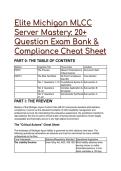
Elite Michigan MLCC
Server Mastery: 20+
Question Exam Bank &
Compliance Cheat Sheet
PART 0: THE TABLE OF CONTENTS
Section Cognitive Tier Focus Area Location
PART I The Preview Mission Parameters & Document Start
Critical Axioms
PART II The Elite Test Bank 40-Point Compliance Core Section
Gauntlet
- Tier 1: Questions 1–15 Foundational Syntax & Sub-section A
Application
- Tier 2: Questions Complex Application & Sub-section B
16–30 Simulation
- Tier 3: Questions Grandmaster Synthesis Sub-section C
31–40
PART I: THE PREVIEW
Mastery of the Michigan Liquor Control Code (MLCC) transcends standard administrative
compliance; it serves as the absolute foundation of elite hospitality management and
professional survival. By internalizing this exhaustive assessment, the practitioner transforms
rigid statutory text into an active clinical shield, ensuring licensed operations remain legally
unassailable and financially secure in any high-stakes environment.
The "Critical Axioms" Cheat Sheet
The landscape of Michigan liquor liability is governed by strict statutory hard stops. The
following operational parameters are absolute and must be memorized by every certified
professional on the floor.
Core Framework Statutory/Regulatory Standard Operational Imperative
The Liability Doctrine Dram Shop Act, MCL 436.1801 Strict liability attaches when
serving minors or visibly
intoxicated persons. A civil
claim mandates a 120-day
,Core Framework Statutory/Regulatory Standard Operational Imperative
written notice and strictly
adheres to a 2-year statute of
limitations.
Diligent Inquiry MCL 436.1701 Age verification requires the
physical examination of an
unexpired, bona fide photo
identification (e.g., driver's
license, passport, military ID).
Visual estimation is legally void.
Supervisory Imperative MCL 436.1906 At least one MLCC-certified
supervisory employee must be
actively on duty during all hours
alcoholic beverages are served.
Certifications expire every three
years.
Holiday Hard Stops MCL 436.2113(5) & R Christmas Eve service
436.1403(7) terminates unequivocally at
11:59 PM. New Year's Eve
permits an extension to 4:00
AM for on-premises sales.
Occupancy & Egress R 436.1403 Standard service ceases strictly
at 2:00 AM. The physical
premises must be completely
cleared of non-employees by
2:30 AM.
Promotional Bans MLCC Administrative Rules Licensees are strictly forbidden
from offering unlimited alcohol
for a single fixed price,
two-for-one specials, or free
drinks.
PART II: THE ELITE TEST BANK
Tier 1: Foundational Syntax & Application
Q1: A newly licensed on-premises establishment in Michigan is aggressively hiring staff for its
grand opening. Based on the principles of the Michigan Liquor Control Code regarding staffing
age requirements, which action is the MOST ACCURATE? A) The establishment may hire
17-year-olds to serve alcohol if they are supervised directly by a 30-year-old certified manager.
B) The establishment may allow 16-year-olds to pour distilled spirits, provided they do not
process the financial transaction at the point of sale. C) The establishment must strictly prohibit
anyone under 18 years of age from selling or serving alcoholic beverages in any capacity. D)
The establishment may hire 17-year-olds to serve beer and wine, but they must be at least 21 to
serve distilled spirits.
● The Answer: C (The establishment must strictly prohibit anyone under 18 years of age
from selling or serving alcoholic beverages in any capacity.)
, ● Distractor Analysis:
○ A is incorrect: Michigan law explicitly prohibits anyone under 18 from selling or
serving alcohol, regardless of adult supervision.
○ B is incorrect: Pouring constitutes "furnishing" under the law, which is a strictly
prohibited act for anyone under 18.
○ D is incorrect: The 18-year-old minimum age requirement applies universally to all
alcoholic liquor, including beer, wine, and spirits.
The Mentor's Analysis: The statutory standard for alcohol service in Michigan establishes a
hard deck at 18 years of age. When facing staffing shortages, the immediate priority is legal
compliance over operational convenience. By utilizing the Minimum Age Rule, you bypass the
common trap of conflating federal labor laws for general restaurant work with specialized state
liquor regulations. Professional/Academic Intuition: No individual under 18 may legally
facilitate the exchange, delivery, or furnishing of alcohol in Michigan, without exception.
Q2: A bartender is approached by a young-looking patron who orders a craft beer. Based on the
principles of Diligent Inquiry under MCL 436.1701, which action is the MOST ACCURATE? A)
The bartender accepts a university-issued library card without a photo because it prominently
displays a verified birthdate. B) The bartender asks the patron their zodiac sign and high school
graduation year to verify their age verbally. C) The bartender demands an official Michigan
driver's license, passport, military ID, or other bona fide picture ID to establish identity and age.
D) The bartender assumes the patron is 21 because the door security staff allegedly checked
IDs outside.
● The Answer: C (The bartender demands an official Michigan driver's license, passport,
military ID, or other bona fide picture ID to establish identity and age.)
● Distractor Analysis:
○ A is incorrect: A library card without a photo is not a bona fide picture identification
as required by statute.
○ B is incorrect: Verbal confirmation does not meet the statutory definition of diligent
inquiry, which requires physical examination of documentary evidence.
○ D is incorrect: The ultimate legal liability rests on the individual seller at the point of
transaction, regardless of front-door security protocols.
The Mentor's Analysis: The legal burden of age verification rests entirely on the individual
furnishing the alcohol. When facing an underage sale accusation, the immediate priority is
demonstrating a good-faith effort. By utilizing Diligent Inquiry, you bypass the common trap of
outsourcing liability to third parties or relying on invalid, non-photo documents.
Professional/Academic Intuition: A valid sale requires a valid, unexpired, photo-bearing
government or officially recognized identification examined at the moment of the
transaction.
Q3: An MLCC investigator conducts a routine audit of a restaurant at 8:00 PM on a Friday.
Based on the principles of MCL 436.1906, which conclusion regarding staff training is the MOST
ACCURATE? A) Every single employee on the floor, including hosts and bussers, must carry a
valid MLCC server training certificate. B) Server training is completely voluntary but highly
recommended to lower commercial liability insurance premiums. C) At least one supervisory
personnel who has successfully completed an approved server training program must be on
duty. D) Only the licensee (owner) must be trained, and they need not be physically present on
the premises.
● The Answer: C (At least one supervisory personnel who has successfully completed an
approved server training program must be on duty.)
● Distractor Analysis:
Server Mastery: 20+
Question Exam Bank &
Compliance Cheat Sheet
PART 0: THE TABLE OF CONTENTS
Section Cognitive Tier Focus Area Location
PART I The Preview Mission Parameters & Document Start
Critical Axioms
PART II The Elite Test Bank 40-Point Compliance Core Section
Gauntlet
- Tier 1: Questions 1–15 Foundational Syntax & Sub-section A
Application
- Tier 2: Questions Complex Application & Sub-section B
16–30 Simulation
- Tier 3: Questions Grandmaster Synthesis Sub-section C
31–40
PART I: THE PREVIEW
Mastery of the Michigan Liquor Control Code (MLCC) transcends standard administrative
compliance; it serves as the absolute foundation of elite hospitality management and
professional survival. By internalizing this exhaustive assessment, the practitioner transforms
rigid statutory text into an active clinical shield, ensuring licensed operations remain legally
unassailable and financially secure in any high-stakes environment.
The "Critical Axioms" Cheat Sheet
The landscape of Michigan liquor liability is governed by strict statutory hard stops. The
following operational parameters are absolute and must be memorized by every certified
professional on the floor.
Core Framework Statutory/Regulatory Standard Operational Imperative
The Liability Doctrine Dram Shop Act, MCL 436.1801 Strict liability attaches when
serving minors or visibly
intoxicated persons. A civil
claim mandates a 120-day
,Core Framework Statutory/Regulatory Standard Operational Imperative
written notice and strictly
adheres to a 2-year statute of
limitations.
Diligent Inquiry MCL 436.1701 Age verification requires the
physical examination of an
unexpired, bona fide photo
identification (e.g., driver's
license, passport, military ID).
Visual estimation is legally void.
Supervisory Imperative MCL 436.1906 At least one MLCC-certified
supervisory employee must be
actively on duty during all hours
alcoholic beverages are served.
Certifications expire every three
years.
Holiday Hard Stops MCL 436.2113(5) & R Christmas Eve service
436.1403(7) terminates unequivocally at
11:59 PM. New Year's Eve
permits an extension to 4:00
AM for on-premises sales.
Occupancy & Egress R 436.1403 Standard service ceases strictly
at 2:00 AM. The physical
premises must be completely
cleared of non-employees by
2:30 AM.
Promotional Bans MLCC Administrative Rules Licensees are strictly forbidden
from offering unlimited alcohol
for a single fixed price,
two-for-one specials, or free
drinks.
PART II: THE ELITE TEST BANK
Tier 1: Foundational Syntax & Application
Q1: A newly licensed on-premises establishment in Michigan is aggressively hiring staff for its
grand opening. Based on the principles of the Michigan Liquor Control Code regarding staffing
age requirements, which action is the MOST ACCURATE? A) The establishment may hire
17-year-olds to serve alcohol if they are supervised directly by a 30-year-old certified manager.
B) The establishment may allow 16-year-olds to pour distilled spirits, provided they do not
process the financial transaction at the point of sale. C) The establishment must strictly prohibit
anyone under 18 years of age from selling or serving alcoholic beverages in any capacity. D)
The establishment may hire 17-year-olds to serve beer and wine, but they must be at least 21 to
serve distilled spirits.
● The Answer: C (The establishment must strictly prohibit anyone under 18 years of age
from selling or serving alcoholic beverages in any capacity.)
, ● Distractor Analysis:
○ A is incorrect: Michigan law explicitly prohibits anyone under 18 from selling or
serving alcohol, regardless of adult supervision.
○ B is incorrect: Pouring constitutes "furnishing" under the law, which is a strictly
prohibited act for anyone under 18.
○ D is incorrect: The 18-year-old minimum age requirement applies universally to all
alcoholic liquor, including beer, wine, and spirits.
The Mentor's Analysis: The statutory standard for alcohol service in Michigan establishes a
hard deck at 18 years of age. When facing staffing shortages, the immediate priority is legal
compliance over operational convenience. By utilizing the Minimum Age Rule, you bypass the
common trap of conflating federal labor laws for general restaurant work with specialized state
liquor regulations. Professional/Academic Intuition: No individual under 18 may legally
facilitate the exchange, delivery, or furnishing of alcohol in Michigan, without exception.
Q2: A bartender is approached by a young-looking patron who orders a craft beer. Based on the
principles of Diligent Inquiry under MCL 436.1701, which action is the MOST ACCURATE? A)
The bartender accepts a university-issued library card without a photo because it prominently
displays a verified birthdate. B) The bartender asks the patron their zodiac sign and high school
graduation year to verify their age verbally. C) The bartender demands an official Michigan
driver's license, passport, military ID, or other bona fide picture ID to establish identity and age.
D) The bartender assumes the patron is 21 because the door security staff allegedly checked
IDs outside.
● The Answer: C (The bartender demands an official Michigan driver's license, passport,
military ID, or other bona fide picture ID to establish identity and age.)
● Distractor Analysis:
○ A is incorrect: A library card without a photo is not a bona fide picture identification
as required by statute.
○ B is incorrect: Verbal confirmation does not meet the statutory definition of diligent
inquiry, which requires physical examination of documentary evidence.
○ D is incorrect: The ultimate legal liability rests on the individual seller at the point of
transaction, regardless of front-door security protocols.
The Mentor's Analysis: The legal burden of age verification rests entirely on the individual
furnishing the alcohol. When facing an underage sale accusation, the immediate priority is
demonstrating a good-faith effort. By utilizing Diligent Inquiry, you bypass the common trap of
outsourcing liability to third parties or relying on invalid, non-photo documents.
Professional/Academic Intuition: A valid sale requires a valid, unexpired, photo-bearing
government or officially recognized identification examined at the moment of the
transaction.
Q3: An MLCC investigator conducts a routine audit of a restaurant at 8:00 PM on a Friday.
Based on the principles of MCL 436.1906, which conclusion regarding staff training is the MOST
ACCURATE? A) Every single employee on the floor, including hosts and bussers, must carry a
valid MLCC server training certificate. B) Server training is completely voluntary but highly
recommended to lower commercial liability insurance premiums. C) At least one supervisory
personnel who has successfully completed an approved server training program must be on
duty. D) Only the licensee (owner) must be trained, and they need not be physically present on
the premises.
● The Answer: C (At least one supervisory personnel who has successfully completed an
approved server training program must be on duty.)
● Distractor Analysis:

