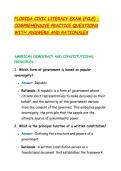
Secure your mandatory Florida graduation milestone on
your very first attempt with this premium, most recent 2026
Florida Civic Literacy Exam (FCLE) actual exam master
test bank. This high-yield digital study guide features 50
real exam-style multiple-choice questions perfectly
formatted with bold italicized answers and detailed
historical rationales mapping out the U.S. Constitution,
landmark Supreme Court cases, and core civic literacy
principles. Designed specifically for rapid memorisation,
building high-conversion study sets, or direct digital upload
to your Stuvia storefront, this verified test bank guarantees
a passing score.
Question 1
What major structural weakness of the Articles of Confederation was highlighted by
Shays' Rebellion?
A) The national government lacked the power to coin money.
B) The national government lacked the power to draft an army and maintain public
order.
C) The executive branch was too tyrannical and powerful.
D) The Supreme Court could easily strike down state laws.
Answer: B) The national government lacked the power to draft an army and
maintain public order.
Rationale: Shays' Rebellion in 1786 exposed the structural weakness of the Articles of
Confederation, as the central government lacked the fiscal authority and military power
to raise a standing army to suppress domestic insurrections.
Question 2
Which landmark United States Supreme Court holding established that individuals
accused of a crime must be explicitly informed of their constitutional rights before
custodial interrogation?
A) Gideon v. Wainwright
B) Miranda v. Arizona
,C) Mapp v. Ohio
D) Terry v. Ohio
Answer: B) Miranda v. Arizona
Rationale: Miranda v. Arizona (1966) ruled that under the Fifth Amendment, law
enforcement must notify suspects of their specific rights, including the right to remain
silent and the right to an attorney, prior to questioning.
Question 3
Which of the following is a power reserved exclusively for the United States federal
government under the framework of the U.S. Constitution?
A) Levying local property taxes
B) Establishing municipal police forces
C) Declaring war and coining money
D) Issuing driver's licenses
Answer: C) Declaring war and coining money
Rationale: Article I, Section 8 of the Constitution grants the federal government
delegated powers to declare war and coin national currency, while individual states are
explicitly barred from these actions to preserve national unity.
Question 4
What was the primary outcome of the Great Compromise during the Constitutional
Convention of 1787?
A) The creation of a unicameral legislature based on population
B) The establishment of a bicameral legislature with a population-based House and an
equal-representation Senate
C) The total abolition of individual state governments
D) The legal expansion of the transatlantic slave trade for fifty years
Answer: B) The establishment of a bicameral legislature with a population-based
House and an equal-representation Senate
Rationale: The Great Compromise resolved the gridlocked debate between large and
small states by combining elements of the Virginia Plan (proportional representation)
and the New Jersey Plan (equal representation).
,Question 5
Which amendment to the U.S. Constitution formally abolished the institution of slavery
throughout the United States?
A) Twelfth Amendment
B) Thirteenth Amendment
C) Fourteenth Amendment
D) Fifteenth Amendment
Answer: B) Thirteenth Amendment
Rationale: Ratified in 1865 at the conclusion of the American Civil War, the Thirteenth
Amendment legally prohibited slavery and involuntary servitude across the entire nation,
except as a punishment for a crime.
Question 6
What landmark piece of federal legislation prohibited discrimination based on race,
color, religion, sex, or national origin in public accommodations and employment?
A) The Voting Rights Act of 1965
) The Civil Rights Act of 1964
C) The War Powers Resolution
D) The Fourteenth Amendment
Answer: B) The Civil Rights Act of 1964
Rationale: The Civil Rights Act of 1964 leveraged the federal government's authority
under the Commerce Clause to ban segregation in public spaces and outlaw workplace
discrimination.
Question 7
Which branch of the United States government holds the constitutional authority to
interpret laws and determine if they align with the Constitution?
A) The Legislative Branch
B) The Executive Branch
C) The Judicial Branch
D) The Bureaucratic Branch
Answer: C) The Judicial Branch
Rationale: Article III of the Constitution establishes the Judicial Branch, led by the
Supreme Court, which holds the ultimate power of judicial interpretation and review.
, Question 8
What baseline legal protection prevents the government from holding a citizen in
custody indefinitely without presenting them before a judge to explain the charges?
A) A bill of attainder
B) An ex post facto law
C) The writ of habeas corpus
D) Eminent domain
Answer: C) The writ of habeas corpus
Rationale: The writ of habeas corpus is a fundamental constitutional protection that
demands the government justify an individual's physical detention before a court of law.
Question 9
Which amendment to the U.S. Constitution guaranteed women the right to vote in all
public elections?
A) This Amendment
B) Nineteenth Amendment
C) Twenty-First Amendment
D) Twenty-Sixth Amendment
Answer: B) Nineteenth Amendment
Rationale: Ratified in 1920, the Nineteenth Amendment prohibited the federal
government and individual states from denying or abridging the right to vote on the
basis of sex.
Question 10
What is the primary function of the U.S. House of Representatives in the constitutional
impeachment process?
A) Holding the formal trial of an accused official
B) Introducing and voting on the formal charges of impeachment
C) Issuing pardons to officials facing civil lawsuits
D) Appointing the defense team for an executive officer
Answer: B) Introducing and voting on the formal charges of impeachment
Rationale: Under the Constitution, the House of Representatives holds the sole power
of impeachment (bringing the formal charges), while the U.S. Senate holds the unique
power to try those impeachments.
your very first attempt with this premium, most recent 2026
Florida Civic Literacy Exam (FCLE) actual exam master
test bank. This high-yield digital study guide features 50
real exam-style multiple-choice questions perfectly
formatted with bold italicized answers and detailed
historical rationales mapping out the U.S. Constitution,
landmark Supreme Court cases, and core civic literacy
principles. Designed specifically for rapid memorisation,
building high-conversion study sets, or direct digital upload
to your Stuvia storefront, this verified test bank guarantees
a passing score.
Question 1
What major structural weakness of the Articles of Confederation was highlighted by
Shays' Rebellion?
A) The national government lacked the power to coin money.
B) The national government lacked the power to draft an army and maintain public
order.
C) The executive branch was too tyrannical and powerful.
D) The Supreme Court could easily strike down state laws.
Answer: B) The national government lacked the power to draft an army and
maintain public order.
Rationale: Shays' Rebellion in 1786 exposed the structural weakness of the Articles of
Confederation, as the central government lacked the fiscal authority and military power
to raise a standing army to suppress domestic insurrections.
Question 2
Which landmark United States Supreme Court holding established that individuals
accused of a crime must be explicitly informed of their constitutional rights before
custodial interrogation?
A) Gideon v. Wainwright
B) Miranda v. Arizona
,C) Mapp v. Ohio
D) Terry v. Ohio
Answer: B) Miranda v. Arizona
Rationale: Miranda v. Arizona (1966) ruled that under the Fifth Amendment, law
enforcement must notify suspects of their specific rights, including the right to remain
silent and the right to an attorney, prior to questioning.
Question 3
Which of the following is a power reserved exclusively for the United States federal
government under the framework of the U.S. Constitution?
A) Levying local property taxes
B) Establishing municipal police forces
C) Declaring war and coining money
D) Issuing driver's licenses
Answer: C) Declaring war and coining money
Rationale: Article I, Section 8 of the Constitution grants the federal government
delegated powers to declare war and coin national currency, while individual states are
explicitly barred from these actions to preserve national unity.
Question 4
What was the primary outcome of the Great Compromise during the Constitutional
Convention of 1787?
A) The creation of a unicameral legislature based on population
B) The establishment of a bicameral legislature with a population-based House and an
equal-representation Senate
C) The total abolition of individual state governments
D) The legal expansion of the transatlantic slave trade for fifty years
Answer: B) The establishment of a bicameral legislature with a population-based
House and an equal-representation Senate
Rationale: The Great Compromise resolved the gridlocked debate between large and
small states by combining elements of the Virginia Plan (proportional representation)
and the New Jersey Plan (equal representation).
,Question 5
Which amendment to the U.S. Constitution formally abolished the institution of slavery
throughout the United States?
A) Twelfth Amendment
B) Thirteenth Amendment
C) Fourteenth Amendment
D) Fifteenth Amendment
Answer: B) Thirteenth Amendment
Rationale: Ratified in 1865 at the conclusion of the American Civil War, the Thirteenth
Amendment legally prohibited slavery and involuntary servitude across the entire nation,
except as a punishment for a crime.
Question 6
What landmark piece of federal legislation prohibited discrimination based on race,
color, religion, sex, or national origin in public accommodations and employment?
A) The Voting Rights Act of 1965
) The Civil Rights Act of 1964
C) The War Powers Resolution
D) The Fourteenth Amendment
Answer: B) The Civil Rights Act of 1964
Rationale: The Civil Rights Act of 1964 leveraged the federal government's authority
under the Commerce Clause to ban segregation in public spaces and outlaw workplace
discrimination.
Question 7
Which branch of the United States government holds the constitutional authority to
interpret laws and determine if they align with the Constitution?
A) The Legislative Branch
B) The Executive Branch
C) The Judicial Branch
D) The Bureaucratic Branch
Answer: C) The Judicial Branch
Rationale: Article III of the Constitution establishes the Judicial Branch, led by the
Supreme Court, which holds the ultimate power of judicial interpretation and review.
, Question 8
What baseline legal protection prevents the government from holding a citizen in
custody indefinitely without presenting them before a judge to explain the charges?
A) A bill of attainder
B) An ex post facto law
C) The writ of habeas corpus
D) Eminent domain
Answer: C) The writ of habeas corpus
Rationale: The writ of habeas corpus is a fundamental constitutional protection that
demands the government justify an individual's physical detention before a court of law.
Question 9
Which amendment to the U.S. Constitution guaranteed women the right to vote in all
public elections?
A) This Amendment
B) Nineteenth Amendment
C) Twenty-First Amendment
D) Twenty-Sixth Amendment
Answer: B) Nineteenth Amendment
Rationale: Ratified in 1920, the Nineteenth Amendment prohibited the federal
government and individual states from denying or abridging the right to vote on the
basis of sex.
Question 10
What is the primary function of the U.S. House of Representatives in the constitutional
impeachment process?
A) Holding the formal trial of an accused official
B) Introducing and voting on the formal charges of impeachment
C) Issuing pardons to officials facing civil lawsuits
D) Appointing the defense team for an executive officer
Answer: B) Introducing and voting on the formal charges of impeachment
Rationale: Under the Constitution, the House of Representatives holds the sole power
of impeachment (bringing the formal charges), while the U.S. Senate holds the unique
power to try those impeachments.