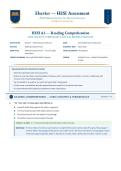
Elsevier — HESI Assessment
2A • GNIDAER
HESI
A2 Health Education Systems, Inc. Admission Assessment
EMPOWERING KNOWLEDGE
ELSEVIER · 1880
HESI A2 — Reading Comprehension
CO R E CO N C E PTS , T E R M I N O LO G Y & C R I T I C A L R E A D I N G ST R AT E G I E S
INSTITUTION Elsevier — HESI Assessment Division EXAM HESI A2 Admission Assessment
SECTION Reading Comprehension ACADEMIC YEAR
EXAM TITLE Reading Comprehension — Core Concepts TOTAL QUESTIONS 40 Questions
Assessment
TARGET PROGRAMS Nursing & Allied Health Programs FORMAT Multiple Choice — Select the Single Best
Answer
EXAMINATION INSTRUCTIONS
▸ Select the single best answer for each question.
▸ Questions cover main ideas, supporting details, inferences, author's purpose and tone, facts vs. opinions, context clues, text
structure, and critical reading strategies.
▸ Pay close attention to question clue words that signal what is being asked.
▸ Correct answers and detailed rationales appear below each question for comprehensive review.
▸ All content reflects HESI A2 Reading Comprehension exam specifications.
READING COMPREHENSION — CORE CONCEPTS & TERMINOLOGY Questions 1 – 40
1. The "main idea" of a passage is best defined as:
A. A specific detail that supports the author's argument
B. The most important point the author wants to convey
C. A brief summary of all minor details in the passage
D. The author's personal opinion about the topic
CORRECT ANSWER B — The most important point the author wants to convey
RATIONALE The main idea is the central, most important concept that the author communicates throughout the passage. It
answers "What is the passage mostly about?" and is often found in the first or last sentence of a paragraph. Option
A describes supporting details. Option C describes a summary. Option D describes the author's opinion or bias.
, 2. Supporting details in a passage function to:
A. Replace the main idea with more specific information
B. Provide facts or examples that explain or back up the main idea
C. Introduce an entirely new and unrelated topic
D. Express the author's emotional response to the subject
CORRECT ANSWER B — Provide facts or examples that explain or back up the main idea
RATIONALE Supporting details serve as evidence — they explain, illustrate, prove, or expand upon the main idea. They include
facts, statistics, examples, anecdotes, and expert testimony. Option A is incorrect because supporting details
reinforce rather than replace the main idea. Option C would indicate poor organization. Option D relates to tone.
3. What is the difference between a topic and a main idea?
A. The topic is the most important point; the main idea is what the passage is about
B. The topic is what the passage is mostly about (usually 1–2 words); the main idea is the most important point the author
conveys about that topic
C. They are identical and interchangeable
D. The topic is found in the conclusion; the main idea is found in the introduction
CORRECT ANSWER B — The topic is what the passage is mostly about (usually 1–2 words); the main idea is the most important
point the author conveys about that topic
RATIONALE The topic is the broad subject (e.g., "climate change"), while the main idea is the specific assertion about that
topic (e.g., "Human activity is the primary driver of climate change"). The topic is a word or phrase; the main idea
is a complete thought or sentence. Option A reverses the definitions.
4. A summary should include:
A. Every detail from the passage in the same order
B. The main idea and key supporting details, without extra detail or personal opinions
C. The reader's personal reaction to the passage
D. Only the author's opinion about the topic
CORRECT ANSWER B — The main idea and key supporting details, without extra detail or personal opinions
RATIONALE A good summary is concise, objective, and captures only the essential elements — the main idea and the most
important supporting details. It should be significantly shorter than the original text and avoid introducing new
ideas or personal opinions (C). Option A describes retelling, not summarizing.
5. An inference is best described as:
A. A statement directly stated in the passage
B. A conclusion based on hints, evidence, or reasoning
C. A random guess with no supporting evidence
D. The author's explicitly stated purpose for writing
CORRECT ANSWER B — A conclusion based on hints, evidence, or reasoning
RATIONALE An inference is an educated conclusion drawn from evidence in the text combined with the reader's reasoning. It is
NOT directly stated — it is implied. Inference questions often use clue words like "suggests," "implies," or "most
likely." Option A describes explicit information. Option C describes speculation without evidence.
2A • GNIDAER
HESI
A2 Health Education Systems, Inc. Admission Assessment
EMPOWERING KNOWLEDGE
ELSEVIER · 1880
HESI A2 — Reading Comprehension
CO R E CO N C E PTS , T E R M I N O LO G Y & C R I T I C A L R E A D I N G ST R AT E G I E S
INSTITUTION Elsevier — HESI Assessment Division EXAM HESI A2 Admission Assessment
SECTION Reading Comprehension ACADEMIC YEAR
EXAM TITLE Reading Comprehension — Core Concepts TOTAL QUESTIONS 40 Questions
Assessment
TARGET PROGRAMS Nursing & Allied Health Programs FORMAT Multiple Choice — Select the Single Best
Answer
EXAMINATION INSTRUCTIONS
▸ Select the single best answer for each question.
▸ Questions cover main ideas, supporting details, inferences, author's purpose and tone, facts vs. opinions, context clues, text
structure, and critical reading strategies.
▸ Pay close attention to question clue words that signal what is being asked.
▸ Correct answers and detailed rationales appear below each question for comprehensive review.
▸ All content reflects HESI A2 Reading Comprehension exam specifications.
READING COMPREHENSION — CORE CONCEPTS & TERMINOLOGY Questions 1 – 40
1. The "main idea" of a passage is best defined as:
A. A specific detail that supports the author's argument
B. The most important point the author wants to convey
C. A brief summary of all minor details in the passage
D. The author's personal opinion about the topic
CORRECT ANSWER B — The most important point the author wants to convey
RATIONALE The main idea is the central, most important concept that the author communicates throughout the passage. It
answers "What is the passage mostly about?" and is often found in the first or last sentence of a paragraph. Option
A describes supporting details. Option C describes a summary. Option D describes the author's opinion or bias.
, 2. Supporting details in a passage function to:
A. Replace the main idea with more specific information
B. Provide facts or examples that explain or back up the main idea
C. Introduce an entirely new and unrelated topic
D. Express the author's emotional response to the subject
CORRECT ANSWER B — Provide facts or examples that explain or back up the main idea
RATIONALE Supporting details serve as evidence — they explain, illustrate, prove, or expand upon the main idea. They include
facts, statistics, examples, anecdotes, and expert testimony. Option A is incorrect because supporting details
reinforce rather than replace the main idea. Option C would indicate poor organization. Option D relates to tone.
3. What is the difference between a topic and a main idea?
A. The topic is the most important point; the main idea is what the passage is about
B. The topic is what the passage is mostly about (usually 1–2 words); the main idea is the most important point the author
conveys about that topic
C. They are identical and interchangeable
D. The topic is found in the conclusion; the main idea is found in the introduction
CORRECT ANSWER B — The topic is what the passage is mostly about (usually 1–2 words); the main idea is the most important
point the author conveys about that topic
RATIONALE The topic is the broad subject (e.g., "climate change"), while the main idea is the specific assertion about that
topic (e.g., "Human activity is the primary driver of climate change"). The topic is a word or phrase; the main idea
is a complete thought or sentence. Option A reverses the definitions.
4. A summary should include:
A. Every detail from the passage in the same order
B. The main idea and key supporting details, without extra detail or personal opinions
C. The reader's personal reaction to the passage
D. Only the author's opinion about the topic
CORRECT ANSWER B — The main idea and key supporting details, without extra detail or personal opinions
RATIONALE A good summary is concise, objective, and captures only the essential elements — the main idea and the most
important supporting details. It should be significantly shorter than the original text and avoid introducing new
ideas or personal opinions (C). Option A describes retelling, not summarizing.
5. An inference is best described as:
A. A statement directly stated in the passage
B. A conclusion based on hints, evidence, or reasoning
C. A random guess with no supporting evidence
D. The author's explicitly stated purpose for writing
CORRECT ANSWER B — A conclusion based on hints, evidence, or reasoning
RATIONALE An inference is an educated conclusion drawn from evidence in the text combined with the reader's reasoning. It is
NOT directly stated — it is implied. Inference questions often use clue words like "suggests," "implies," or "most
likely." Option A describes explicit information. Option C describes speculation without evidence.