

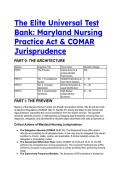
The Elite Universal Test
Bank: Maryland Nursing
Practice Act & COMAR
Jurisprudence
PART 0: THE ARCHITECTURE
Section Cognitive Tier Focus Area Question Range
PART I The Preview Critical Axioms & N/A
Jurisprudential
Frameworks
PART II Tier 1: Foundational COMAR Definitions & 1 – 10
Syntax Hard Deck Statutes
PART II Tier 2: Complex Clinical Simulation & 11 – 20
Application Legal Modification
PART II Tier 3: Grandmaster High-Stakes 21 – 30
Synthesis Jurisprudence
Synthesis
PART I: THE PREVIEW
Mastery of the Maryland Nurse Practice Act (Health Occupations Article, Title 8) and the Code
of Maryland Regulations (COMAR Title 10, Subtitle 27) directly translates to elite clinical and
legal protection, separating the novice practitioner from the master clinician. This gauntlet
demands absolute precision in distinguishing overlapping legal thresholds, ensuring that your
diagnostic, delegatory, and administrative rationale aligns seamlessly with state jurisprudence.
Critical Axioms of Maryland Nursing Jurisprudence
● The Delegation Absolute (COMAR 10.27.11): The Registered Nurse (RN) retains
ultimate accountability for all delegated tasks. A task may only be delegated if the client's
condition is chronic, stable, routine, and predictable. If clinical instability arises, the
delegation is immediately voided.
● The Assessment Bifurcation Rule: Under COMAR 10.27.09 and 10.27.10, the RN
performs the comprehensive nursing assessment. The Licensed Practical Nurse (LPN)
performs a focused nursing assessment but is strictly prohibited from performing nursing
triage.
● The Supervisory Frequency Mandate: The frequency of RN evaluation is dictated by
, clinical stability and wound pathology.
Clinical Scenario Supervisory Evaluation Regulatory Source
Mandate
Standard Delegation (Stable, RN on-site visit every 45 days COMAR 10.27.11
Chronic Client)
Client fails to meet optimal RN on-site visit every 14 days COMAR 10.27.11
stability criteria
Topical medication to Stage 3 RN on-site visit every 7 days COMAR 10.27.11.05
or 4 Ulcer
● The Legal Renewal Timeline: Maryland nursing licenses expire on the 28th day of the
licensee's birth month on a biennial schedule (odd/even years mirroring the birth year).
Active practice requires 1,000 hours in 5 years, or 30 CEUs in 2 years.
● The "Rap Back" & Section 8-316 Precedent: Practicing without an active license,
committing fraud, or failing to report criminal history triggers immediate sanctions under
Health Occupations § 8-316, carrying potential civil penalties up to $20,000 for unlicensed
practice.
PART II: THE ELITE TEST BANK
Q1: A newly appointed member of the Maryland Board of Nursing is reviewing the structural
composition of the Board as mandated by Health Occupations Article § 8-202. To legally
constitute the 14-member Board, which specific representation is STRICTLY REQUIRED by
state statute? A) Seven Registered Nurses, four Licensed Practical Nurses, and three
Consumer Members. B) Nine Registered Nurses (including specific educational and clinical
roles), two Licensed Practical Nurses, one Licensed Nurse, and two Consumers. C) Eight
Registered Nurses, two Advanced Practice Registered Nurses, and four Consumers. D) Ten
Registered Nurses, two Licensed Practical Nurses, and two Physicians.
● The Answer: B (Nine Registered Nurses (including specific educational and clinical
roles), two Licensed Practical Nurses, one Licensed Nurse, and two Consumers.)
● Distractor Analysis:
○ A is incorrect: The statute requires exactly nine RNs and exactly two consumers,
strictly limiting public representation to a 12-to-2 clinical ratio.
○ C is incorrect: This configuration completely omits the legally mandated LPN
representation and over-represents the consumer block.
○ D is incorrect: Physicians do not hold statutory seats on the Board of Nursing; the
Board is composed exclusively of nurses and public consumers to maintain
autonomous professional self-regulation.
The Mentor's Analysis: Self-regulation requires a precise balance of clinical, educational, and
public oversight. By legally codifying the exact breakdown of the 14 members, the state ensures
that every tier of the profession—from practical nursing to advanced practice and
academia—has a direct voice in the rulemaking authority. Professional/Academic Intuition:
The Board protects the public, but it is populated by an exact 12-to-2 ratio of nurses to public
consumers.
Q2: A Registered Nurse born in an odd-numbered year is preparing to renew their Maryland
license. According to COMAR definitions and Board requirements, which timeline and condition
must FIRST be satisfied to execute a legal biennial renewal? A) Renewal by December 31st of
the odd-numbered year, provided the nurse has completed 50 CEUs. B) Renewal on the 28th
, day of the nurse's birth month in the odd-numbered year, accompanied by a one-time attestation
of implicit bias training. C) Renewal exactly two years from the date the initial license was
issued, regardless of the birth month. D) Renewal by the 28th day of the birth month, provided
the nurse submits physical fingerprint cards annually.
● The Answer: B (Renewal on the 28th day of the nurse's birth month in the odd-numbered
year, accompanied by a one-time attestation of implicit bias training.)
● Distractor Analysis:
○ A is incorrect: Maryland requires 30 CEUs in 2 years, not 50, and the expiration is
tied strictly to the birth month, not the end of the calendar year.
○ C is incorrect: The expiration defaults to the 28th day of the birth month on a
biennial cycle (odd/odd or even/even), severing the timeline from the initial issuance
anniversary.
○ D is incorrect: Physical fingerprinting is not required annually; the state utilizes a
continuous Rap Back system for ongoing background monitoring.
The Mentor's Analysis: Administrative compliance is the absolute baseline of legal practice.
Maryland tightly controls the renewal cycle using the biennial birth month framework, and
recently integrated the implicit bias attestation to address systemic health disparities originating
in clinical delivery. Professional/Academic Intuition: Your license dies on the 28th of your birth
month every two years. Missing this date constitutes unauthorized practice.
Q3: An experienced out-of-state nurse applying for Maryland licensure by endorsement realizes
their generic nursing program was completed over 8 years ago, and they have not practiced a
single hour in the past 6 years. Under Maryland law, what is the MOST APPROPRIATE legal
pathway to regain active licensure? A) The nurse must retake the NCLEX-RN examination
immediately to prove clinical competence. B) The nurse must apply for a temporary license and
immediately begin unrestricted practice under facility supervision. C) The nurse must apply for
an inactive license, obtain a 90-day temporary license, and successfully complete a
Board-approved nurse refresher course. D) The nurse may practice independently for 30 days
while waiting for the Board to waive the practice hour requirement.
● The Answer: C (The nurse must apply for an inactive license, obtain a 90-day temporary
license, and successfully complete a Board-approved nurse refresher course.)
● Distractor Analysis:
○ A is incorrect: Retaking the NCLEX is not the statutory mechanism for rectifying
lapsed clinical hours; a structured clinical refresher course is required.
○ B is incorrect: A temporary license for a refresher course does not grant
unrestricted practice rights; it is strictly limited to the clinical preceptorship
parameters of the course.
○ D is incorrect: The Board does not waive the 1,000-hour/5-year rule. Practicing
without meeting this standard is a direct, finable violation of the Nurse Practice Act.
The Mentor's Analysis: Clinical competency decays without use. The state recognizes that a
license granted 8 years ago without recent application represents a severe risk to public safety.
The Board-approved refresher course bridges this gap, requiring a temporary, non-renewable
90-day license to facilitate a heavily supervised clinical re-entry. Professional/Academic
Intuition: Less than 1,000 hours in 5 years equates to a mandatory refresher course.
Q4: Under COMAR 10.27.11 (Delegation of Nursing Functions), a Registered Nurse delegates
the administration of routine oral medications to a Certified Medication Technician (CMT) in an
assisted living facility. The RN's legal accountability in this scenario is BEST described as: A)
Transferred entirely to the CMT once the medication is successfully administered. B)
Transferred to the facility administrator who officially hired and scheduled the CMT. C) Retained
Bank: Maryland Nursing
Practice Act & COMAR
Jurisprudence
PART 0: THE ARCHITECTURE
Section Cognitive Tier Focus Area Question Range
PART I The Preview Critical Axioms & N/A
Jurisprudential
Frameworks
PART II Tier 1: Foundational COMAR Definitions & 1 – 10
Syntax Hard Deck Statutes
PART II Tier 2: Complex Clinical Simulation & 11 – 20
Application Legal Modification
PART II Tier 3: Grandmaster High-Stakes 21 – 30
Synthesis Jurisprudence
Synthesis
PART I: THE PREVIEW
Mastery of the Maryland Nurse Practice Act (Health Occupations Article, Title 8) and the Code
of Maryland Regulations (COMAR Title 10, Subtitle 27) directly translates to elite clinical and
legal protection, separating the novice practitioner from the master clinician. This gauntlet
demands absolute precision in distinguishing overlapping legal thresholds, ensuring that your
diagnostic, delegatory, and administrative rationale aligns seamlessly with state jurisprudence.
Critical Axioms of Maryland Nursing Jurisprudence
● The Delegation Absolute (COMAR 10.27.11): The Registered Nurse (RN) retains
ultimate accountability for all delegated tasks. A task may only be delegated if the client's
condition is chronic, stable, routine, and predictable. If clinical instability arises, the
delegation is immediately voided.
● The Assessment Bifurcation Rule: Under COMAR 10.27.09 and 10.27.10, the RN
performs the comprehensive nursing assessment. The Licensed Practical Nurse (LPN)
performs a focused nursing assessment but is strictly prohibited from performing nursing
triage.
● The Supervisory Frequency Mandate: The frequency of RN evaluation is dictated by
, clinical stability and wound pathology.
Clinical Scenario Supervisory Evaluation Regulatory Source
Mandate
Standard Delegation (Stable, RN on-site visit every 45 days COMAR 10.27.11
Chronic Client)
Client fails to meet optimal RN on-site visit every 14 days COMAR 10.27.11
stability criteria
Topical medication to Stage 3 RN on-site visit every 7 days COMAR 10.27.11.05
or 4 Ulcer
● The Legal Renewal Timeline: Maryland nursing licenses expire on the 28th day of the
licensee's birth month on a biennial schedule (odd/even years mirroring the birth year).
Active practice requires 1,000 hours in 5 years, or 30 CEUs in 2 years.
● The "Rap Back" & Section 8-316 Precedent: Practicing without an active license,
committing fraud, or failing to report criminal history triggers immediate sanctions under
Health Occupations § 8-316, carrying potential civil penalties up to $20,000 for unlicensed
practice.
PART II: THE ELITE TEST BANK
Q1: A newly appointed member of the Maryland Board of Nursing is reviewing the structural
composition of the Board as mandated by Health Occupations Article § 8-202. To legally
constitute the 14-member Board, which specific representation is STRICTLY REQUIRED by
state statute? A) Seven Registered Nurses, four Licensed Practical Nurses, and three
Consumer Members. B) Nine Registered Nurses (including specific educational and clinical
roles), two Licensed Practical Nurses, one Licensed Nurse, and two Consumers. C) Eight
Registered Nurses, two Advanced Practice Registered Nurses, and four Consumers. D) Ten
Registered Nurses, two Licensed Practical Nurses, and two Physicians.
● The Answer: B (Nine Registered Nurses (including specific educational and clinical
roles), two Licensed Practical Nurses, one Licensed Nurse, and two Consumers.)
● Distractor Analysis:
○ A is incorrect: The statute requires exactly nine RNs and exactly two consumers,
strictly limiting public representation to a 12-to-2 clinical ratio.
○ C is incorrect: This configuration completely omits the legally mandated LPN
representation and over-represents the consumer block.
○ D is incorrect: Physicians do not hold statutory seats on the Board of Nursing; the
Board is composed exclusively of nurses and public consumers to maintain
autonomous professional self-regulation.
The Mentor's Analysis: Self-regulation requires a precise balance of clinical, educational, and
public oversight. By legally codifying the exact breakdown of the 14 members, the state ensures
that every tier of the profession—from practical nursing to advanced practice and
academia—has a direct voice in the rulemaking authority. Professional/Academic Intuition:
The Board protects the public, but it is populated by an exact 12-to-2 ratio of nurses to public
consumers.
Q2: A Registered Nurse born in an odd-numbered year is preparing to renew their Maryland
license. According to COMAR definitions and Board requirements, which timeline and condition
must FIRST be satisfied to execute a legal biennial renewal? A) Renewal by December 31st of
the odd-numbered year, provided the nurse has completed 50 CEUs. B) Renewal on the 28th
, day of the nurse's birth month in the odd-numbered year, accompanied by a one-time attestation
of implicit bias training. C) Renewal exactly two years from the date the initial license was
issued, regardless of the birth month. D) Renewal by the 28th day of the birth month, provided
the nurse submits physical fingerprint cards annually.
● The Answer: B (Renewal on the 28th day of the nurse's birth month in the odd-numbered
year, accompanied by a one-time attestation of implicit bias training.)
● Distractor Analysis:
○ A is incorrect: Maryland requires 30 CEUs in 2 years, not 50, and the expiration is
tied strictly to the birth month, not the end of the calendar year.
○ C is incorrect: The expiration defaults to the 28th day of the birth month on a
biennial cycle (odd/odd or even/even), severing the timeline from the initial issuance
anniversary.
○ D is incorrect: Physical fingerprinting is not required annually; the state utilizes a
continuous Rap Back system for ongoing background monitoring.
The Mentor's Analysis: Administrative compliance is the absolute baseline of legal practice.
Maryland tightly controls the renewal cycle using the biennial birth month framework, and
recently integrated the implicit bias attestation to address systemic health disparities originating
in clinical delivery. Professional/Academic Intuition: Your license dies on the 28th of your birth
month every two years. Missing this date constitutes unauthorized practice.
Q3: An experienced out-of-state nurse applying for Maryland licensure by endorsement realizes
their generic nursing program was completed over 8 years ago, and they have not practiced a
single hour in the past 6 years. Under Maryland law, what is the MOST APPROPRIATE legal
pathway to regain active licensure? A) The nurse must retake the NCLEX-RN examination
immediately to prove clinical competence. B) The nurse must apply for a temporary license and
immediately begin unrestricted practice under facility supervision. C) The nurse must apply for
an inactive license, obtain a 90-day temporary license, and successfully complete a
Board-approved nurse refresher course. D) The nurse may practice independently for 30 days
while waiting for the Board to waive the practice hour requirement.
● The Answer: C (The nurse must apply for an inactive license, obtain a 90-day temporary
license, and successfully complete a Board-approved nurse refresher course.)
● Distractor Analysis:
○ A is incorrect: Retaking the NCLEX is not the statutory mechanism for rectifying
lapsed clinical hours; a structured clinical refresher course is required.
○ B is incorrect: A temporary license for a refresher course does not grant
unrestricted practice rights; it is strictly limited to the clinical preceptorship
parameters of the course.
○ D is incorrect: The Board does not waive the 1,000-hour/5-year rule. Practicing
without meeting this standard is a direct, finable violation of the Nurse Practice Act.
The Mentor's Analysis: Clinical competency decays without use. The state recognizes that a
license granted 8 years ago without recent application represents a severe risk to public safety.
The Board-approved refresher course bridges this gap, requiring a temporary, non-renewable
90-day license to facilitate a heavily supervised clinical re-entry. Professional/Academic
Intuition: Less than 1,000 hours in 5 years equates to a mandatory refresher course.
Q4: Under COMAR 10.27.11 (Delegation of Nursing Functions), a Registered Nurse delegates
the administration of routine oral medications to a Certified Medication Technician (CMT) in an
assisted living facility. The RN's legal accountability in this scenario is BEST described as: A)
Transferred entirely to the CMT once the medication is successfully administered. B)
Transferred to the facility administrator who officially hired and scheduled the CMT. C) Retained

