

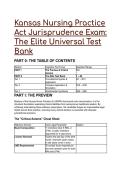
Kansas Nursing Practice
Act Jurisprudence Exam:
The Elite Universal Test
Bank
PART 0: THE TABLE OF CONTENTS
Section Cognitive Tier Focus Question Range
PART I The Preview & Critical N/A
Axioms
PART II The Elite Test Bank 1 – 60
Tier 1 Foundational Syntax & Q1 – Q15
Application
Tier 2 Complex Application & Q16 – Q35
Simulation
Tier 3 Grandmaster Synthesis Q36 – Q60
PART I: THE PREVIEW
Mastery of the Kansas Nurse Practice Act (KNPA) transcends rote memorization; it is the
structural foundation separating clinical liabilities from autonomous healthcare leaders. By
ruthlessly internalizing these statutory parameters, the candidate forges an impenetrable legal
shield around their practice, ensuring every clinical decision is executed with absolute
jurisdictional precision.
The "Critical Axioms" Cheat Sheet
Statutory Domain Core Legal Parameter Citation
Board Composition 11 members total: 6 RNs, 2
LPNs, 3 public members.
Appointed for 4-year terms.
License Renewal Expires the last day of the birth
month. Odd birth years renew
in odd years; even in even.
CNE Requirements 30 contact hours required per
two-year renewal cycle for both
RNs and LPNs.
,Statutory Domain Core Legal Parameter Citation
Misdemeanor Mandate Specific convictions (theft, DUI,
exploitation) must be reported
within exactly 30 days.
LPN IV "Hard Deck" Banned: Blood, TPN, lipids,
investigational meds,
antineoplastics, patients < 12
years OR < 80 lbs.
School Delegation Only RNs delegate to UAPs.
Written competency required.
No dosage calculations for
UAPs.
PART II: THE ELITE TEST BANK
Tier 1: Foundational Syntax & Application
Q1: A newly elected Kansas Governor is reviewing the composition of the Kansas State Board
of Nursing (KSBN) under K.S.A. 74-1106. The current Board includes five registered
professional nurses, two licensed practical nurses, and three members of the general public. To
achieve full statutory compliance, which action is FIRST required? A) Appoint one advanced
practice registered nurse (APRN) to oversee prescribing regulations. B) Appoint one additional
licensed practical nurse with at least five years of clinical experience. C) Appoint one additional
registered professional nurse from a list provided by the state nurses association. D) Appoint
one additional member of the general public to fulfill consumer protection mandates.
● The Answer: C (Appoint one additional registered professional nurse from a list provided
by the state nurses association.)
● Distractor Analysis:
○ A is incorrect: The statute does not legally mandate a dedicated APRN slot outside
of the 6 RN positions.
○ B is incorrect: The statutory limit for LPNs is exactly two, which is already met.
○ D is incorrect: The statutory limit for public members is exactly three, which is
already met.
The Mentor's Analysis: The KSBN is an 11-member architecture strictly codified by K.S.A.
74-1106. The configuration is immutable: 6 RNs, 2 LPNs, and 3 public members. By identifying
the missing RN, the candidate bypasses the novice urge to insert specialty roles.
Professional/Academic Intuition: Regulatory governance boards must be mapped by
their strict statutory math, never by assumed clinical specialty representation.
Q2: A registered nurse born in August 1991 is applying for their first Kansas license renewal
under K.S.A. 65-1117. Based on KSBN expiration protocols, which renewal timeline is MOST
ACCURATE? A) The license expires on the last day of August in the next even-numbered year.
B) The license expires on the last day of August in the next odd-numbered year. C) The license
expires exactly two years from the initial date of issue. D) The license expires on the first day of
August in the next odd-numbered year.
● The Answer: B (The license expires on the last day of August in the next odd-numbered
year.)
● Distractor Analysis:
○ A is incorrect: 1991 is an odd year, placing the nurse in the odd-year renewal cycle.
, ○ C is incorrect: Kansas does not use a 24-month rolling clock from the issue date; it
aligns with demographics.
○ D is incorrect: Expiration occurs on the last day of the birth month, not the first.
The Mentor's Analysis: Kansas utilizes a biometric anchor for license renewal: the birth year
and birth month. Odd birth years renew in odd years; even in even. Expirations always strike on
the final day of the birth month. Professional/Academic Intuition: License expiration is a
rigid chronological trap; calculate renewal based purely on the licensee's demographic
anchor, not the date of licensure.
Q3: Under K.S.A. 65-1117, a licensed practical nurse (LPN) is preparing for license renewal.
Which continuing nursing education (CNE) parameter represents the MOST APPROPRIATE
compliance standard? A) 20 contact hours completed annually. B) 30 contact hours completed
during the two-year renewal period. C) 30 contact hours, with a minimum of 10 hours in
pharmacology. D) 15 contact hours completed specifically in intravenous therapy protocols.
● The Answer: B (30 contact hours completed during the two-year renewal period.)
● Distractor Analysis:
○ A is incorrect: Kansas utilizes a biennial cycle, not an annual hour requirement.
○ C is incorrect: While 30 hours is correct, Kansas does not mandate specific
pharmacology hours for standard LPN renewal.
○ D is incorrect: There is no strict fractional requirement dedicated solely to IV
therapy for general renewal.
The Mentor's Analysis: The standard for continued competence in Kansas is a flat 30 contact
hours over a two-year cycle for both RNs and LPNs. The law requires the education to enhance
clinical practice but does not micromanage the specific sub-topics for general licensure.
Professional/Academic Intuition: Statutory CNE requirements establish the volume (30
hours), while the licensee's scope dictates the relevance.
Q4: A registered nurse receives a finalized misdemeanor conviction for theft following an
off-duty incident. Under K.A.R. 60-3-113, what is the nurse's IMMEDIATE statutory obligation?
A) Report the conviction to the KSBN upon the next biennial license renewal. B) Surrender their
nursing license within 15 days of the court date. C) Report the conviction to the KSBN within 30
days from the date the conviction becomes final. D) Enroll in the Kansas Nurses Assistance
Program (KNAP) within 30 days.
● The Answer: C (Report the conviction to the KSBN within 30 days from the date the
conviction becomes final.)
● Distractor Analysis:
○ A is incorrect: Waiting for the renewal cycle violates the 30-day reporting mandate,
constituting further unprofessional conduct.
○ B is incorrect: Surrender is not an automatic statutory requirement for a
misdemeanor.
○ D is incorrect: Theft is a reportable misdemeanor, but KNAP is designated for
impaired providers, not general criminal diversion.
The Mentor's Analysis: Transparency is non-negotiable. K.A.R. 60-3-113 demands immediate
self-reporting of specific misdemeanors—including theft, exploitation, and DUI—within a strict
30-day window. Concealment is treated as severely as the crime itself. Professional/Academic
Intuition: Regulatory bodies punish the cover-up as aggressively as the crime;
self-reporting within 30 days is an absolute shield against secondary charges of deceit.
Q5: An LPN with expanded IV therapy training is assessing a newly admitted patient. Under
K.A.R. 60-16-102, which intravenous task is the LPN STRICLY FORBIDDEN from performing?
A) Adding premixed antibiotics to an existing peripheral IV line. B) Changing the sterile dressing
Act Jurisprudence Exam:
The Elite Universal Test
Bank
PART 0: THE TABLE OF CONTENTS
Section Cognitive Tier Focus Question Range
PART I The Preview & Critical N/A
Axioms
PART II The Elite Test Bank 1 – 60
Tier 1 Foundational Syntax & Q1 – Q15
Application
Tier 2 Complex Application & Q16 – Q35
Simulation
Tier 3 Grandmaster Synthesis Q36 – Q60
PART I: THE PREVIEW
Mastery of the Kansas Nurse Practice Act (KNPA) transcends rote memorization; it is the
structural foundation separating clinical liabilities from autonomous healthcare leaders. By
ruthlessly internalizing these statutory parameters, the candidate forges an impenetrable legal
shield around their practice, ensuring every clinical decision is executed with absolute
jurisdictional precision.
The "Critical Axioms" Cheat Sheet
Statutory Domain Core Legal Parameter Citation
Board Composition 11 members total: 6 RNs, 2
LPNs, 3 public members.
Appointed for 4-year terms.
License Renewal Expires the last day of the birth
month. Odd birth years renew
in odd years; even in even.
CNE Requirements 30 contact hours required per
two-year renewal cycle for both
RNs and LPNs.
,Statutory Domain Core Legal Parameter Citation
Misdemeanor Mandate Specific convictions (theft, DUI,
exploitation) must be reported
within exactly 30 days.
LPN IV "Hard Deck" Banned: Blood, TPN, lipids,
investigational meds,
antineoplastics, patients < 12
years OR < 80 lbs.
School Delegation Only RNs delegate to UAPs.
Written competency required.
No dosage calculations for
UAPs.
PART II: THE ELITE TEST BANK
Tier 1: Foundational Syntax & Application
Q1: A newly elected Kansas Governor is reviewing the composition of the Kansas State Board
of Nursing (KSBN) under K.S.A. 74-1106. The current Board includes five registered
professional nurses, two licensed practical nurses, and three members of the general public. To
achieve full statutory compliance, which action is FIRST required? A) Appoint one advanced
practice registered nurse (APRN) to oversee prescribing regulations. B) Appoint one additional
licensed practical nurse with at least five years of clinical experience. C) Appoint one additional
registered professional nurse from a list provided by the state nurses association. D) Appoint
one additional member of the general public to fulfill consumer protection mandates.
● The Answer: C (Appoint one additional registered professional nurse from a list provided
by the state nurses association.)
● Distractor Analysis:
○ A is incorrect: The statute does not legally mandate a dedicated APRN slot outside
of the 6 RN positions.
○ B is incorrect: The statutory limit for LPNs is exactly two, which is already met.
○ D is incorrect: The statutory limit for public members is exactly three, which is
already met.
The Mentor's Analysis: The KSBN is an 11-member architecture strictly codified by K.S.A.
74-1106. The configuration is immutable: 6 RNs, 2 LPNs, and 3 public members. By identifying
the missing RN, the candidate bypasses the novice urge to insert specialty roles.
Professional/Academic Intuition: Regulatory governance boards must be mapped by
their strict statutory math, never by assumed clinical specialty representation.
Q2: A registered nurse born in August 1991 is applying for their first Kansas license renewal
under K.S.A. 65-1117. Based on KSBN expiration protocols, which renewal timeline is MOST
ACCURATE? A) The license expires on the last day of August in the next even-numbered year.
B) The license expires on the last day of August in the next odd-numbered year. C) The license
expires exactly two years from the initial date of issue. D) The license expires on the first day of
August in the next odd-numbered year.
● The Answer: B (The license expires on the last day of August in the next odd-numbered
year.)
● Distractor Analysis:
○ A is incorrect: 1991 is an odd year, placing the nurse in the odd-year renewal cycle.
, ○ C is incorrect: Kansas does not use a 24-month rolling clock from the issue date; it
aligns with demographics.
○ D is incorrect: Expiration occurs on the last day of the birth month, not the first.
The Mentor's Analysis: Kansas utilizes a biometric anchor for license renewal: the birth year
and birth month. Odd birth years renew in odd years; even in even. Expirations always strike on
the final day of the birth month. Professional/Academic Intuition: License expiration is a
rigid chronological trap; calculate renewal based purely on the licensee's demographic
anchor, not the date of licensure.
Q3: Under K.S.A. 65-1117, a licensed practical nurse (LPN) is preparing for license renewal.
Which continuing nursing education (CNE) parameter represents the MOST APPROPRIATE
compliance standard? A) 20 contact hours completed annually. B) 30 contact hours completed
during the two-year renewal period. C) 30 contact hours, with a minimum of 10 hours in
pharmacology. D) 15 contact hours completed specifically in intravenous therapy protocols.
● The Answer: B (30 contact hours completed during the two-year renewal period.)
● Distractor Analysis:
○ A is incorrect: Kansas utilizes a biennial cycle, not an annual hour requirement.
○ C is incorrect: While 30 hours is correct, Kansas does not mandate specific
pharmacology hours for standard LPN renewal.
○ D is incorrect: There is no strict fractional requirement dedicated solely to IV
therapy for general renewal.
The Mentor's Analysis: The standard for continued competence in Kansas is a flat 30 contact
hours over a two-year cycle for both RNs and LPNs. The law requires the education to enhance
clinical practice but does not micromanage the specific sub-topics for general licensure.
Professional/Academic Intuition: Statutory CNE requirements establish the volume (30
hours), while the licensee's scope dictates the relevance.
Q4: A registered nurse receives a finalized misdemeanor conviction for theft following an
off-duty incident. Under K.A.R. 60-3-113, what is the nurse's IMMEDIATE statutory obligation?
A) Report the conviction to the KSBN upon the next biennial license renewal. B) Surrender their
nursing license within 15 days of the court date. C) Report the conviction to the KSBN within 30
days from the date the conviction becomes final. D) Enroll in the Kansas Nurses Assistance
Program (KNAP) within 30 days.
● The Answer: C (Report the conviction to the KSBN within 30 days from the date the
conviction becomes final.)
● Distractor Analysis:
○ A is incorrect: Waiting for the renewal cycle violates the 30-day reporting mandate,
constituting further unprofessional conduct.
○ B is incorrect: Surrender is not an automatic statutory requirement for a
misdemeanor.
○ D is incorrect: Theft is a reportable misdemeanor, but KNAP is designated for
impaired providers, not general criminal diversion.
The Mentor's Analysis: Transparency is non-negotiable. K.A.R. 60-3-113 demands immediate
self-reporting of specific misdemeanors—including theft, exploitation, and DUI—within a strict
30-day window. Concealment is treated as severely as the crime itself. Professional/Academic
Intuition: Regulatory bodies punish the cover-up as aggressively as the crime;
self-reporting within 30 days is an absolute shield against secondary charges of deceit.
Q5: An LPN with expanded IV therapy training is assessing a newly admitted patient. Under
K.A.R. 60-16-102, which intravenous task is the LPN STRICLY FORBIDDEN from performing?
A) Adding premixed antibiotics to an existing peripheral IV line. B) Changing the sterile dressing

