

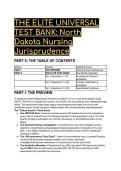
THE ELITE UNIVERSAL
TEST BANK: North
Dakota Nursing
Jurisprudence
PART 0: THE TABLE OF CONTENTS
Section Content Cognitive Focus
PART I THE PREVIEW Axioms & Core Frameworks
PART II THE ELITE TEST BANK The 30-Point Gauntlet
Tier 1 (Questions 1–10) Foundational Syntax &
Application
Tier 2 (Questions 11–20) Complex Application &
Simulation
Tier 3 (Questions 21–30) Grandmaster Synthesis
PART I: THE PREVIEW
To master the North Dakota Nurse Practices Act (NDCC 43-12.1) and Administrative Code
(NDAC Title 54) is to insulate your license, your facility, and your patients from catastrophic legal
failure. This assessment strips away legacy misconceptions and forges you into an elite
practitioner whose clinical execution perfectly aligns with uncompromising legal frameworks.
The "Critical Axioms" Cheat Sheet:
● The 400/12/30 Rule: Licensure renewal requires 400 practice hours in the preceding 4
years, and 12 contact hours of continuing education in the preceding 2 years. You have
exactly 30 days to self-report any criminal, disciplinary, or administrative action to the
Board.
● The Absolute Ceiling of Delegation: A licensed nurse may never delegate nursing
judgment, comprehensive physical/psychological assessment, formulation of the care
plan, or the triage of patients to an Unlicensed Assistive Person (UAP) or Medication
Assistant III (MAIII).
● The LPN Intravenous "Hard Deck": Under no circumstances may a Licensed Practical
Nurse (LPN) administer moderate sedation via IV bolus, administer
investigational/cytotoxic medications, or discontinue a central venous line.
● The Aesthetics Mandate: A Registered Nurse (RN) may inject FDA-approved aesthetic
agents ONLY after an authorized prescriber (MD, NP, PA) has conducted an initial
assessment and prescribed the treatment.
, ● The Minor Incident Threshold: Minor Incidents (low risk, no pattern, remediated) do not
require Board reporting UNLESS the nurse accumulates 5 or more within a 1-year period,
or leaves employment prior to completing facility-mandated remediation.
PART II: THE ELITE TEST BANK
Tier 1: Foundational Syntax & Application
Q1: A Registered Nurse (RN) in North Dakota is preparing to renew their license. They have
completed 8 hours of clinical seminars, a 4-hour Basic Life Support (BLS) recertification, and
have practiced 500 hours over the last four years. Based on the principles of the North Dakota
Board of Nursing (NDBON) continuing education requirements, which conclusion is the MOST
ACCURATE? A) The RN has met all renewal requirements because BLS is a universally
accepted clinical competency required by all facilities. B) The RN must submit to a random audit
before the BLS hours can be formally credited toward the 12-hour requirement. C) The RN falls
short of the continuing education requirement because BLS and CPR classes do not meet the
criteria for acceptable contact hours. D) The RN must complete an additional 400 practice
hours, as the 500 hours must be accrued within the immediately preceding two years.
● The Answer: C (The RN falls short of the continuing education requirement because BLS
and CPR classes do not meet the criteria for acceptable contact hours.)
● Distractor Analysis:
○ A is incorrect: While BLS is a foundational clinical requirement for employment,
NDAC explicitly lists Basic Life Support and CPR as unacceptable subject matter
for continuing education contact hours.
○ B is incorrect: The NDBON does perform random audits , but auditing a submission
does not validate inherently unacceptable content. BLS will be rejected during an
audit.
○ D is incorrect: The practice requirement dictates 400 hours within the preceding
four years, not two. The RN has met the practice hour requirement, making this
distractor technically flawed.
The Mentor's Analysis: Regulatory boards distinguish between basic operational certifications
and true professional advancement. Continuing education must elevate the nurse's cognitive or
clinical mastery, not merely refresh a baseline employment requisite. By utilizing
Board-Approved Contact Hours, you bypass the common trap of assuming facility mandates
equal regulatory compliance.
Unacceptable ND CE Content Acceptable ND CE Alternatives
BLS / CPR / ACLS Recertifications Publication in a refereed journal
Agency-specific orientation Pharmacotherapy courses
Volunteer practice / Community service Presentation/Lecture (max 6 hours)
Professional/Academic Intuition: Never
conflate mandatory facility safety training
with legally sanctioned Continuing
Education.
Q2: An applicant applying for initial North Dakota licensure by endorsement is awaiting the
results of a Criminal History Record Check (CHRC). The facility requires the nurse to begin
orientation IMMEDIATELY. Which action aligns perfectly with NDBON regulations? A) The
, nurse may practice utilizing a 90-day, non-renewable temporary permit issued by the Board
while the CHRC is processing. B) The nurse may practice under a provisional status indefinitely,
provided they are directly supervised by an RN. C) The nurse must wait until the CHRC is fully
cleared and the permanent license is issued before engaging in any patient care. D) The nurse
may practice independently if they hold a multistate license from a non-compact state.
● The Answer: A (The nurse may practice utilizing a 90-day, non-renewable temporary
permit issued by the Board while the CHRC is processing.)
● Distractor Analysis:
○ B is incorrect: Provisional, indefinite supervised practice without a Board-issued
permit is an illegal authorization and constitutes practicing without a license.
○ C is incorrect: This is a legacy methodology. To prevent workforce bottlenecks, the
NDBON specifically authorizes a 90-day permit to allow safe onboarding while
federal/state background checks process.
○ D is incorrect: A "multistate license from a non-compact state" is an oxymoron. Only
Nurse Licensure Compact (eNLC) states issue multistate privileges.
The Mentor's Analysis: Jurisdictions must balance public protection (CHRC) with the
operational realities of healthcare staffing. The temporary permit is the legal bridge. By utilizing
the 90-Day Temporary Permit, you bypass the common trap of delaying critical workforce
integration. Professional/Academic Intuition: A temporary permit is a rigid, non-renewable
90-day contract. If the CHRC fails or delays past 90 days, clinical practice must halt
instantly.
Q3: The North Dakota Board of Nursing operates as the ultimate regulatory authority over
nursing practice in the state. Based on the statutory composition outlined in NDCC 43-12.1,
which framework dictates the Board's membership? A) Eleven members elected by popular vote
of the North Dakota Nurses Association. B) Nine members appointed by the Governor,
comprising five RNs, one APRN, two LPNs, and one public member. C) Seven members
appointed by the state legislature, all of whom must hold an active APRN license. D) Nine
members appointed by the Department of Health, limited to facility administrators and
educators.
● The Answer: B (Nine members appointed by the Governor, comprising five RNs, one
APRN, two LPNs, and one public member.)
● Distractor Analysis:
○ A is incorrect: Board members are appointed by the executive branch (Governor),
not elected by professional trade associations.
○ C is incorrect: This distorts historical data. In 1963, the Board had seven members,
but it has since expanded. Furthermore, an all-APRN board would fail to represent
practical nursing and public interests.
○ D is incorrect: The Department of Health oversees facility regulation (e.g., civil
money penalties for nursing facilities ), but the Governor appoints professional
regulatory boards.
The Mentor's Analysis: The Board of Nursing is an instrument of the state executive branch,
designed to protect the public, not to advocate for the nursing profession (which is the role of
associations). Its composition ensures peer review across all licensure tiers while maintaining
civilian oversight. By understanding Executive Appointment, you bypass the common trap of
confusing a regulatory body with a labor union. Professional/Academic Intuition: Regulatory
boards exist to protect the public from the practitioner, not to protect the practitioner
from the public.
Q4: A licensed nurse receives a citation and is convicted of Driving Under the Influence (DUI)
TEST BANK: North
Dakota Nursing
Jurisprudence
PART 0: THE TABLE OF CONTENTS
Section Content Cognitive Focus
PART I THE PREVIEW Axioms & Core Frameworks
PART II THE ELITE TEST BANK The 30-Point Gauntlet
Tier 1 (Questions 1–10) Foundational Syntax &
Application
Tier 2 (Questions 11–20) Complex Application &
Simulation
Tier 3 (Questions 21–30) Grandmaster Synthesis
PART I: THE PREVIEW
To master the North Dakota Nurse Practices Act (NDCC 43-12.1) and Administrative Code
(NDAC Title 54) is to insulate your license, your facility, and your patients from catastrophic legal
failure. This assessment strips away legacy misconceptions and forges you into an elite
practitioner whose clinical execution perfectly aligns with uncompromising legal frameworks.
The "Critical Axioms" Cheat Sheet:
● The 400/12/30 Rule: Licensure renewal requires 400 practice hours in the preceding 4
years, and 12 contact hours of continuing education in the preceding 2 years. You have
exactly 30 days to self-report any criminal, disciplinary, or administrative action to the
Board.
● The Absolute Ceiling of Delegation: A licensed nurse may never delegate nursing
judgment, comprehensive physical/psychological assessment, formulation of the care
plan, or the triage of patients to an Unlicensed Assistive Person (UAP) or Medication
Assistant III (MAIII).
● The LPN Intravenous "Hard Deck": Under no circumstances may a Licensed Practical
Nurse (LPN) administer moderate sedation via IV bolus, administer
investigational/cytotoxic medications, or discontinue a central venous line.
● The Aesthetics Mandate: A Registered Nurse (RN) may inject FDA-approved aesthetic
agents ONLY after an authorized prescriber (MD, NP, PA) has conducted an initial
assessment and prescribed the treatment.
, ● The Minor Incident Threshold: Minor Incidents (low risk, no pattern, remediated) do not
require Board reporting UNLESS the nurse accumulates 5 or more within a 1-year period,
or leaves employment prior to completing facility-mandated remediation.
PART II: THE ELITE TEST BANK
Tier 1: Foundational Syntax & Application
Q1: A Registered Nurse (RN) in North Dakota is preparing to renew their license. They have
completed 8 hours of clinical seminars, a 4-hour Basic Life Support (BLS) recertification, and
have practiced 500 hours over the last four years. Based on the principles of the North Dakota
Board of Nursing (NDBON) continuing education requirements, which conclusion is the MOST
ACCURATE? A) The RN has met all renewal requirements because BLS is a universally
accepted clinical competency required by all facilities. B) The RN must submit to a random audit
before the BLS hours can be formally credited toward the 12-hour requirement. C) The RN falls
short of the continuing education requirement because BLS and CPR classes do not meet the
criteria for acceptable contact hours. D) The RN must complete an additional 400 practice
hours, as the 500 hours must be accrued within the immediately preceding two years.
● The Answer: C (The RN falls short of the continuing education requirement because BLS
and CPR classes do not meet the criteria for acceptable contact hours.)
● Distractor Analysis:
○ A is incorrect: While BLS is a foundational clinical requirement for employment,
NDAC explicitly lists Basic Life Support and CPR as unacceptable subject matter
for continuing education contact hours.
○ B is incorrect: The NDBON does perform random audits , but auditing a submission
does not validate inherently unacceptable content. BLS will be rejected during an
audit.
○ D is incorrect: The practice requirement dictates 400 hours within the preceding
four years, not two. The RN has met the practice hour requirement, making this
distractor technically flawed.
The Mentor's Analysis: Regulatory boards distinguish between basic operational certifications
and true professional advancement. Continuing education must elevate the nurse's cognitive or
clinical mastery, not merely refresh a baseline employment requisite. By utilizing
Board-Approved Contact Hours, you bypass the common trap of assuming facility mandates
equal regulatory compliance.
Unacceptable ND CE Content Acceptable ND CE Alternatives
BLS / CPR / ACLS Recertifications Publication in a refereed journal
Agency-specific orientation Pharmacotherapy courses
Volunteer practice / Community service Presentation/Lecture (max 6 hours)
Professional/Academic Intuition: Never
conflate mandatory facility safety training
with legally sanctioned Continuing
Education.
Q2: An applicant applying for initial North Dakota licensure by endorsement is awaiting the
results of a Criminal History Record Check (CHRC). The facility requires the nurse to begin
orientation IMMEDIATELY. Which action aligns perfectly with NDBON regulations? A) The
, nurse may practice utilizing a 90-day, non-renewable temporary permit issued by the Board
while the CHRC is processing. B) The nurse may practice under a provisional status indefinitely,
provided they are directly supervised by an RN. C) The nurse must wait until the CHRC is fully
cleared and the permanent license is issued before engaging in any patient care. D) The nurse
may practice independently if they hold a multistate license from a non-compact state.
● The Answer: A (The nurse may practice utilizing a 90-day, non-renewable temporary
permit issued by the Board while the CHRC is processing.)
● Distractor Analysis:
○ B is incorrect: Provisional, indefinite supervised practice without a Board-issued
permit is an illegal authorization and constitutes practicing without a license.
○ C is incorrect: This is a legacy methodology. To prevent workforce bottlenecks, the
NDBON specifically authorizes a 90-day permit to allow safe onboarding while
federal/state background checks process.
○ D is incorrect: A "multistate license from a non-compact state" is an oxymoron. Only
Nurse Licensure Compact (eNLC) states issue multistate privileges.
The Mentor's Analysis: Jurisdictions must balance public protection (CHRC) with the
operational realities of healthcare staffing. The temporary permit is the legal bridge. By utilizing
the 90-Day Temporary Permit, you bypass the common trap of delaying critical workforce
integration. Professional/Academic Intuition: A temporary permit is a rigid, non-renewable
90-day contract. If the CHRC fails or delays past 90 days, clinical practice must halt
instantly.
Q3: The North Dakota Board of Nursing operates as the ultimate regulatory authority over
nursing practice in the state. Based on the statutory composition outlined in NDCC 43-12.1,
which framework dictates the Board's membership? A) Eleven members elected by popular vote
of the North Dakota Nurses Association. B) Nine members appointed by the Governor,
comprising five RNs, one APRN, two LPNs, and one public member. C) Seven members
appointed by the state legislature, all of whom must hold an active APRN license. D) Nine
members appointed by the Department of Health, limited to facility administrators and
educators.
● The Answer: B (Nine members appointed by the Governor, comprising five RNs, one
APRN, two LPNs, and one public member.)
● Distractor Analysis:
○ A is incorrect: Board members are appointed by the executive branch (Governor),
not elected by professional trade associations.
○ C is incorrect: This distorts historical data. In 1963, the Board had seven members,
but it has since expanded. Furthermore, an all-APRN board would fail to represent
practical nursing and public interests.
○ D is incorrect: The Department of Health oversees facility regulation (e.g., civil
money penalties for nursing facilities ), but the Governor appoints professional
regulatory boards.
The Mentor's Analysis: The Board of Nursing is an instrument of the state executive branch,
designed to protect the public, not to advocate for the nursing profession (which is the role of
associations). Its composition ensures peer review across all licensure tiers while maintaining
civilian oversight. By understanding Executive Appointment, you bypass the common trap of
confusing a regulatory body with a labor union. Professional/Academic Intuition: Regulatory
boards exist to protect the public from the practitioner, not to protect the practitioner
from the public.
Q4: A licensed nurse receives a citation and is convicted of Driving Under the Influence (DUI)

