

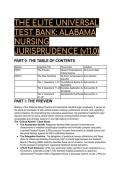
THE ELITE UNIVERSAL
TEST BANK: ALABAMA
NURSING
JURISPRUDENCE (v11.0)
PART 0: THE TABLE OF CONTENTS
Section Cognitive Tier Focus Area Location
PART I The Preview Mission Parameters & Document Start
Critical Axioms
PART II The Elite Test Bank 30-Point Jurisprudence Core Section
Gauntlet
- Tier 1: Questions 1–10 Foundational Syntax & Sub-section A
Application
- Tier 2: Questions 11–20 Complex Application & Sub-section B
Simulation
- Tier 3: Questions Grandmaster Synthesis Sub-section C
21–30
PART I: THE PREVIEW
Mastery of the Alabama Nurse Practice Act transcends standard legal compliance; it serves as
the absolute foundation of elite clinical decision-making, professional survival, and unyielding
public protection. By internalizing this exhaustive assessment, the practitioner transforms rigid
statutory text into an active clinical shield, ensuring nursing practice remains legally
unassailable and clinically superior in any high-stakes environment.
The "Critical Axioms" Cheat Sheet:
● The Assessment Divide: Registered Nurses (RNs) execute Comprehensive
Assessments to establish physiological baselines and formulate complex care plans;
Licensed Practical Nurses (LPNs) execute Focused Assessments to identify normal and
abnormal findings against the RN's established baseline.
● The Delegation Doctrine: The delegation of peripheral venous phlebotomy and finger
sticks to Unlicensed Assistive Personnel (UAP) is strictly legal because the Alabama
Board of Nursing (ABN) explicitly classifies these as non-invasive, non-sterile procedures
for the purpose of assignment, bypassing traditional clinical semantics.
● LPN IV Push Strictures: LPNs may administer highly specific IV push medications (e.g.,
H2 blockers, antiemetics) ONLY if the licensed hospital possesses an approved
Standardized Procedure AND a Registered Nurse is physically present on-site. LPNs are
, permanently and strictly forbidden from administering IV push insulin or chemotherapy,
and may never directly access implanted central venous ports.
● The Standardized Procedure Trinity: Any practice extending beyond basic educational
preparation mandates a Standardized Procedure application. This legal contract must be
unequivocally signed by the facility's Chief Nursing Officer (CNO), Chief Medical Officer
(CMO), and Chief Executive Officer (CEO) before clinical implementation occurs.
● Temporary Permit Extinction: A temporary permit for a graduate nurse immediately and
permanently invalidates upon official notification of a failed NCLEX result, or at the
expiration of the 180-day window. Practicing past this precise chronological threshold
constitutes the unauthorized and criminal practice of nursing.
PART II: THE ELITE TEST BANK
Tier 1: Foundational Syntax & Application (Questions 1–10)
Q1: A newly licensed Registered Nurse (RN) in Alabama is meticulously preparing for their first
license renewal cycle. Based on the principles of the Alabama Administrative Code Chapter
610-X-4, which action is the MOST ACCURATE pathway regarding statutory continuing
education (CE) requirements? A) The nurse must complete 24 random contact hours sourced
exclusively from any nationally accredited healthcare provider. B) The nurse must wait until the
second renewal cycle to begin accruing their required 24 contact hours, as new graduates are
granted a statutory grace period. C) The nurse must complete four contact hours of
Board-provided CE related to regulatory frameworks and prorate the remaining hours based on
the calendar months remaining in the earning period. D) The nurse is entirely exempt from all
continuing education requirements for the first three years of active clinical licensure.
● The Answer: C (The nurse must complete four contact hours of Board-provided CE
related to regulatory frameworks and prorate the remaining hours based on the calendar
months remaining in the earning period.)
● Distractor Analysis:
○ A is incorrect: The ABN rigorously mandates that for the first license renewal, a
newly licensed nurse cannot simply submit 24 random hours. They must complete
a highly specific four-hour Board-provided mandatory class covering Alabama
statutory frameworks before general hours are accepted.
○ B is incorrect: CE accrual begins immediately upon initial licensure. Waiting until the
second cycle would categorically result in a lapsed license due to severe hour
deficiencies.
○ D is incorrect: There are absolutely no three-year exemptions in Alabama nursing
jurisprudence. CE compliance is strictly mandatory for the very first renewal via the
precisely calculated prorated framework.
The Mentor's Analysis: Novice practitioners often dangerously assume new graduates are
exempt from continuing education due to their recent academic graduation. The Alabama Board
of Nursing engineered the prorated first-renewal system to immediately and forcefully immerse
new nurses into the state's specific statutory framework. By utilizing the Board-provided
mandatory class, you bypass the common trap of accidental non-compliance and establish a
foundation in state-specific jurisprudence. Professional/Academic Intuition: First-time
renewals always demand the four-hour ABN mandatory course; subsequent renewals
require 24 standard approved hours. Proration is the legal bridge between graduation
, and your first renewal.
Q2: An RN delegates the task of obtaining a blood glucose reading via a capillary finger stick to
an Unlicensed Assistive Personnel (UAP) on a medical-surgical unit. Based on the principles of
ABN Delegation Rules (610-X-6-.11), which legal conclusion regarding this delegation is the
MOST ACCURATE? A) The delegation is fundamentally illegal because all clinical procedures
breaking the dermal layer are classified as invasive by the state. B) The delegation is illegal
unless the UAP has successfully obtained a Medication Assistant, Certified (MAC) permit from
the Board. C) The delegation is perfectly legal because the ABN explicitly defines finger sticks
as a non-invasive and non-sterile procedure for the purposes of assignment. D) The delegation
is legal only if the facility has a formally signed Standardized Procedure contract on file with the
Board.
● The Answer: C (The delegation is perfectly legal because the ABN explicitly defines
finger sticks as a non-invasive and non-sterile procedure for the purposes of assignment.)
● Distractor Analysis:
○ A is incorrect: While a finger stick technically pierces the human dermis in a clinical
sense, ABN Administrative Code explicitly carves out a legal exception, declaring it
"not an invasive or sterile procedure within the meaning of these rules".
○ B is incorrect: A MAC permit is strictly regulated for medication administration, not
for standard point-of-care vital testing like glucometer checks.
○ D is incorrect: Standardized Procedures are exclusively utilized for licensed nurses
(RNs and LPNs) practicing beyond their basic educational preparation, never for
UAP delegations.
The Mentor's Analysis: The razor-thin distinction between literal clinical definitions and legal
statutory definitions is where professional careers are either saved or lost. The ABN has
specifically engineered the legal definition of "non-invasive" to include finger sticks and
peripheral venous phlebotomy to optimize facility workflow without compromising patient safety.
Professional/Academic Intuition: Legal definitions supersede clinical semantics; if the
Board explicitly defines a needle-stick as non-invasive within the administrative code, it
is non-invasive for all purposes of legal delegation.
Q3: An applicant applies for the Voluntary Disciplinary Alternative Program (VDAP) due to a
profound opioid addiction. During the mandatory intake assessment, it is discovered the nurse
diverted hospital fentanyl to sell to a family member for profit. Based on the principles of ABN
VDAP Eligibility (610-X-13-.05), which regulatory action is the MOST APPROPRIATE? A) Admit
the nurse to VDAP with an extended, hyper-vigilant monitoring contract of 60 months due to the
financial component. B) Admit the nurse to VDAP but restrict their access to controlled
substances indefinitely to protect the public. C) Deny admission to VDAP entirely because
diversion of controlled substances for anything other than self-use is an absolute statutory
disqualifier. D) Deny admission to VDAP until the nurse successfully completes a 90-day
inpatient rehabilitation program at an approved facility.
● The Answer: C (Deny admission to VDAP entirely because diversion of controlled
substances for anything other than self-use is an absolute statutory disqualifier.)
● Distractor Analysis:
○ A is incorrect: Extended monitoring is a standard VDAP protocol for admitted
nurses, but this applicant is fundamentally and permanently ineligible for admission
due to the nature of the diversion.
○ B is incorrect: While restricting controlled substance access is a highly valid
stipulation for impaired participants, the board will absolutely not admit this specific
nurse into the program.
TEST BANK: ALABAMA
NURSING
JURISPRUDENCE (v11.0)
PART 0: THE TABLE OF CONTENTS
Section Cognitive Tier Focus Area Location
PART I The Preview Mission Parameters & Document Start
Critical Axioms
PART II The Elite Test Bank 30-Point Jurisprudence Core Section
Gauntlet
- Tier 1: Questions 1–10 Foundational Syntax & Sub-section A
Application
- Tier 2: Questions 11–20 Complex Application & Sub-section B
Simulation
- Tier 3: Questions Grandmaster Synthesis Sub-section C
21–30
PART I: THE PREVIEW
Mastery of the Alabama Nurse Practice Act transcends standard legal compliance; it serves as
the absolute foundation of elite clinical decision-making, professional survival, and unyielding
public protection. By internalizing this exhaustive assessment, the practitioner transforms rigid
statutory text into an active clinical shield, ensuring nursing practice remains legally
unassailable and clinically superior in any high-stakes environment.
The "Critical Axioms" Cheat Sheet:
● The Assessment Divide: Registered Nurses (RNs) execute Comprehensive
Assessments to establish physiological baselines and formulate complex care plans;
Licensed Practical Nurses (LPNs) execute Focused Assessments to identify normal and
abnormal findings against the RN's established baseline.
● The Delegation Doctrine: The delegation of peripheral venous phlebotomy and finger
sticks to Unlicensed Assistive Personnel (UAP) is strictly legal because the Alabama
Board of Nursing (ABN) explicitly classifies these as non-invasive, non-sterile procedures
for the purpose of assignment, bypassing traditional clinical semantics.
● LPN IV Push Strictures: LPNs may administer highly specific IV push medications (e.g.,
H2 blockers, antiemetics) ONLY if the licensed hospital possesses an approved
Standardized Procedure AND a Registered Nurse is physically present on-site. LPNs are
, permanently and strictly forbidden from administering IV push insulin or chemotherapy,
and may never directly access implanted central venous ports.
● The Standardized Procedure Trinity: Any practice extending beyond basic educational
preparation mandates a Standardized Procedure application. This legal contract must be
unequivocally signed by the facility's Chief Nursing Officer (CNO), Chief Medical Officer
(CMO), and Chief Executive Officer (CEO) before clinical implementation occurs.
● Temporary Permit Extinction: A temporary permit for a graduate nurse immediately and
permanently invalidates upon official notification of a failed NCLEX result, or at the
expiration of the 180-day window. Practicing past this precise chronological threshold
constitutes the unauthorized and criminal practice of nursing.
PART II: THE ELITE TEST BANK
Tier 1: Foundational Syntax & Application (Questions 1–10)
Q1: A newly licensed Registered Nurse (RN) in Alabama is meticulously preparing for their first
license renewal cycle. Based on the principles of the Alabama Administrative Code Chapter
610-X-4, which action is the MOST ACCURATE pathway regarding statutory continuing
education (CE) requirements? A) The nurse must complete 24 random contact hours sourced
exclusively from any nationally accredited healthcare provider. B) The nurse must wait until the
second renewal cycle to begin accruing their required 24 contact hours, as new graduates are
granted a statutory grace period. C) The nurse must complete four contact hours of
Board-provided CE related to regulatory frameworks and prorate the remaining hours based on
the calendar months remaining in the earning period. D) The nurse is entirely exempt from all
continuing education requirements for the first three years of active clinical licensure.
● The Answer: C (The nurse must complete four contact hours of Board-provided CE
related to regulatory frameworks and prorate the remaining hours based on the calendar
months remaining in the earning period.)
● Distractor Analysis:
○ A is incorrect: The ABN rigorously mandates that for the first license renewal, a
newly licensed nurse cannot simply submit 24 random hours. They must complete
a highly specific four-hour Board-provided mandatory class covering Alabama
statutory frameworks before general hours are accepted.
○ B is incorrect: CE accrual begins immediately upon initial licensure. Waiting until the
second cycle would categorically result in a lapsed license due to severe hour
deficiencies.
○ D is incorrect: There are absolutely no three-year exemptions in Alabama nursing
jurisprudence. CE compliance is strictly mandatory for the very first renewal via the
precisely calculated prorated framework.
The Mentor's Analysis: Novice practitioners often dangerously assume new graduates are
exempt from continuing education due to their recent academic graduation. The Alabama Board
of Nursing engineered the prorated first-renewal system to immediately and forcefully immerse
new nurses into the state's specific statutory framework. By utilizing the Board-provided
mandatory class, you bypass the common trap of accidental non-compliance and establish a
foundation in state-specific jurisprudence. Professional/Academic Intuition: First-time
renewals always demand the four-hour ABN mandatory course; subsequent renewals
require 24 standard approved hours. Proration is the legal bridge between graduation
, and your first renewal.
Q2: An RN delegates the task of obtaining a blood glucose reading via a capillary finger stick to
an Unlicensed Assistive Personnel (UAP) on a medical-surgical unit. Based on the principles of
ABN Delegation Rules (610-X-6-.11), which legal conclusion regarding this delegation is the
MOST ACCURATE? A) The delegation is fundamentally illegal because all clinical procedures
breaking the dermal layer are classified as invasive by the state. B) The delegation is illegal
unless the UAP has successfully obtained a Medication Assistant, Certified (MAC) permit from
the Board. C) The delegation is perfectly legal because the ABN explicitly defines finger sticks
as a non-invasive and non-sterile procedure for the purposes of assignment. D) The delegation
is legal only if the facility has a formally signed Standardized Procedure contract on file with the
Board.
● The Answer: C (The delegation is perfectly legal because the ABN explicitly defines
finger sticks as a non-invasive and non-sterile procedure for the purposes of assignment.)
● Distractor Analysis:
○ A is incorrect: While a finger stick technically pierces the human dermis in a clinical
sense, ABN Administrative Code explicitly carves out a legal exception, declaring it
"not an invasive or sterile procedure within the meaning of these rules".
○ B is incorrect: A MAC permit is strictly regulated for medication administration, not
for standard point-of-care vital testing like glucometer checks.
○ D is incorrect: Standardized Procedures are exclusively utilized for licensed nurses
(RNs and LPNs) practicing beyond their basic educational preparation, never for
UAP delegations.
The Mentor's Analysis: The razor-thin distinction between literal clinical definitions and legal
statutory definitions is where professional careers are either saved or lost. The ABN has
specifically engineered the legal definition of "non-invasive" to include finger sticks and
peripheral venous phlebotomy to optimize facility workflow without compromising patient safety.
Professional/Academic Intuition: Legal definitions supersede clinical semantics; if the
Board explicitly defines a needle-stick as non-invasive within the administrative code, it
is non-invasive for all purposes of legal delegation.
Q3: An applicant applies for the Voluntary Disciplinary Alternative Program (VDAP) due to a
profound opioid addiction. During the mandatory intake assessment, it is discovered the nurse
diverted hospital fentanyl to sell to a family member for profit. Based on the principles of ABN
VDAP Eligibility (610-X-13-.05), which regulatory action is the MOST APPROPRIATE? A) Admit
the nurse to VDAP with an extended, hyper-vigilant monitoring contract of 60 months due to the
financial component. B) Admit the nurse to VDAP but restrict their access to controlled
substances indefinitely to protect the public. C) Deny admission to VDAP entirely because
diversion of controlled substances for anything other than self-use is an absolute statutory
disqualifier. D) Deny admission to VDAP until the nurse successfully completes a 90-day
inpatient rehabilitation program at an approved facility.
● The Answer: C (Deny admission to VDAP entirely because diversion of controlled
substances for anything other than self-use is an absolute statutory disqualifier.)
● Distractor Analysis:
○ A is incorrect: Extended monitoring is a standard VDAP protocol for admitted
nurses, but this applicant is fundamentally and permanently ineligible for admission
due to the nature of the diversion.
○ B is incorrect: While restricting controlled substance access is a highly valid
stipulation for impaired participants, the board will absolutely not admit this specific
nurse into the program.

