

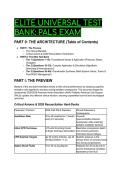
ELITE UNIVERSAL TEST
BANK: PALS EXAM
PART 0: THE ARCHITECTURE (Table of Contents)
● PART I: The Preview
○ The Clinical Mandate
○ Critical Axioms & 2026 Resuscitation Hard-Decks
● PART II: The Elite Test Bank
○ Tier 1 (Questions 1–15): Foundational Syntax & Application (Protocols, Ratios,
Dosages)
○ Tier 2 (Questions 16–35): Complex Application & Simulation (Algorithmic
Branching & Hemodynamics)
○ Tier 3 (Questions 36–60): Grandmaster Synthesis (Multi-System Failure, Toxins &
Post-ROSC Management)
PART I: THE PREVIEW
Mastery of this test bank translates directly to elite clinical performance by replacing cognitive
hesitation with algorithmic precision during pediatric emergencies. This document forges the
fundamental 2025/2026 American Heart Association (AHA) Pediatric Advanced Life Support
(PALS) updates into reflexive clinical intuition, ensuring unparalleled survival and neurological
outcomes.
Critical Axioms & 2026 Resuscitation Hard-Decks
Parameter / Protocol 2026 AHA PALS Standard Clinical Rationale &
Consequence
Ventilation Rate 20 to 30 breaths/min (1 breath Prevents
every 2-3 seconds) hyperventilation-induced
hypotension while matching
pediatric metabolic demand.
Infant CPR Technique 2-Thumb Encircling Hands Maximizes compression depth
(2-finger technique eliminated) and coronary perfusion;
minimizes rescuer fatigue.
CPR Diastolic Targets \ge 25 mmHg (Infants), \ge 30 Diastolic pressure is the
mmHg (Children >1 yr) primary driver of coronary blood
flow during compressions.
Septic Shock Fluids 10 to 20 mL/kg aliquots Replaces the 30 mL/kg rule to
prevent mechanical ventilation
dependency from fluid
,Parameter / Protocol 2026 AHA PALS Standard Clinical Rationale &
Consequence
overload.
Epinephrine Timing IMMEDIATELY for Early vasoconstriction in
Non-Shockable (PEA/Asystole) non-shockable rhythms is the
primary determinant of ROSC.
Post-ROSC BP Target Systolic & Mean Arterial Ischemic post-arrest brains lose
Pressure >10th Percentile autoregulation; aggressive BP
support prevents secondary
anoxic injury.
PART II: THE ELITE TEST BANK
TIER 1: FOUNDATIONAL SYNTAX & APPLICATION
Q1: A 6-month-old infant presents unresponsive, apneic, and pulseless. Two healthcare
providers are initiating basic life support. Based on the principles of the 2025/2026 AHA PALS
framework, which chest compression technique is the MOST ACCURATE? A) The 2-finger
technique positioned just below the nipple line. B) The heel of one hand positioned on the lower
half of the sternum. C) The 2 thumb-encircling hands technique. D) The abdominal thrust
maneuver synchronized with ventilations.
● The Answer: C (The 2 thumb-encircling hands technique.)
● Distractor Analysis:
○ A is incorrect: The 2026 updates explicitly eliminated the 2-finger technique for
infants due to its inherent failure to achieve adequate, consistent compression
depth.
○ B is incorrect: While the 1-hand technique is acceptable for infants under the new
guidelines, the 2 thumb-encircling hands technique remains the optimal method
when two rescuers are present.
○ D is incorrect: Abdominal thrusts are an airway clearance maneuver for children,
entirely contraindicated during cardiac arrest.
The Mentor's Analysis: Elite resuscitation relies on mechanical perfection. The elimination of
the 2-finger technique underscores a shift toward prioritizing rigid depth and complete chest
recoil. By utilizing the 2 thumb-encircling hands technique, you bypass the common trap of
provider fatigue and inadequate depth. Professional/Academic Intuition: Maximal
myocardial perfusion in infant arrest demands the 2-thumb encircling technique; never
compromise depth for speed.
Q2: An 8-year-old child is in cardiac arrest. An endotracheal tube (ETT) has been successfully
placed and confirmed. Based on the 2026 PALS Advanced Airway protocols, what is the MOST
APPROPRIATE ventilation rate during continuous chest compressions? A) 1 breath every 6
seconds (10 breaths per minute). B) 1 breath every 2 to 3 seconds (20 to 30 breaths per
minute). C) 2 breaths after every 15 compressions. D) 2 breaths after every 30 compressions.
● The Answer: B (1 breath every 2 to 3 seconds (20 to 30 breaths per minute).)
● Distractor Analysis:
○ A is incorrect: This is the outdated 2015 standard and current adult ACLS standard.
Applying it to pediatrics results in critical hypoventilation.
○ C is incorrect: This is the ratio for 2-rescuer CPR without an advanced airway.
○ D is incorrect: This is the ratio for 1-rescuer CPR without an advanced airway.
, The Mentor's Analysis: Pediatric cardiac arrests are predominantly respiratory in origin. The
2026 guidelines aggressive shift to 20-30 breaths per minute addresses the higher physiologic
metabolic demand of children. By utilizing continuous compressions with asynchronous
ventilations, you bypass the common trap of fatal hypoventilation. Professional/Academic
Intuition: When the tube is secured, compressions are continuous and the bag is
squeezed every 2 to 3 seconds.
Q3: You are managing a 9-month-old infant with severe foreign-body airway obstruction
(FBAO). The infant is conscious but exhibits a silent cough, severe stridor, and cyanosis. What
is the FIRST interventional sequence? A) 5 back blows alternating with 5 abdominal thrusts. B)
Immediate direct laryngoscopy and Magill forceps extraction. C) 5 back blows alternating with 5
chest thrusts. D) Blind finger sweep followed by continuous CPR.
● The Answer: C (5 back blows alternating with 5 chest thrusts.)
● Distractor Analysis:
○ A is incorrect: Abdominal thrusts cause devastating hepatic and splenic ruptures in
infants due to unprotected abdominal organs.
○ B is incorrect: Definitive airway maneuvers require equipment prep; basic
mechanical clearance must be initiated immediately.
○ D is incorrect: Blind finger sweeps are universally contraindicated as they push the
obstruction deeper.
The Mentor's Analysis: The anatomical fragility of an infant dictates strict deviation from the
standard older child Heimlich maneuver. By utilizing chest thrusts, you bypass the common trap
of causing catastrophic intra-abdominal hemorrhage. Professional/Academic Intuition: If they
are under one year of age, their abdomen is a no-touch zone for FBAO clearance.
Q4: A 6-year-old child goes into cardiac arrest. The monitor displays Ventricular Fibrillation (VF).
CPR is in progress. According to the 2026 PALS algorithms, when is the MOST APPROPRIATE
time to administer the first dose of Epinephrine? A) Immediately upon recognition of the rhythm.
B) During the first 2 minutes of CPR, prior to the first defibrillation. C) After the second
defibrillation attempt has failed. D) Epinephrine is contraindicated in shockable rhythms.
● The Answer: C (After the second defibrillation attempt has failed.)
● Distractor Analysis:
○ A is incorrect: Administering epinephrine immediately in a shockable rhythm
increases myocardial oxygen demand and reduces initial shock efficacy.
○ B is incorrect: The absolute priority is early defibrillation. Pushing a vasopressor
before electricity is a sequencing error.
○ D is incorrect: Epinephrine is required, but reserved until the rhythm is deemed
refractory.
The Mentor's Analysis: In shockable rhythms, adding an inotrope/chronotrope prematurely
starves the myocardium of oxygen. By utilizing delayed epinephrine administration post-second
shock, you bypass the common trap of chemical sabotage prior to defibrillation.
Professional/Academic Intuition: Shockable rhythms demand electricity first; save the
chemistry for refractory states.
Q5: An 18-month-old child presents in pulseless electrical activity (PEA). High-quality CPR is
ongoing. Based on the 2026 guidelines, what is the IMMEDIATE pharmacological priority? A)
Administer Amiodarone 5 mg/kg IV. B) Administer Epinephrine 0.01 mg/kg IV/IO as early as
possible. C) Administer Atropine 0.02 mg/kg IV. D) Withhold medications until a reversible cause
is identified.
● The Answer: B (Administer Epinephrine 0.01 mg/kg IV/IO as early as possible.)
● Distractor Analysis:
BANK: PALS EXAM
PART 0: THE ARCHITECTURE (Table of Contents)
● PART I: The Preview
○ The Clinical Mandate
○ Critical Axioms & 2026 Resuscitation Hard-Decks
● PART II: The Elite Test Bank
○ Tier 1 (Questions 1–15): Foundational Syntax & Application (Protocols, Ratios,
Dosages)
○ Tier 2 (Questions 16–35): Complex Application & Simulation (Algorithmic
Branching & Hemodynamics)
○ Tier 3 (Questions 36–60): Grandmaster Synthesis (Multi-System Failure, Toxins &
Post-ROSC Management)
PART I: THE PREVIEW
Mastery of this test bank translates directly to elite clinical performance by replacing cognitive
hesitation with algorithmic precision during pediatric emergencies. This document forges the
fundamental 2025/2026 American Heart Association (AHA) Pediatric Advanced Life Support
(PALS) updates into reflexive clinical intuition, ensuring unparalleled survival and neurological
outcomes.
Critical Axioms & 2026 Resuscitation Hard-Decks
Parameter / Protocol 2026 AHA PALS Standard Clinical Rationale &
Consequence
Ventilation Rate 20 to 30 breaths/min (1 breath Prevents
every 2-3 seconds) hyperventilation-induced
hypotension while matching
pediatric metabolic demand.
Infant CPR Technique 2-Thumb Encircling Hands Maximizes compression depth
(2-finger technique eliminated) and coronary perfusion;
minimizes rescuer fatigue.
CPR Diastolic Targets \ge 25 mmHg (Infants), \ge 30 Diastolic pressure is the
mmHg (Children >1 yr) primary driver of coronary blood
flow during compressions.
Septic Shock Fluids 10 to 20 mL/kg aliquots Replaces the 30 mL/kg rule to
prevent mechanical ventilation
dependency from fluid
,Parameter / Protocol 2026 AHA PALS Standard Clinical Rationale &
Consequence
overload.
Epinephrine Timing IMMEDIATELY for Early vasoconstriction in
Non-Shockable (PEA/Asystole) non-shockable rhythms is the
primary determinant of ROSC.
Post-ROSC BP Target Systolic & Mean Arterial Ischemic post-arrest brains lose
Pressure >10th Percentile autoregulation; aggressive BP
support prevents secondary
anoxic injury.
PART II: THE ELITE TEST BANK
TIER 1: FOUNDATIONAL SYNTAX & APPLICATION
Q1: A 6-month-old infant presents unresponsive, apneic, and pulseless. Two healthcare
providers are initiating basic life support. Based on the principles of the 2025/2026 AHA PALS
framework, which chest compression technique is the MOST ACCURATE? A) The 2-finger
technique positioned just below the nipple line. B) The heel of one hand positioned on the lower
half of the sternum. C) The 2 thumb-encircling hands technique. D) The abdominal thrust
maneuver synchronized with ventilations.
● The Answer: C (The 2 thumb-encircling hands technique.)
● Distractor Analysis:
○ A is incorrect: The 2026 updates explicitly eliminated the 2-finger technique for
infants due to its inherent failure to achieve adequate, consistent compression
depth.
○ B is incorrect: While the 1-hand technique is acceptable for infants under the new
guidelines, the 2 thumb-encircling hands technique remains the optimal method
when two rescuers are present.
○ D is incorrect: Abdominal thrusts are an airway clearance maneuver for children,
entirely contraindicated during cardiac arrest.
The Mentor's Analysis: Elite resuscitation relies on mechanical perfection. The elimination of
the 2-finger technique underscores a shift toward prioritizing rigid depth and complete chest
recoil. By utilizing the 2 thumb-encircling hands technique, you bypass the common trap of
provider fatigue and inadequate depth. Professional/Academic Intuition: Maximal
myocardial perfusion in infant arrest demands the 2-thumb encircling technique; never
compromise depth for speed.
Q2: An 8-year-old child is in cardiac arrest. An endotracheal tube (ETT) has been successfully
placed and confirmed. Based on the 2026 PALS Advanced Airway protocols, what is the MOST
APPROPRIATE ventilation rate during continuous chest compressions? A) 1 breath every 6
seconds (10 breaths per minute). B) 1 breath every 2 to 3 seconds (20 to 30 breaths per
minute). C) 2 breaths after every 15 compressions. D) 2 breaths after every 30 compressions.
● The Answer: B (1 breath every 2 to 3 seconds (20 to 30 breaths per minute).)
● Distractor Analysis:
○ A is incorrect: This is the outdated 2015 standard and current adult ACLS standard.
Applying it to pediatrics results in critical hypoventilation.
○ C is incorrect: This is the ratio for 2-rescuer CPR without an advanced airway.
○ D is incorrect: This is the ratio for 1-rescuer CPR without an advanced airway.
, The Mentor's Analysis: Pediatric cardiac arrests are predominantly respiratory in origin. The
2026 guidelines aggressive shift to 20-30 breaths per minute addresses the higher physiologic
metabolic demand of children. By utilizing continuous compressions with asynchronous
ventilations, you bypass the common trap of fatal hypoventilation. Professional/Academic
Intuition: When the tube is secured, compressions are continuous and the bag is
squeezed every 2 to 3 seconds.
Q3: You are managing a 9-month-old infant with severe foreign-body airway obstruction
(FBAO). The infant is conscious but exhibits a silent cough, severe stridor, and cyanosis. What
is the FIRST interventional sequence? A) 5 back blows alternating with 5 abdominal thrusts. B)
Immediate direct laryngoscopy and Magill forceps extraction. C) 5 back blows alternating with 5
chest thrusts. D) Blind finger sweep followed by continuous CPR.
● The Answer: C (5 back blows alternating with 5 chest thrusts.)
● Distractor Analysis:
○ A is incorrect: Abdominal thrusts cause devastating hepatic and splenic ruptures in
infants due to unprotected abdominal organs.
○ B is incorrect: Definitive airway maneuvers require equipment prep; basic
mechanical clearance must be initiated immediately.
○ D is incorrect: Blind finger sweeps are universally contraindicated as they push the
obstruction deeper.
The Mentor's Analysis: The anatomical fragility of an infant dictates strict deviation from the
standard older child Heimlich maneuver. By utilizing chest thrusts, you bypass the common trap
of causing catastrophic intra-abdominal hemorrhage. Professional/Academic Intuition: If they
are under one year of age, their abdomen is a no-touch zone for FBAO clearance.
Q4: A 6-year-old child goes into cardiac arrest. The monitor displays Ventricular Fibrillation (VF).
CPR is in progress. According to the 2026 PALS algorithms, when is the MOST APPROPRIATE
time to administer the first dose of Epinephrine? A) Immediately upon recognition of the rhythm.
B) During the first 2 minutes of CPR, prior to the first defibrillation. C) After the second
defibrillation attempt has failed. D) Epinephrine is contraindicated in shockable rhythms.
● The Answer: C (After the second defibrillation attempt has failed.)
● Distractor Analysis:
○ A is incorrect: Administering epinephrine immediately in a shockable rhythm
increases myocardial oxygen demand and reduces initial shock efficacy.
○ B is incorrect: The absolute priority is early defibrillation. Pushing a vasopressor
before electricity is a sequencing error.
○ D is incorrect: Epinephrine is required, but reserved until the rhythm is deemed
refractory.
The Mentor's Analysis: In shockable rhythms, adding an inotrope/chronotrope prematurely
starves the myocardium of oxygen. By utilizing delayed epinephrine administration post-second
shock, you bypass the common trap of chemical sabotage prior to defibrillation.
Professional/Academic Intuition: Shockable rhythms demand electricity first; save the
chemistry for refractory states.
Q5: An 18-month-old child presents in pulseless electrical activity (PEA). High-quality CPR is
ongoing. Based on the 2026 guidelines, what is the IMMEDIATE pharmacological priority? A)
Administer Amiodarone 5 mg/kg IV. B) Administer Epinephrine 0.01 mg/kg IV/IO as early as
possible. C) Administer Atropine 0.02 mg/kg IV. D) Withhold medications until a reversible cause
is identified.
● The Answer: B (Administer Epinephrine 0.01 mg/kg IV/IO as early as possible.)
● Distractor Analysis:

