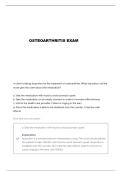
A client is taking ibuprofen for the treatment of osteoarthritis. What education will the
nurse give the client about the medication?
a. Take the medication with food to avoid stomach upset.
b. Take the medication on an empty stomach in order to increase effectiveness.
c. Inform the health care provider if there is ringing in the ears.
d. Since the medication is able to be obtained over the counter, it has few side
effects.
Give this one a try later!
a. Take the medication with food to avoid stomach upset.
Explanation:
Ibuprofen is a nonsteroidal anti-inflammatory drug. The nurse should advise
the patient to take NSAIDs with food to avoid stomach upset. Ibuprofen is
available over the counter, but it still has side effects. Aspirin is known to
cause ringing in the ears, not NSAIDs.
,A 47-year-old client with osteoarthritis and hypertension is diagnosed with breast
cancer. The client tells the nurse that her mother also suffered from osteoarthritis and
hypertension, and she developed breast cancer at the age of 51 years. The nurse
should recognize that this client's health status may be the result of what
phenomenon?
a. Autosomal recessive inheritance
b. X-linked inheritance
c. Multifactorial inheritance
d. Autosomal dominant inheritance
Give this one a try later!
c. Multifactorial inheritance
Explanation:
Many birth defects and common health conditions, such as heart disease,
high blood pressure, cancer, osteoarthritis, and diabetes, occur as a result
of interactions of multiple gene mutations and environmental influences.
Thus, they are called multifactorial or complex conditions. Multifactorial
conditions are partly caused by genes and run along family lines and in
people of the same sex. The other answers are incorrect because X-linked
conditions, autosomal recessive conditions, and autosomal dominant
conditions are not caused by the interactions of multiple gene mutations
and environmental influences.
A clinic nurse assesses a client with diabetes who reports taking naproxen (Aleve) and
the herb bilberry for osteoarthritis. To assess for an adverse reaction between
naproxen and bilberry, the nurse asks the client
a. "Have you been constipated?"
b. "Do you bleed easily?"
c. "Has your blood sugar been elevated more than usual?"
d. "Have you noticed an increase in your pain levels?"
, Give this one a try later!
b. "Do you bleed easily?"
Explanation:
Naproxen, a nonsteroidal anti-inflammatory drug, with the herb bilberry
may enhance a client's risk for bleeding. Diarrhea, constipation, or both are
frequent adverse reactions to naproxen but not bilberry. Bilberry may
cause hypoglycemia. Naproxen does not. There should not be an
increased level of pain as a result of the interaction of naproxen and
bilberry.
The nurse provides teaching to a client with osteoarthritis (OA). Which statement(s)
indicate that teaching about pain management and functional ability were effective?
Select all that apply.
a. "I will increase the amount of walking I do every day."
b. "I will spend more time resting."
c. "I will take the pain medication after exercising."
d. "I will need to lose some weight."
e. "I will avoid using a cane to walk."
Give this one a try later!
a. “I will increase the amount of walking I do every day.”
d. “I will need to lose some weight.”
Explanation:
Pain management and optimal functional ability are the major goals of
nursing interventions. With those goals in mind, nursing management of the
client with OA includes pharmacologic and nonpharmacologic approaches
as well as education. Weight loss is an important approach to lessen pain
and disability caused by OA. Exercises such as walking should be begin in
moderation and gradually increase. A sedentary lifestyle contributes to the
development of OA so resting would not be encouraged. Canes or other
assistive devices for ambulation should be considered, and any stigma
about the use of these devices should be explored. Clients should plan
nurse give the client about the medication?
a. Take the medication with food to avoid stomach upset.
b. Take the medication on an empty stomach in order to increase effectiveness.
c. Inform the health care provider if there is ringing in the ears.
d. Since the medication is able to be obtained over the counter, it has few side
effects.
Give this one a try later!
a. Take the medication with food to avoid stomach upset.
Explanation:
Ibuprofen is a nonsteroidal anti-inflammatory drug. The nurse should advise
the patient to take NSAIDs with food to avoid stomach upset. Ibuprofen is
available over the counter, but it still has side effects. Aspirin is known to
cause ringing in the ears, not NSAIDs.
,A 47-year-old client with osteoarthritis and hypertension is diagnosed with breast
cancer. The client tells the nurse that her mother also suffered from osteoarthritis and
hypertension, and she developed breast cancer at the age of 51 years. The nurse
should recognize that this client's health status may be the result of what
phenomenon?
a. Autosomal recessive inheritance
b. X-linked inheritance
c. Multifactorial inheritance
d. Autosomal dominant inheritance
Give this one a try later!
c. Multifactorial inheritance
Explanation:
Many birth defects and common health conditions, such as heart disease,
high blood pressure, cancer, osteoarthritis, and diabetes, occur as a result
of interactions of multiple gene mutations and environmental influences.
Thus, they are called multifactorial or complex conditions. Multifactorial
conditions are partly caused by genes and run along family lines and in
people of the same sex. The other answers are incorrect because X-linked
conditions, autosomal recessive conditions, and autosomal dominant
conditions are not caused by the interactions of multiple gene mutations
and environmental influences.
A clinic nurse assesses a client with diabetes who reports taking naproxen (Aleve) and
the herb bilberry for osteoarthritis. To assess for an adverse reaction between
naproxen and bilberry, the nurse asks the client
a. "Have you been constipated?"
b. "Do you bleed easily?"
c. "Has your blood sugar been elevated more than usual?"
d. "Have you noticed an increase in your pain levels?"
, Give this one a try later!
b. "Do you bleed easily?"
Explanation:
Naproxen, a nonsteroidal anti-inflammatory drug, with the herb bilberry
may enhance a client's risk for bleeding. Diarrhea, constipation, or both are
frequent adverse reactions to naproxen but not bilberry. Bilberry may
cause hypoglycemia. Naproxen does not. There should not be an
increased level of pain as a result of the interaction of naproxen and
bilberry.
The nurse provides teaching to a client with osteoarthritis (OA). Which statement(s)
indicate that teaching about pain management and functional ability were effective?
Select all that apply.
a. "I will increase the amount of walking I do every day."
b. "I will spend more time resting."
c. "I will take the pain medication after exercising."
d. "I will need to lose some weight."
e. "I will avoid using a cane to walk."
Give this one a try later!
a. “I will increase the amount of walking I do every day.”
d. “I will need to lose some weight.”
Explanation:
Pain management and optimal functional ability are the major goals of
nursing interventions. With those goals in mind, nursing management of the
client with OA includes pharmacologic and nonpharmacologic approaches
as well as education. Weight loss is an important approach to lessen pain
and disability caused by OA. Exercises such as walking should be begin in
moderation and gradually increase. A sedentary lifestyle contributes to the
development of OA so resting would not be encouraged. Canes or other
assistive devices for ambulation should be considered, and any stigma
about the use of these devices should be explored. Clients should plan