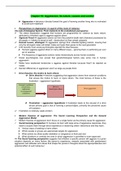
Chapter 10: Aggression, its nature, causes and control
Aggression = behaviour directed toward the goal of harming another living who is motivated
to avoid such treatment
Perspectives on Aggression: In search of the roots of violence:
The role of biological factors: From instincts to the evolutionary perspective
The oldest explanation suggests that humans are programmes for violence by basic nature,
attributed to inherited urges to aggress against others
Sigmund Freud => aggression stems out from the powerful death wish (thanatos) possessed by
all people => Initially its aimed at self – destruction but then aimed outwards
Konrad Lorenz, ethologist => aggression springs from inherited fighting instinct, insuring that
only the strongest males will obtain mates and pass their genes to the next generation
Until recently most social psychologists rejected the idea because:
Humans aggress against others in many different ways – ignoring them or performing an over
act of violence
The frequency of aggressive actions varies tremendously across human societies
Social psychologists now accept that genetic/biological factors play some role in human
aggression
Males have weakened tendencies o aggress against females because they’ll be rejected as
mates
Gender differences in aggression aren’t as large as people think
Drive theories: the motive to harm others:
Drive theories = theories suggesting that aggression stems from external conditions
that arouse the motive to harm or injure others. The most famous of these is the
frustration – aggression hypothesis
External conditions
(frustration, Drive to
unpleasant harm/injure others Overt aggression
environmental
conditions
Frustration – aggression hypothesis = frustration leads to the arousal of a drive
whose primary goal is that of harming a person/object, primarily the perceived cause
of frustration
Frustration is relatively weak emotion
Modern theories of aggression: The Social Learning Perspective and the General
Aggression Model
Modern theories of aggression don’t focus on a single factor as the primary cause for aggression
Social learning perspective => humans not born with large array of aggressive responses, they
need to acquire them through direct experience or observing others’ behaviours and they learn:
1. Various ways of seeking to harm others
2. Which people or groups are appropriate targets for aggression
3. What actions by others justify retaliation or vengeance on their part and
4. What situations or contexts are ones in which aggression is permitted or even approved
=> The Social learning perspective suggests that whether a specific person will aggress in a given
situation depends on many factors like person’s experience, rewards associated with past/present
aggression and attitudes and values that shape this person’s thoughts about the appropriateness and
potential effect of such behaviour
Aggression = behaviour directed toward the goal of harming another living who is motivated
to avoid such treatment
Perspectives on Aggression: In search of the roots of violence:
The role of biological factors: From instincts to the evolutionary perspective
The oldest explanation suggests that humans are programmes for violence by basic nature,
attributed to inherited urges to aggress against others
Sigmund Freud => aggression stems out from the powerful death wish (thanatos) possessed by
all people => Initially its aimed at self – destruction but then aimed outwards
Konrad Lorenz, ethologist => aggression springs from inherited fighting instinct, insuring that
only the strongest males will obtain mates and pass their genes to the next generation
Until recently most social psychologists rejected the idea because:
Humans aggress against others in many different ways – ignoring them or performing an over
act of violence
The frequency of aggressive actions varies tremendously across human societies
Social psychologists now accept that genetic/biological factors play some role in human
aggression
Males have weakened tendencies o aggress against females because they’ll be rejected as
mates
Gender differences in aggression aren’t as large as people think
Drive theories: the motive to harm others:
Drive theories = theories suggesting that aggression stems from external conditions
that arouse the motive to harm or injure others. The most famous of these is the
frustration – aggression hypothesis
External conditions
(frustration, Drive to
unpleasant harm/injure others Overt aggression
environmental
conditions
Frustration – aggression hypothesis = frustration leads to the arousal of a drive
whose primary goal is that of harming a person/object, primarily the perceived cause
of frustration
Frustration is relatively weak emotion
Modern theories of aggression: The Social Learning Perspective and the General
Aggression Model
Modern theories of aggression don’t focus on a single factor as the primary cause for aggression
Social learning perspective => humans not born with large array of aggressive responses, they
need to acquire them through direct experience or observing others’ behaviours and they learn:
1. Various ways of seeking to harm others
2. Which people or groups are appropriate targets for aggression
3. What actions by others justify retaliation or vengeance on their part and
4. What situations or contexts are ones in which aggression is permitted or even approved
=> The Social learning perspective suggests that whether a specific person will aggress in a given
situation depends on many factors like person’s experience, rewards associated with past/present
aggression and attitudes and values that shape this person’s thoughts about the appropriateness and
potential effect of such behaviour