Microbial metabolism summary
L2 Bioenergetics
Metabolism = catabolism + anabolism
Anabolism = biosynthesis = make cell components with nutrients -> consumes energy
Catabolism = make energy carriers (ATP, NADH) (and waste) with energy sources
Energy source = chemical reaction, but which one
Electron donor = gets oxidised -> take away electron
Electron acceptor = gets reduced -> add electron
Thermodynamics: energy can’t be created or destroyed, only transformed
Exergonic = releases energy = dG < 0, make atp
Endergonic = uses energy = dG > 0, uses atp
Coupling of ender- and exogonic reactions
dG does not provide infromation on reaction rates!
Redox
Cations (+) are good electron acceptors, anions (-) are good electron donors
E0 = redox potential = tendency to donate/accept
E0 > 0 = electron acceptor, E0 < 0 = electron donor
E0 further away from 0 -> bigger potential
Difference between E0 of donor and acceptor = dG
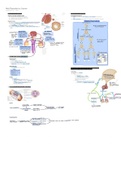
Redox tower: ->
• High up: best donors
• Low: best acceptors
Reaction rate: dG + kinetics
Kinetics = velocity of catalysis
Reaction is sped up with catalysts (= enzyme)
• Not consumed in the reaction
• Lowers activation energy -> increases reaction rate
• Does not effect dG/equilibrium
,6 enzyme classes:
• Oxidoreductases = redox reactions
• Transferases = transfer of molecules
• Hydrolases = cleavage through hydrolysis
• Lyases = cleavage or build of bond without redox/hydrolysis
• Isomerases = isomerisation
• Ligases = bonding of molecules through ATP hydrolysis
Enzymes use cofactors: prosthetic groups or coenzymes
L3 chemoorganotrophy
Chemoorganotrophs = organisms that use organic molecules as energy source for catabolism
Can be aerobic: glycolysis -> citric acid cycle -> respiration
or anaerobic: glycolysis -> fermentation/anaerobic respiration
Glycolysis (anaerobe):
1. Preparation & production of gly-3p
2. Redox reactions -> NADH, ATP, pyruvate
3. Redox balance -> regenerate NAD, ADP (= respiration/fermentation)
Stage 1: 1 glucose split 2 gly-3p; uses 2 ATP
Stage 2: gly-3p oxidised to pyruvate; forms 4 ATP + 2 NADH
Formation of ATP: substrate level phosphorylation = uses free energy of oxidation reaction to
couple with ADP + P -> ATP + H2O
Electron carrier = transfers electrons; when recycled = reducing equivalents
NAD = electron acceptor
NADH = electron donor, E0 = -320 mV
NAD + e- -> NADH
Fermentation = anaerobic regeneration of NAD from NADH; stage 3 glycolysis
Named after end product: lactic acid fermentation forms lactate
Homofermentative lactic acid fermentation = produces only lactate
Heterofermentative lactic acid fermentation = produces lactate + ethanol + CO2
Entner-doudoroff (ED) pathway = missing aldolase -> no glycolysis -> glucose is oxidised and
decarboxylated first -> less ATP yield
Alcohol fermentation = produces only ethanol
+ other fermentation pathways
, L4 aerobic respiration
= aerobic stage 3 of glycolysis in chemoorganotrophs; yields ATP
= reoxidation of NADH with terminal electron acceptor (ex. O2 -> aerobic)
Uses proton motor force (PMF) for electron transport phosphorylation = chemiosmosis
PMF = oxidation of NADH is coupled to membrane and stores energy as H+ gradient
-> ATP with ATPsyntase = oxidative phosphorylation
1. Electron transport chain oxidises NADH -> reduces O2
2. H+ is pumped out of cell
3. ATP synthase uses PMF to generate ATP
Respiration builds up membrane potential with H+ = dP: electrical component + pH component
ATPsynthase: F0 = rotor; F1 = stable -> F0 rotates in F1 -> energy
Uses H+; ADP + P -> ATP
Electron transport chain:
• Complex I = NADH dehydrogenase + flavoproteins
• Complex II = succinate dehydrogenase + Q-cycling + flavoproteins
• Complex III = cytochrome bc complex
• Complex IV = cytochrome aa oxidase
• (Complex V = ATPsynthase)
Co-factors:
Flavoproteins = FAD/FADH & FMN/FMNH, can take up 2 e-
Q-cycling = have 2 groups that can take up e-, but only one at a time. Quinones + 2 e- -> quinols
Iron-sulphur proteins -> high redox potential
Cytochromes = protein that contain hemegroups: redox active iron
L2 Bioenergetics
Metabolism = catabolism + anabolism
Anabolism = biosynthesis = make cell components with nutrients -> consumes energy
Catabolism = make energy carriers (ATP, NADH) (and waste) with energy sources
Energy source = chemical reaction, but which one
Electron donor = gets oxidised -> take away electron
Electron acceptor = gets reduced -> add electron
Thermodynamics: energy can’t be created or destroyed, only transformed
Exergonic = releases energy = dG < 0, make atp
Endergonic = uses energy = dG > 0, uses atp
Coupling of ender- and exogonic reactions
dG does not provide infromation on reaction rates!
Redox
Cations (+) are good electron acceptors, anions (-) are good electron donors
E0 = redox potential = tendency to donate/accept
E0 > 0 = electron acceptor, E0 < 0 = electron donor
E0 further away from 0 -> bigger potential
Difference between E0 of donor and acceptor = dG
Redox tower: ->
• High up: best donors
• Low: best acceptors
Reaction rate: dG + kinetics
Kinetics = velocity of catalysis
Reaction is sped up with catalysts (= enzyme)
• Not consumed in the reaction
• Lowers activation energy -> increases reaction rate
• Does not effect dG/equilibrium
,6 enzyme classes:
• Oxidoreductases = redox reactions
• Transferases = transfer of molecules
• Hydrolases = cleavage through hydrolysis
• Lyases = cleavage or build of bond without redox/hydrolysis
• Isomerases = isomerisation
• Ligases = bonding of molecules through ATP hydrolysis
Enzymes use cofactors: prosthetic groups or coenzymes
L3 chemoorganotrophy
Chemoorganotrophs = organisms that use organic molecules as energy source for catabolism
Can be aerobic: glycolysis -> citric acid cycle -> respiration
or anaerobic: glycolysis -> fermentation/anaerobic respiration
Glycolysis (anaerobe):
1. Preparation & production of gly-3p
2. Redox reactions -> NADH, ATP, pyruvate
3. Redox balance -> regenerate NAD, ADP (= respiration/fermentation)
Stage 1: 1 glucose split 2 gly-3p; uses 2 ATP
Stage 2: gly-3p oxidised to pyruvate; forms 4 ATP + 2 NADH
Formation of ATP: substrate level phosphorylation = uses free energy of oxidation reaction to
couple with ADP + P -> ATP + H2O
Electron carrier = transfers electrons; when recycled = reducing equivalents
NAD = electron acceptor
NADH = electron donor, E0 = -320 mV
NAD + e- -> NADH
Fermentation = anaerobic regeneration of NAD from NADH; stage 3 glycolysis
Named after end product: lactic acid fermentation forms lactate
Homofermentative lactic acid fermentation = produces only lactate
Heterofermentative lactic acid fermentation = produces lactate + ethanol + CO2
Entner-doudoroff (ED) pathway = missing aldolase -> no glycolysis -> glucose is oxidised and
decarboxylated first -> less ATP yield
Alcohol fermentation = produces only ethanol
+ other fermentation pathways
, L4 aerobic respiration
= aerobic stage 3 of glycolysis in chemoorganotrophs; yields ATP
= reoxidation of NADH with terminal electron acceptor (ex. O2 -> aerobic)
Uses proton motor force (PMF) for electron transport phosphorylation = chemiosmosis
PMF = oxidation of NADH is coupled to membrane and stores energy as H+ gradient
-> ATP with ATPsyntase = oxidative phosphorylation
1. Electron transport chain oxidises NADH -> reduces O2
2. H+ is pumped out of cell
3. ATP synthase uses PMF to generate ATP
Respiration builds up membrane potential with H+ = dP: electrical component + pH component
ATPsynthase: F0 = rotor; F1 = stable -> F0 rotates in F1 -> energy
Uses H+; ADP + P -> ATP
Electron transport chain:
• Complex I = NADH dehydrogenase + flavoproteins
• Complex II = succinate dehydrogenase + Q-cycling + flavoproteins
• Complex III = cytochrome bc complex
• Complex IV = cytochrome aa oxidase
• (Complex V = ATPsynthase)
Co-factors:
Flavoproteins = FAD/FADH & FMN/FMNH, can take up 2 e-
Q-cycling = have 2 groups that can take up e-, but only one at a time. Quinones + 2 e- -> quinols
Iron-sulphur proteins -> high redox potential
Cytochromes = protein that contain hemegroups: redox active iron