

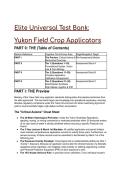
Elite Universal Test Bank:
Yukon Field Crop Applicators
PART 0: THE (Table of Contents)
Section Reference Cognitive Tier & Focus Area Page/Navigation Target
PART I The Preview: Critical Axioms & Pre-Assessment Module
Mentorship Directives
PART II Tier 1 (Questions 1–10): Assessment Block A
Foundational Syntax, Yukon
Law & Core Biology
PART II Tier 2 (Questions 11–20): Assessment Block B
Complex Application,
Calibration & Equipment
PART II Tier 3 (Questions 21–30): Assessment Block C
Grandmaster Synthesis,
High-Stakes Logistics & IPM
PART I: THE Preview
Mastery of the Yukon field crop applicator standards distinguishes the baseline technician from
the elite agronomist. This test bank forges raw knowledge into operational supremacy, ensuring
absolute regulatory compliance under the Yukon Environment Act while maximizing agronomic
yield in environmentally fragile, high-stakes northern ecosystems.
The "Critical Axioms" Cheat Sheet
● The 30-Metre Hydrological Perimeter: Under the Yukon Pesticides Regulations,
applying, storing, or mixing commercial or restricted pesticides within 30 horizontal metres
of an open body of water is strictly prohibited without securing a specific Pesticide Use
Permit.
● The 3-Year Lexicon & March 1st Mandate: All certified applicators and permit holders
must maintain comprehensive application records for exactly three years. Furthermore, an
annual summary of these records must be submitted to the Minister by March 1st of the
following year.
● The Exposure-Toxicity Paradigm: Toxicological risk is mathematically defined as Risk =
Toxicity × Exposure. Because an applicator cannot alter the inherent toxicity of a federally
registered active ingredient, risk mitigation relies entirely on utilizing engineering controls
and Personal Protective Equipment (PPE) to drive exposure to zero.
● The 10% Nozzle Variance Rule: In precision boom calibration, if any individual nozzle's
, output deviates by more than 10% from the boom's calculated average output, the nozzle
is irreparably deformed and must be replaced immediately to prevent striping and
phytotoxicity.
● Jurisdictional Layering: The federal Pest Control Products Act (PCPA) registers
chemicals and dictates broad classification (Domestic, Commercial, Restricted). However,
territorial Yukon law dictates the specific permits required for their acquisition, storage,
and environmental deployment.
Federal PCPA Classification End-User Profile Yukon Permitting Reality
Domestic Class General public, residential No permit for private property;
Permit required for tenant
properties or near water.
Commercial Class Agriculture, forestry, industrial Permit required for aircraft,
Schedule 4, or within 30m of
water.
Restricted Class Highly trained commercial Strictest label limitations;
operators Permit required for aquatic or
aerial applications.
PART II: THE ELITE TEST BANK
Tier 1 - Foundational Syntax & Application
Q1: A Yukon field crop applicator is hired to treat a 100-hectare barley field. They intend to
purchase a product classified for broad-acre agricultural operations. Under the federal Pest
Control Products Act, which classification MOST ACCURATELY designates this pesticide? A)
Domestic Class B) Agricultural Class C) Commercial Class D) Special Waste Class
● The Answer: C (Commercial Class)
● Distractor Analysis:
○ A is incorrect: Domestic Class pesticides are strictly formulated for low-toxicity
public use in and around residential homes, lacking the concentration required for
field crops.
○ B is incorrect: "Agricultural Class" is a common novice misnomer. The legal federal
designation encompassing agriculture, forestry, and industry is Commercial.
○ D is incorrect: Special waste relates to the end-of-life disposal and spill containment
of hazardous materials, not the registration classification of an active, usable
pesticide.
The Mentor's Analysis: Federal law categorizes products by end-user intent and hazard profile
to prevent untrained individuals from accessing highly concentrated active ingredients. When
purchasing for a farming operation, the legal category is Commercial Class. By utilizing correct
federal nomenclature, you bypass the common trap of seeking non-existent registration
categories that delay procurement. Professional/Academic Intuition: Classification dictates
access; Commercial Class is the baseline for agricultural production.
Q2: A producer intends to apply a Commercial Class herbicide to a canola crop located 20
metres from a year-round creek. Based on the Yukon Pesticides Regulations, which action is
MANDATORY? A) Proceed normally if using a drift-reducing nozzle. B) Obtain a specific
Pesticide Use Permit prior to application. C) Downgrade the application to a Domestic Class
product. D) Construct a physical berm between the field and the water.
● The Answer: B (Obtain a specific Pesticide Use Permit prior to application.)
, ● Distractor Analysis:
○ A is incorrect: Equipment modifications, such as air-induction nozzles, do not
supersede or negate territorial statutory distance restrictions.
○ C is incorrect: The prompt requires treating a field crop; substituting a domestic
product is off-label, agriculturally unviable, and still requires a permit within 30
metres.
○ D is incorrect: While berms mitigate soil runoff, the law strictly regulates the
30-metre perimeter via administrative permitting, not physical earthworks.
The Mentor's Analysis: The Yukon Environment Act heavily guards its hydrology due to the
slow degradation rates of chemicals in cold northern waters. When operating within the
30-metre buffer, the immediate priority is legal authorization. By utilizing a Pesticide Use Permit,
you bypass the common trap of assuming good field practices negate rigid regulatory
requirements. Professional/Academic Intuition: Water is the ultimate legal boundary;
breach 30 metres only with a permit in hand.
Q3: A certified pesticide applicator in Whitehorse completes their spray season in September.
Under the Yukon Pesticides Regulations, when is the absolute LATEST date they must submit
their annual summary of pesticide use to the Minister? A) December 31st of the application
year. B) Exactly 3 years from the application date. C) March 1st of the following year. D) Prior to
purchasing next season's chemicals.
● The Answer: C (March 1st of the following year.)
● Distractor Analysis:
○ A is incorrect: The calendar year-end is not the statutory deadline recognized by the
territory.
○ B is incorrect: Three years is the mandatory data retention period for physical
records, not the annual summary submission deadline.
○ D is incorrect: Purchasing timelines are dictated by operational supply chains and
vendor permits, independent of territorial reporting laws.
The Mentor's Analysis: Regulatory compliance requires strict adherence to administrative
calendars to allow the government to track aggregate chemical loads. When the season ends,
the immediate priority is data compilation. By utilizing the March 1st deadline, you bypass the
common trap of conflating physical record retention periods with active reporting mandates.
Professional/Academic Intuition: Keep records securely for three years, but summarize
and report them annually by March 1st.
Q4: In integrated pest management (IPM), a grower scouting a wheat field notes a low
population of aphids. The population is causing minor foliar damage but has not yet reached the
density where the cost of chemical control equals the value of the potential yield loss. This
population has NOT breached the: A) Action Threshold B) Economic Injury Level C) Eradication
Threshold D) Biological Control Limit
● The Answer: B (Economic Injury Level)
● Distractor Analysis:
○ A is incorrect: The action threshold is the operational trigger point to take action
before the pest population reaches the economic injury level.
○ C is incorrect: Eradication is a quarantine concept; it is almost never the goal of IPM
in broad-acre field crops.
○ D is incorrect: Biological limits refer to predator/prey carrying capacities in ecology,
not financial crop metrics.
The Mentor's Analysis: IPM relies on applied agricultural economics rather than the mere
presence of insects. When evaluating pest density, the immediate priority is protecting the profit
Yukon Field Crop Applicators
PART 0: THE (Table of Contents)
Section Reference Cognitive Tier & Focus Area Page/Navigation Target
PART I The Preview: Critical Axioms & Pre-Assessment Module
Mentorship Directives
PART II Tier 1 (Questions 1–10): Assessment Block A
Foundational Syntax, Yukon
Law & Core Biology
PART II Tier 2 (Questions 11–20): Assessment Block B
Complex Application,
Calibration & Equipment
PART II Tier 3 (Questions 21–30): Assessment Block C
Grandmaster Synthesis,
High-Stakes Logistics & IPM
PART I: THE Preview
Mastery of the Yukon field crop applicator standards distinguishes the baseline technician from
the elite agronomist. This test bank forges raw knowledge into operational supremacy, ensuring
absolute regulatory compliance under the Yukon Environment Act while maximizing agronomic
yield in environmentally fragile, high-stakes northern ecosystems.
The "Critical Axioms" Cheat Sheet
● The 30-Metre Hydrological Perimeter: Under the Yukon Pesticides Regulations,
applying, storing, or mixing commercial or restricted pesticides within 30 horizontal metres
of an open body of water is strictly prohibited without securing a specific Pesticide Use
Permit.
● The 3-Year Lexicon & March 1st Mandate: All certified applicators and permit holders
must maintain comprehensive application records for exactly three years. Furthermore, an
annual summary of these records must be submitted to the Minister by March 1st of the
following year.
● The Exposure-Toxicity Paradigm: Toxicological risk is mathematically defined as Risk =
Toxicity × Exposure. Because an applicator cannot alter the inherent toxicity of a federally
registered active ingredient, risk mitigation relies entirely on utilizing engineering controls
and Personal Protective Equipment (PPE) to drive exposure to zero.
● The 10% Nozzle Variance Rule: In precision boom calibration, if any individual nozzle's
, output deviates by more than 10% from the boom's calculated average output, the nozzle
is irreparably deformed and must be replaced immediately to prevent striping and
phytotoxicity.
● Jurisdictional Layering: The federal Pest Control Products Act (PCPA) registers
chemicals and dictates broad classification (Domestic, Commercial, Restricted). However,
territorial Yukon law dictates the specific permits required for their acquisition, storage,
and environmental deployment.
Federal PCPA Classification End-User Profile Yukon Permitting Reality
Domestic Class General public, residential No permit for private property;
Permit required for tenant
properties or near water.
Commercial Class Agriculture, forestry, industrial Permit required for aircraft,
Schedule 4, or within 30m of
water.
Restricted Class Highly trained commercial Strictest label limitations;
operators Permit required for aquatic or
aerial applications.
PART II: THE ELITE TEST BANK
Tier 1 - Foundational Syntax & Application
Q1: A Yukon field crop applicator is hired to treat a 100-hectare barley field. They intend to
purchase a product classified for broad-acre agricultural operations. Under the federal Pest
Control Products Act, which classification MOST ACCURATELY designates this pesticide? A)
Domestic Class B) Agricultural Class C) Commercial Class D) Special Waste Class
● The Answer: C (Commercial Class)
● Distractor Analysis:
○ A is incorrect: Domestic Class pesticides are strictly formulated for low-toxicity
public use in and around residential homes, lacking the concentration required for
field crops.
○ B is incorrect: "Agricultural Class" is a common novice misnomer. The legal federal
designation encompassing agriculture, forestry, and industry is Commercial.
○ D is incorrect: Special waste relates to the end-of-life disposal and spill containment
of hazardous materials, not the registration classification of an active, usable
pesticide.
The Mentor's Analysis: Federal law categorizes products by end-user intent and hazard profile
to prevent untrained individuals from accessing highly concentrated active ingredients. When
purchasing for a farming operation, the legal category is Commercial Class. By utilizing correct
federal nomenclature, you bypass the common trap of seeking non-existent registration
categories that delay procurement. Professional/Academic Intuition: Classification dictates
access; Commercial Class is the baseline for agricultural production.
Q2: A producer intends to apply a Commercial Class herbicide to a canola crop located 20
metres from a year-round creek. Based on the Yukon Pesticides Regulations, which action is
MANDATORY? A) Proceed normally if using a drift-reducing nozzle. B) Obtain a specific
Pesticide Use Permit prior to application. C) Downgrade the application to a Domestic Class
product. D) Construct a physical berm between the field and the water.
● The Answer: B (Obtain a specific Pesticide Use Permit prior to application.)
, ● Distractor Analysis:
○ A is incorrect: Equipment modifications, such as air-induction nozzles, do not
supersede or negate territorial statutory distance restrictions.
○ C is incorrect: The prompt requires treating a field crop; substituting a domestic
product is off-label, agriculturally unviable, and still requires a permit within 30
metres.
○ D is incorrect: While berms mitigate soil runoff, the law strictly regulates the
30-metre perimeter via administrative permitting, not physical earthworks.
The Mentor's Analysis: The Yukon Environment Act heavily guards its hydrology due to the
slow degradation rates of chemicals in cold northern waters. When operating within the
30-metre buffer, the immediate priority is legal authorization. By utilizing a Pesticide Use Permit,
you bypass the common trap of assuming good field practices negate rigid regulatory
requirements. Professional/Academic Intuition: Water is the ultimate legal boundary;
breach 30 metres only with a permit in hand.
Q3: A certified pesticide applicator in Whitehorse completes their spray season in September.
Under the Yukon Pesticides Regulations, when is the absolute LATEST date they must submit
their annual summary of pesticide use to the Minister? A) December 31st of the application
year. B) Exactly 3 years from the application date. C) March 1st of the following year. D) Prior to
purchasing next season's chemicals.
● The Answer: C (March 1st of the following year.)
● Distractor Analysis:
○ A is incorrect: The calendar year-end is not the statutory deadline recognized by the
territory.
○ B is incorrect: Three years is the mandatory data retention period for physical
records, not the annual summary submission deadline.
○ D is incorrect: Purchasing timelines are dictated by operational supply chains and
vendor permits, independent of territorial reporting laws.
The Mentor's Analysis: Regulatory compliance requires strict adherence to administrative
calendars to allow the government to track aggregate chemical loads. When the season ends,
the immediate priority is data compilation. By utilizing the March 1st deadline, you bypass the
common trap of conflating physical record retention periods with active reporting mandates.
Professional/Academic Intuition: Keep records securely for three years, but summarize
and report them annually by March 1st.
Q4: In integrated pest management (IPM), a grower scouting a wheat field notes a low
population of aphids. The population is causing minor foliar damage but has not yet reached the
density where the cost of chemical control equals the value of the potential yield loss. This
population has NOT breached the: A) Action Threshold B) Economic Injury Level C) Eradication
Threshold D) Biological Control Limit
● The Answer: B (Economic Injury Level)
● Distractor Analysis:
○ A is incorrect: The action threshold is the operational trigger point to take action
before the pest population reaches the economic injury level.
○ C is incorrect: Eradication is a quarantine concept; it is almost never the goal of IPM
in broad-acre field crops.
○ D is incorrect: Biological limits refer to predator/prey carrying capacities in ecology,
not financial crop metrics.
The Mentor's Analysis: IPM relies on applied agricultural economics rather than the mere
presence of insects. When evaluating pest density, the immediate priority is protecting the profit

