

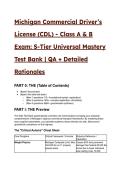
Michigan Commercial Driver’s
License (CDL) - Class A & B
Exam: S-Tier Universal Mastery
Test Bank | QA + Detailed
Rationales
PART 0: THE (Table of Contents)
● (#part-i-the-preview)
● (#part-ii-the-elite-test-bank)
○ (#tier-1-questions-115---foundational-syntax--application)
○ (#tier-2-questions-1635---complex-application--simulation)
○ (#tier-3-questions-3660---grandmaster-synthesis)
PART I: THE Preview
This Elite Test Bank systematically overrides rote memorization by forging your analytical
comprehension of Michigan’s rigorous commercial transport frameworks. By mastering these
exact cognitive parameters, you translate academic theory directly into elite, failure-proof
operational competence on the highway.
The "Critical Axioms" Cheat Sheet
Core Discipline Critical Framework / Formula Statutory Reference /
Implication
Weight Physics Michigan Centipede Limit: Max Causes 60% less pavement
164,000 lbs on 11 properly damage than federal 80,000 lbs
spaced axles. trucks due to lower individual
axle loading (max 13,000
,Core Discipline Critical Framework / Formula Statutory Reference /
Implication
lbs/axle).
Pneumatic Limits Air Brake Triad: 60 PSI Ensures immediate fail-safe
(Warning), 20-45 PSI (Spring mechanical locking before total
Deploy), 150 PSI (Safety pneumatic hemorrhage occurs.
Valve).
Speed Dynamics Limited-Access Freeways: Commercial heavy metal is
Maximum 65 mph for trucks > strictly capped below the
10,000 lbs. passenger 70 mph threshold.
Frost Laws Seasonal Restrictions Axle weights drop by 25% on
(March-May): 35 mph Max Rigid (concrete) and 35% on
Speed. Flexible (asphalt) surfaces.
Toxicology The 0.04% Kill-Switch: 1-Year Applies to CMV operation at
CDL Disqualification. 0.04%, or a personal vehicle
OWI at 0.08%. Both
immediately trigger the
commercial death penalty.
PART II: THE ELITE TEST BANK
Tier 1 (Questions 1–15) - Foundational Syntax & Application
Q1: You are operating a combination vehicle with a Gross Combination Weight Rating (GCWR)
of 34,000 lbs. The towed trailer has a Gross Vehicle Weight Rating (GVWR) of 9,500 lbs. Based
on the principles of Michigan CDL group designations, which commercial license class is the
MOST ACCURATE requirement for this configuration? A) Group A, because the total combined
GCWR exceeds 26,001 lbs. B) Group C, because the trailer is under the 10,000 lbs statutory
threshold. C) Group B, because the power unit exceeds 26,001 lbs and the towed unit is 10,000
lbs or less. D) An F-Endorsement, because combination vehicles automatically fall under
universal agricultural exemptions.
● The Answer: C (Group B, because the power unit exceeds 26,001 lbs and the towed unit
is 10,000 lbs or less.)
● Distractor Analysis:
○ A is incorrect: Group A designation strictly requires the towed vehicle's GVWR to be
10,001 lbs or heavier.
○ B is incorrect: Group C is reserved for vehicles under 26,001 lbs GCWR that carry
16+ passengers or transport placardable hazardous materials.
○ D is incorrect: F-Endorsements are highly restricted, non-automatic exemptions
applicable only to qualifying farm operations.
The Mentor's Analysis: The federal and state threshold for a Group A license hinges entirely
on the weight of the towed unit. When determining licensing classifications, the immediate
priority is isolating the trailer's exact GVWR. By utilizing Group B syntax, you bypass the
common trap of assuming total combined weight dictates a Group A classification.
Professional/Academic Intuition: If the trailer is 10,000 lbs or lighter, you are legally operating
a Class B truck, regardless of the tractor's massive total weight.
Q2: During a pre-trip inspection, you identify a malfunction in the air compressor governor,
causing air pressure to continually rise past the 125 PSI cut-out threshold. Based on the
, principles of pneumatic safety systems, at what exact pressure will the safety valve
automatically vent to prevent catastrophic tank failure? A) 120 PSI B) 135 PSI C) 150 PSI D)
200 PSI
● The Answer: C (150 PSI)
● Distractor Analysis:
○ A is incorrect: 120 PSI represents a normal operating range, not an
over-pressurization emergency limit.
○ B is incorrect: 135 PSI is slightly above the standard cut-out but does not trigger the
mechanical safety release.
○ D is incorrect: Allowing a commercial tank to reach 200 PSI would result in fatal
structural failure of the air lines or tank weld seams.
The Mentor's Analysis: Air brake systems rely on mechanical fail-safes to prevent explosive
decompression. When facing an unregulated pressure spike, the immediate priority is ensuring
the mechanical relief valve operates flawlessly. By utilizing the 150 PSI safety threshold, you
bypass the common trap of misdiagnosing normal pressure fluctuations as critical failures.
Professional/Academic Intuition: The safety valve is a mechanical fuse; if you hear it blow at
150 PSI, your governor has completely failed.
Q3: You are driving a fully loaded, 80,000 lbs commercial tractor-trailer on a limited-access
Michigan freeway under ideal, dry daytime conditions. The posted speed limit for passenger
vehicles is 70 mph. Under MCL 257.627, what is the MAXIMUM legal speed you may travel? A)
55 mph B) 60 mph C) 65 mph D) 70 mph
● The Answer: C (65 mph)
● Distractor Analysis:
○ A is incorrect: 55 mph is the minimum speed limit on limited-access freeways, not
the maximum.
○ B is incorrect: 60 mph is an outdated legacy speed limit that was legally superseded
by Public Act 445.
○ D is incorrect: Commercial trucks over 10,000 lbs do not share the 70 mph limit with
passenger vehicles on freeways.
The Mentor's Analysis: Speed differentials dictate highway physics. When driving heavy
transport on a limited-access freeway, the immediate priority is adhering to the specific
commercial speed tier. By utilizing the 65 mph statutory cap, you bypass the common trap of
driving at outdated legacy speeds or pacing illegal passenger traffic. Professional/Academic
Intuition: On a Michigan freeway, cars run 70, but heavy metal is strictly chained to 65 mph.
Q4: A Michigan CDL holder is pulled over while driving their personal, non-commercial sedan
on a Sunday afternoon. They register a Blood Alcohol Content (BAC) of 0.09% and are
convicted of an OWI. Based on the principles of the Federal Motor Carrier Safety Administration
(FMCSA), what is the MOST ACCURATE consequence for their commercial driving privileges?
A) No consequence, as the offense occurred in a personal vehicle off-duty. B) A 90-day
suspension of their CDL, pending a rehabilitation course. C) A 1-year total disqualification of
their CDL. D) A lifetime revocation of their CDL without the possibility of reinstatement.
● The Answer: C (A 1-year total disqualification of their CDL.)
● Distractor Analysis:
○ A is incorrect: Federal law explicitly intertwines personal driving conduct with
commercial licensing; an OWI in a personal car directly impacts the CDL.
○ B is incorrect: 90 days is a standard penalty for minor infractions, not a major
alcohol-related offense.
○ D is incorrect: A lifetime ban is reserved for a second major offense, not a first-time
License (CDL) - Class A & B
Exam: S-Tier Universal Mastery
Test Bank | QA + Detailed
Rationales
PART 0: THE (Table of Contents)
● (#part-i-the-preview)
● (#part-ii-the-elite-test-bank)
○ (#tier-1-questions-115---foundational-syntax--application)
○ (#tier-2-questions-1635---complex-application--simulation)
○ (#tier-3-questions-3660---grandmaster-synthesis)
PART I: THE Preview
This Elite Test Bank systematically overrides rote memorization by forging your analytical
comprehension of Michigan’s rigorous commercial transport frameworks. By mastering these
exact cognitive parameters, you translate academic theory directly into elite, failure-proof
operational competence on the highway.
The "Critical Axioms" Cheat Sheet
Core Discipline Critical Framework / Formula Statutory Reference /
Implication
Weight Physics Michigan Centipede Limit: Max Causes 60% less pavement
164,000 lbs on 11 properly damage than federal 80,000 lbs
spaced axles. trucks due to lower individual
axle loading (max 13,000
,Core Discipline Critical Framework / Formula Statutory Reference /
Implication
lbs/axle).
Pneumatic Limits Air Brake Triad: 60 PSI Ensures immediate fail-safe
(Warning), 20-45 PSI (Spring mechanical locking before total
Deploy), 150 PSI (Safety pneumatic hemorrhage occurs.
Valve).
Speed Dynamics Limited-Access Freeways: Commercial heavy metal is
Maximum 65 mph for trucks > strictly capped below the
10,000 lbs. passenger 70 mph threshold.
Frost Laws Seasonal Restrictions Axle weights drop by 25% on
(March-May): 35 mph Max Rigid (concrete) and 35% on
Speed. Flexible (asphalt) surfaces.
Toxicology The 0.04% Kill-Switch: 1-Year Applies to CMV operation at
CDL Disqualification. 0.04%, or a personal vehicle
OWI at 0.08%. Both
immediately trigger the
commercial death penalty.
PART II: THE ELITE TEST BANK
Tier 1 (Questions 1–15) - Foundational Syntax & Application
Q1: You are operating a combination vehicle with a Gross Combination Weight Rating (GCWR)
of 34,000 lbs. The towed trailer has a Gross Vehicle Weight Rating (GVWR) of 9,500 lbs. Based
on the principles of Michigan CDL group designations, which commercial license class is the
MOST ACCURATE requirement for this configuration? A) Group A, because the total combined
GCWR exceeds 26,001 lbs. B) Group C, because the trailer is under the 10,000 lbs statutory
threshold. C) Group B, because the power unit exceeds 26,001 lbs and the towed unit is 10,000
lbs or less. D) An F-Endorsement, because combination vehicles automatically fall under
universal agricultural exemptions.
● The Answer: C (Group B, because the power unit exceeds 26,001 lbs and the towed unit
is 10,000 lbs or less.)
● Distractor Analysis:
○ A is incorrect: Group A designation strictly requires the towed vehicle's GVWR to be
10,001 lbs or heavier.
○ B is incorrect: Group C is reserved for vehicles under 26,001 lbs GCWR that carry
16+ passengers or transport placardable hazardous materials.
○ D is incorrect: F-Endorsements are highly restricted, non-automatic exemptions
applicable only to qualifying farm operations.
The Mentor's Analysis: The federal and state threshold for a Group A license hinges entirely
on the weight of the towed unit. When determining licensing classifications, the immediate
priority is isolating the trailer's exact GVWR. By utilizing Group B syntax, you bypass the
common trap of assuming total combined weight dictates a Group A classification.
Professional/Academic Intuition: If the trailer is 10,000 lbs or lighter, you are legally operating
a Class B truck, regardless of the tractor's massive total weight.
Q2: During a pre-trip inspection, you identify a malfunction in the air compressor governor,
causing air pressure to continually rise past the 125 PSI cut-out threshold. Based on the
, principles of pneumatic safety systems, at what exact pressure will the safety valve
automatically vent to prevent catastrophic tank failure? A) 120 PSI B) 135 PSI C) 150 PSI D)
200 PSI
● The Answer: C (150 PSI)
● Distractor Analysis:
○ A is incorrect: 120 PSI represents a normal operating range, not an
over-pressurization emergency limit.
○ B is incorrect: 135 PSI is slightly above the standard cut-out but does not trigger the
mechanical safety release.
○ D is incorrect: Allowing a commercial tank to reach 200 PSI would result in fatal
structural failure of the air lines or tank weld seams.
The Mentor's Analysis: Air brake systems rely on mechanical fail-safes to prevent explosive
decompression. When facing an unregulated pressure spike, the immediate priority is ensuring
the mechanical relief valve operates flawlessly. By utilizing the 150 PSI safety threshold, you
bypass the common trap of misdiagnosing normal pressure fluctuations as critical failures.
Professional/Academic Intuition: The safety valve is a mechanical fuse; if you hear it blow at
150 PSI, your governor has completely failed.
Q3: You are driving a fully loaded, 80,000 lbs commercial tractor-trailer on a limited-access
Michigan freeway under ideal, dry daytime conditions. The posted speed limit for passenger
vehicles is 70 mph. Under MCL 257.627, what is the MAXIMUM legal speed you may travel? A)
55 mph B) 60 mph C) 65 mph D) 70 mph
● The Answer: C (65 mph)
● Distractor Analysis:
○ A is incorrect: 55 mph is the minimum speed limit on limited-access freeways, not
the maximum.
○ B is incorrect: 60 mph is an outdated legacy speed limit that was legally superseded
by Public Act 445.
○ D is incorrect: Commercial trucks over 10,000 lbs do not share the 70 mph limit with
passenger vehicles on freeways.
The Mentor's Analysis: Speed differentials dictate highway physics. When driving heavy
transport on a limited-access freeway, the immediate priority is adhering to the specific
commercial speed tier. By utilizing the 65 mph statutory cap, you bypass the common trap of
driving at outdated legacy speeds or pacing illegal passenger traffic. Professional/Academic
Intuition: On a Michigan freeway, cars run 70, but heavy metal is strictly chained to 65 mph.
Q4: A Michigan CDL holder is pulled over while driving their personal, non-commercial sedan
on a Sunday afternoon. They register a Blood Alcohol Content (BAC) of 0.09% and are
convicted of an OWI. Based on the principles of the Federal Motor Carrier Safety Administration
(FMCSA), what is the MOST ACCURATE consequence for their commercial driving privileges?
A) No consequence, as the offense occurred in a personal vehicle off-duty. B) A 90-day
suspension of their CDL, pending a rehabilitation course. C) A 1-year total disqualification of
their CDL. D) A lifetime revocation of their CDL without the possibility of reinstatement.
● The Answer: C (A 1-year total disqualification of their CDL.)
● Distractor Analysis:
○ A is incorrect: Federal law explicitly intertwines personal driving conduct with
commercial licensing; an OWI in a personal car directly impacts the CDL.
○ B is incorrect: 90 days is a standard penalty for minor infractions, not a major
alcohol-related offense.
○ D is incorrect: A lifetime ban is reserved for a second major offense, not a first-time

