

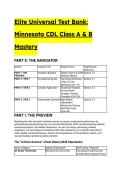
Elite Universal Test Bank:
Minnesota CDL Class A & B
Mastery
PART 0: THE NAVIGATOR
Section Cognitive Tier Subject Focus Page/Section
Reference
PART I: THE Academic Baseline Golden Axioms & 2026 Section 1.0
PREVIEW Statutory Metrics
PART II: TIER 1 Foundational Syntax Hard-Deck Definitions, Section 2.1
Limits, & Core
Mechanics (Q1–15)
PART II: TIER 2 Complex Application Situational Analytics, Section 2.2
Environmental
Variables, Penalty
Cascades (Q16–35)
PART II: TIER 3 Grandmaster Synthesis High-Stakes Section 2.3
Adjudication,
Mechanical Failures,
Multi-Rule Logic
(Q36–60)
PART I: THE PREVIEW
Mastering this elite test bank translates directly to superior professional performance by
systematically reprogramming how you process Minnesota's 2026 commercial driving statutes,
mechanical physics, and liability frameworks. You are not simply memorizing isolated
regulations; you are forging an analytical matrix that empowers you to instantly deconstruct
multi-variable mechanical failures, enforce strict Department of Transportation metrics, and
execute flawless operational safety protocols.
The "Critical Axioms" Cheat Sheet (2026 Standards)
Axiom Category Statutory Mechanism 2026 Critical Threshold
Air Brake Thresholds Warning & Cut-Out Limits Low-pressure warning must
activate before pressure drops
,Axiom Category Statutory Mechanism 2026 Critical Threshold
to 55 psi. Governor cut-in
occurs at 100 psi; cut-out
occurs at 125 psi.
Leakage Maximums Applied Brake Tests Pressure loss must not exceed
3 psi/min for single vehicles
and 4 psi/min for combination
vehicles.
Following Distance Highway Operations Minnesota law mandates a
strict minimum 500-foot
following distance for
commercial trucks on
highways.
The Ted Foss Law Responder & Stalled Vehicle Failing to move over or
Safety significantly slow down for
stopped emergency,
maintenance, or disabled
vehicles is a criminal
misdemeanor.
Dimensional Hard-Decks State Route Limits Maximum legal vehicle height is
13 feet 6 inches; maximum
semi-trailer length is 53 feet;
maximum tandem axle weight
is 34,000 lbs.
Configuration Legality Double/Triple Dynamics Minnesota strictly prohibits
triple trailers. Double trailers
are permitted but possess a
3.5x rearward amplification risk.
PART II: THE ELITE TEST BANK
Section 2.1: Tier 1 - Foundational Syntax & Application
Q1: A driver operates a combination vehicle with a gross combination weight rating (GCWR) of
27,000 pounds. The towed unit possesses a gross vehicle weight rating (GVWR) of 9,500
pounds. Based on the principles of Minnesota CDL classifications, which license class is MOST
ACCURATE for this configuration? A) Class A B) Class B C) Class C D) Non-Commercial Class
D
● The Answer: B (Class B)
● Distractor Analysis:
○ A is incorrect: Class A specifically requires the towed unit's GVWR to exceed
10,000 pounds.
○ C is incorrect: Class C applies exclusively to single vehicles under 26,000 pounds
transporting hazardous materials or 16+ passengers.
○ D is incorrect: The total GCWR exceeds the 26,000-pound commercial threshold.
The Mentor's Analysis: The 10,000-pound threshold on the towed unit dictates the statutory
shift from Class B to Class A. When evaluating towing configurations, the immediate priority is
,calculating the trailer's GVWR independently of the total mass. By utilizing GVWR syntax limits,
you bypass the common trap of assuming overall weight automatically dictates a Class A
requirement. Professional/Academic Intuition: A heavy truck pulling a light trailer mandates
Class B; a heavy truck pulling a heavy trailer mandates Class A.
Q2: A commercial driver performs a static air brake test on a single-unit Class B vehicle with a
fully charged system. The engine is off, and the parking brake is released. Based on the
principles of pneumatic retention, what is the MAXIMUM allowable pressure loss per minute? A)
2 psi B) 3 psi C) 4 psi D) 5 psi
● The Answer: A (2 psi)
● Distractor Analysis:
○ B is incorrect: 3 psi is the threshold for a single-unit vehicle during an applied brake
test, not a static test.
○ C is incorrect: 4 psi is the applied leakage threshold for combination vehicles.
○ D is incorrect: A 5 psi loss indicates a catastrophic pneumatic failure requiring an
immediate out-of-service designation.
The Mentor's Analysis: Pneumatic integrity is the absolute foundation of heavy-vehicle
deceleration. When verifying static air retention, the immediate priority is isolating the unapplied
service lines. By utilizing the static leakage baseline (2 psi), you bypass the common trap of
confusing applied versus unapplied pressure metrics. Professional/Academic Intuition: Static
tests test the tanks; applied tests test the chambers.
Q3: During a pre-trip inspection, a driver observes the air compressor governor cutting out.
Based on standard Minnesota air brake specifications, at what pressure range does this
automatic cutoff NORMALLY occur? A) 85 to 100 psi B) 100 to 125 psi C) 120 to 140 psi D) 150
to 175 psi
● The Answer: B (100 to 125 psi)
● Distractor Analysis:
○ A is incorrect: This range represents the cut-in phase where the compressor
activates, not the cut-out phase.
○ C is incorrect: While some modern systems reach 140 psi, the standard
manufacturer cut-out specification utilized in state testing peaks at approximately
125 psi.
○ D is incorrect: Pressures at this level trigger the mechanical safety valve to
forcefully vent excess air.
The Mentor's Analysis: The governor serves as the mechanical brain of the pneumatic supply
chain. When monitoring system pressure, the immediate priority is ensuring the compressor
ceases operation before structural tank limits are breached. By utilizing standard governor
cut-out thresholds, you bypass the common trap of over-pressurizing the braking system.
Professional/Academic Intuition: The governor awakens at 100 psi and sleeps at 125 psi.
Q4: A commercial operator approaches an at-grade railroad crossing in a school bus. Based on
the principles of commercial highway safety, which distance parameter dictates where the
vehicle must INITIALLY halt? A) No closer than 10 feet and no further than 30 feet from the
nearest rail. B) No closer than 15 feet and no further than 50 feet from the nearest rail. C) No
closer than 25 feet and no further than 75 feet from the nearest rail. D) Exactly at the visual stop
line, regardless of rail proximity.
● The Answer: B (No closer than 15 feet and no further than 50 feet from the nearest rail.)
● Distractor Analysis:
○ A is incorrect: 10 feet places the vehicle's front bumper inside the train's dynamic
kinetic envelope.
, ○ C is incorrect: Stopping beyond 50 feet degrades the driver's visual angle, masking
approaching trains.
○ D is incorrect: Stop lines are often faded or misaligned; statutory distance
parameters completely supersede road markings.
The Mentor's Analysis: Grade crossings represent binary survival environments. When halting
at a track, the immediate priority is establishing a safety buffer outside the train's physical
overhang while maintaining an optimal visual corridor. By utilizing the 15-to-50-foot containment
zone, you bypass the common trap of relying on compromised municipal paint lines.
Professional/Academic Intuition: Stop close enough to see, but far enough to survive.
Q5: A motor carrier plans a logistics route through Minnesota utilizing triple trailers to maximize
freight efficiency. Based on the principles of Minnesota commercial vehicle dimensions, which
conclusion is the MOST ACCURATE? A) Triple trailers may operate exclusively on designated
interstate corridors. B) Triple trailers require a specialized "T" endorsement but are otherwise
legal statewide. C) Triple trailers are strictly prohibited from operating as commercial
configurations in Minnesota. D) Triple trailers may operate if the total combination length
remains under 110 feet.
● The Answer: C (Triple trailers are strictly prohibited from operating as commercial
configurations in Minnesota.)
● Distractor Analysis:
○ A is incorrect: While Western states permit this, Minnesota explicitly bans triple
trailer commercial operation universally.
○ B is incorrect: A "T" endorsement exists federally for doubles/triples, but the
endorsement does not override state-level prohibitions of the physical configuration.
○ D is incorrect: Length limits do not legitimize an inherently illegal articulation
configuration.
The Mentor's Analysis: Jurisdictional geometry laws override federal endorsement capacities.
When routing multi-articulated vehicles, the immediate priority is state-level configuration
legality. By utilizing Minnesota's specific statutory prohibition on triples, you bypass the common
trap of assuming federal endorsements grant universal operational authority.
Professional/Academic Intuition: A federal "T" endorsement in Minnesota is legally restricted
to double trailers only.
Q6: A commercial driver is convicted of a second offense of texting while driving a commercial
motor vehicle (CMV) within a three-year period. Based on the principles of federal and state
disqualifications, what is the MANDATORY penalty? A) A 30-day CDL disqualification. B) A
60-day CDL disqualification. C) A 120-day CDL disqualification. D) A lifetime CDL
disqualification with a 10-year reinstatement option.
● The Answer: B (A 60-day CDL disqualification.)
● Distractor Analysis:
○ A is incorrect: 30 days is a legacy penalty scale not aligned with current
FMCSA/Minnesota mandates.
○ C is incorrect: 120 days is the statutory penalty for a third or subsequent texting
offense within a three-year window.
○ D is incorrect: Lifetime disqualifications apply to sequential major violations (e.g.,
DUI, leaving the scene), not distracted driving.
The Mentor's Analysis: Distracted driving in a commercial vehicle is treated as a severe
behavioral failure. When analyzing traffic convictions, the immediate priority is tracking the
frequency of infractions within the rolling 36-month window. By utilizing the graduated
disqualification matrix, you bypass the common trap of underestimating the administrative
Minnesota CDL Class A & B
Mastery
PART 0: THE NAVIGATOR
Section Cognitive Tier Subject Focus Page/Section
Reference
PART I: THE Academic Baseline Golden Axioms & 2026 Section 1.0
PREVIEW Statutory Metrics
PART II: TIER 1 Foundational Syntax Hard-Deck Definitions, Section 2.1
Limits, & Core
Mechanics (Q1–15)
PART II: TIER 2 Complex Application Situational Analytics, Section 2.2
Environmental
Variables, Penalty
Cascades (Q16–35)
PART II: TIER 3 Grandmaster Synthesis High-Stakes Section 2.3
Adjudication,
Mechanical Failures,
Multi-Rule Logic
(Q36–60)
PART I: THE PREVIEW
Mastering this elite test bank translates directly to superior professional performance by
systematically reprogramming how you process Minnesota's 2026 commercial driving statutes,
mechanical physics, and liability frameworks. You are not simply memorizing isolated
regulations; you are forging an analytical matrix that empowers you to instantly deconstruct
multi-variable mechanical failures, enforce strict Department of Transportation metrics, and
execute flawless operational safety protocols.
The "Critical Axioms" Cheat Sheet (2026 Standards)
Axiom Category Statutory Mechanism 2026 Critical Threshold
Air Brake Thresholds Warning & Cut-Out Limits Low-pressure warning must
activate before pressure drops
,Axiom Category Statutory Mechanism 2026 Critical Threshold
to 55 psi. Governor cut-in
occurs at 100 psi; cut-out
occurs at 125 psi.
Leakage Maximums Applied Brake Tests Pressure loss must not exceed
3 psi/min for single vehicles
and 4 psi/min for combination
vehicles.
Following Distance Highway Operations Minnesota law mandates a
strict minimum 500-foot
following distance for
commercial trucks on
highways.
The Ted Foss Law Responder & Stalled Vehicle Failing to move over or
Safety significantly slow down for
stopped emergency,
maintenance, or disabled
vehicles is a criminal
misdemeanor.
Dimensional Hard-Decks State Route Limits Maximum legal vehicle height is
13 feet 6 inches; maximum
semi-trailer length is 53 feet;
maximum tandem axle weight
is 34,000 lbs.
Configuration Legality Double/Triple Dynamics Minnesota strictly prohibits
triple trailers. Double trailers
are permitted but possess a
3.5x rearward amplification risk.
PART II: THE ELITE TEST BANK
Section 2.1: Tier 1 - Foundational Syntax & Application
Q1: A driver operates a combination vehicle with a gross combination weight rating (GCWR) of
27,000 pounds. The towed unit possesses a gross vehicle weight rating (GVWR) of 9,500
pounds. Based on the principles of Minnesota CDL classifications, which license class is MOST
ACCURATE for this configuration? A) Class A B) Class B C) Class C D) Non-Commercial Class
D
● The Answer: B (Class B)
● Distractor Analysis:
○ A is incorrect: Class A specifically requires the towed unit's GVWR to exceed
10,000 pounds.
○ C is incorrect: Class C applies exclusively to single vehicles under 26,000 pounds
transporting hazardous materials or 16+ passengers.
○ D is incorrect: The total GCWR exceeds the 26,000-pound commercial threshold.
The Mentor's Analysis: The 10,000-pound threshold on the towed unit dictates the statutory
shift from Class B to Class A. When evaluating towing configurations, the immediate priority is
,calculating the trailer's GVWR independently of the total mass. By utilizing GVWR syntax limits,
you bypass the common trap of assuming overall weight automatically dictates a Class A
requirement. Professional/Academic Intuition: A heavy truck pulling a light trailer mandates
Class B; a heavy truck pulling a heavy trailer mandates Class A.
Q2: A commercial driver performs a static air brake test on a single-unit Class B vehicle with a
fully charged system. The engine is off, and the parking brake is released. Based on the
principles of pneumatic retention, what is the MAXIMUM allowable pressure loss per minute? A)
2 psi B) 3 psi C) 4 psi D) 5 psi
● The Answer: A (2 psi)
● Distractor Analysis:
○ B is incorrect: 3 psi is the threshold for a single-unit vehicle during an applied brake
test, not a static test.
○ C is incorrect: 4 psi is the applied leakage threshold for combination vehicles.
○ D is incorrect: A 5 psi loss indicates a catastrophic pneumatic failure requiring an
immediate out-of-service designation.
The Mentor's Analysis: Pneumatic integrity is the absolute foundation of heavy-vehicle
deceleration. When verifying static air retention, the immediate priority is isolating the unapplied
service lines. By utilizing the static leakage baseline (2 psi), you bypass the common trap of
confusing applied versus unapplied pressure metrics. Professional/Academic Intuition: Static
tests test the tanks; applied tests test the chambers.
Q3: During a pre-trip inspection, a driver observes the air compressor governor cutting out.
Based on standard Minnesota air brake specifications, at what pressure range does this
automatic cutoff NORMALLY occur? A) 85 to 100 psi B) 100 to 125 psi C) 120 to 140 psi D) 150
to 175 psi
● The Answer: B (100 to 125 psi)
● Distractor Analysis:
○ A is incorrect: This range represents the cut-in phase where the compressor
activates, not the cut-out phase.
○ C is incorrect: While some modern systems reach 140 psi, the standard
manufacturer cut-out specification utilized in state testing peaks at approximately
125 psi.
○ D is incorrect: Pressures at this level trigger the mechanical safety valve to
forcefully vent excess air.
The Mentor's Analysis: The governor serves as the mechanical brain of the pneumatic supply
chain. When monitoring system pressure, the immediate priority is ensuring the compressor
ceases operation before structural tank limits are breached. By utilizing standard governor
cut-out thresholds, you bypass the common trap of over-pressurizing the braking system.
Professional/Academic Intuition: The governor awakens at 100 psi and sleeps at 125 psi.
Q4: A commercial operator approaches an at-grade railroad crossing in a school bus. Based on
the principles of commercial highway safety, which distance parameter dictates where the
vehicle must INITIALLY halt? A) No closer than 10 feet and no further than 30 feet from the
nearest rail. B) No closer than 15 feet and no further than 50 feet from the nearest rail. C) No
closer than 25 feet and no further than 75 feet from the nearest rail. D) Exactly at the visual stop
line, regardless of rail proximity.
● The Answer: B (No closer than 15 feet and no further than 50 feet from the nearest rail.)
● Distractor Analysis:
○ A is incorrect: 10 feet places the vehicle's front bumper inside the train's dynamic
kinetic envelope.
, ○ C is incorrect: Stopping beyond 50 feet degrades the driver's visual angle, masking
approaching trains.
○ D is incorrect: Stop lines are often faded or misaligned; statutory distance
parameters completely supersede road markings.
The Mentor's Analysis: Grade crossings represent binary survival environments. When halting
at a track, the immediate priority is establishing a safety buffer outside the train's physical
overhang while maintaining an optimal visual corridor. By utilizing the 15-to-50-foot containment
zone, you bypass the common trap of relying on compromised municipal paint lines.
Professional/Academic Intuition: Stop close enough to see, but far enough to survive.
Q5: A motor carrier plans a logistics route through Minnesota utilizing triple trailers to maximize
freight efficiency. Based on the principles of Minnesota commercial vehicle dimensions, which
conclusion is the MOST ACCURATE? A) Triple trailers may operate exclusively on designated
interstate corridors. B) Triple trailers require a specialized "T" endorsement but are otherwise
legal statewide. C) Triple trailers are strictly prohibited from operating as commercial
configurations in Minnesota. D) Triple trailers may operate if the total combination length
remains under 110 feet.
● The Answer: C (Triple trailers are strictly prohibited from operating as commercial
configurations in Minnesota.)
● Distractor Analysis:
○ A is incorrect: While Western states permit this, Minnesota explicitly bans triple
trailer commercial operation universally.
○ B is incorrect: A "T" endorsement exists federally for doubles/triples, but the
endorsement does not override state-level prohibitions of the physical configuration.
○ D is incorrect: Length limits do not legitimize an inherently illegal articulation
configuration.
The Mentor's Analysis: Jurisdictional geometry laws override federal endorsement capacities.
When routing multi-articulated vehicles, the immediate priority is state-level configuration
legality. By utilizing Minnesota's specific statutory prohibition on triples, you bypass the common
trap of assuming federal endorsements grant universal operational authority.
Professional/Academic Intuition: A federal "T" endorsement in Minnesota is legally restricted
to double trailers only.
Q6: A commercial driver is convicted of a second offense of texting while driving a commercial
motor vehicle (CMV) within a three-year period. Based on the principles of federal and state
disqualifications, what is the MANDATORY penalty? A) A 30-day CDL disqualification. B) A
60-day CDL disqualification. C) A 120-day CDL disqualification. D) A lifetime CDL
disqualification with a 10-year reinstatement option.
● The Answer: B (A 60-day CDL disqualification.)
● Distractor Analysis:
○ A is incorrect: 30 days is a legacy penalty scale not aligned with current
FMCSA/Minnesota mandates.
○ C is incorrect: 120 days is the statutory penalty for a third or subsequent texting
offense within a three-year window.
○ D is incorrect: Lifetime disqualifications apply to sequential major violations (e.g.,
DUI, leaving the scene), not distracted driving.
The Mentor's Analysis: Distracted driving in a commercial vehicle is treated as a severe
behavioral failure. When analyzing traffic convictions, the immediate priority is tracking the
frequency of infractions within the rolling 36-month window. By utilizing the graduated
disqualification matrix, you bypass the common trap of underestimating the administrative

