

Escrito por estudiantes que aprobaron Inmediatamente disponible después del pago Leer en línea o como PDF ¿Documento equivocado? Cámbialo gratis 4,6 TrustPilot
logo-home
Examen

Food Manager Exam 2026 Questions & Answers | 150+ Practice Questions | Foodborne Illnesses, HACCP, Food Safety, Temperature Control & ServSafe Certification

Puntuación
-
Vendido
-
Páginas
17
Grado
A+
Subido en
05-06-2026
Escrito en
2025/2026

This comprehensive Food Manager Exam 2026 Questions and Answers study guide contains more than 150 carefully compiled certification-style questions and verified answers covering the most frequently tested food safety concepts required for Food Protection Manager, ServSafe, NRFSP, and Food Manager Certification examinations. The resource is designed to help candidates master critical food safety principles through an easy-to-follow question-and-answer format, reinforcing essential knowledge on foodborne illnesses, contamination prevention, personal hygiene, temperature control, food storage, sanitation procedures, and regulatory compliance. The material serves as an effective exam preparation tool for food service professionals seeking certification and individuals responsible for maintaining food safety standards in restaurants, healthcare facilities, schools, catering operations, and retail food establishments. The study guide provides extensive coverage of foodborne infections and foodborne intoxications, bacterial, viral, parasitic, and fungal contaminants, HACCP principles, FATTOM bacterial growth conditions, cross-contamination prevention, high-risk populations, food handling procedures, cooling and reheating requirements, thermometer calibration, receiving and storage guidelines, seafood safety, allergen awareness, and food service sanitation protocols. Learners will review key food safety pathogens including Salmonella, Escherichia coli O157, Clostridium botulinum, Listeria monocytogenes, Shigella, Staphylococcus aureus, Bacillus cereus, Vibrio species, Hepatitis A, Norovirus, Giardia, Trichinella, and Anisakis, along with their sources, symptoms, prevention methods, and public health implications. Major topics covered include foodborne disease prevention, food contamination hazards, cooking temperature requirements for poultry, pork, eggs, seafood, and ground beef, two-stage cooling procedures, temperature danger zone management, personal hygiene standards, handwashing procedures, warewashing operations, cleaning and sanitizing food-contact surfaces, chemical sanitization methods, food storage hierarchy, cross-contamination prevention, high-risk populations (PIES), food receiving standards, shellfish handling requirements, refrigerator and freezer storage practices, thermometer usage and calibration, parasite control methods, seafood poisoning risks, food preservation techniques, and employee food safety responsibilities. The guide also emphasizes practical food safety decision-making and regulatory standards commonly evaluated on Food Manager Certification examinations. Key exam topics include: • Foodborne infections and foodborne intoxications • HACCP food safety principles • FATTOM bacterial growth conditions • Food contamination hazards • Biological, chemical, physical, and cross-contamination risks • Salmonella, E. coli, Listeria, Shigella, and Norovirus • Clostridium botulinum and foodborne toxins • Temperature Danger Zone (41°F–135°F) • Cooking temperatures and holding requirements • Two-stage cooling process • Reheating and hot-holding standards • Food storage and receiving procedures • Thermometer calibration and temperature monitoring • High-risk populations (PIES) • Personal hygiene and handwashing requirements • Food-contact surface cleaning and sanitizing • Seafood safety and shellfish handling • Parasites and foodborne disease prevention • Cross-contamination prevention strategies • Warewashing and sanitation procedures • Food safety regulations and certification standards The content reflects food safety principles outlined in the FDA Food Code, Hazard Analysis Critical Control Point (HACCP) systems, Centers for Disease Control and Prevention (CDC) foodborne illness prevention guidance, and industry-recognized Food Protection Manager Certification programs. The study material focuses on evidence-based food safety practices designed to minimize contamination risks, reduce foodborne disease outbreaks, maintain sanitation compliance, and promote public health protection in commercial food service environments. Relevant for: • Food Manager Certification candidates • ServSafe Food Protection Manager candidates • NRFSP certification candidates • Restaurant managers and supervisors • Food service managers • Kitchen managers and executive chefs • Culinary arts students • Hospitality management students • Food safety inspectors • Catering professionals • School nutrition personnel • Healthcare food service staff • Retail food establishment managers • Food manufacturing employees • Public health professionals • Individuals preparing for Food Protection Manager Certification examinations Keywords Food Manager Exam 2026, Food Manager Certification, Food Protection Manager, ServSafe Manager Exam, NRFSP Exam, food safety certification, foodborne illness, foodborne infection, foodborne intoxication, HACCP, FATTOM, food contamination, biological hazards, chemical hazards, physical hazards, cross contamination, Salmonella, E coli O157 H7, Clostridium botulinum, Listeria monocytogenes, Shigella, Staphylococcus aureus, Bacillus cereus, Vibrio, Hepatitis A, Norovirus, Giardia, Trichinella, Anisakis, food safety training, temperature danger zone, cooking temperatures, food storage, food receiving, thermometer calibration, food sanitation, handwashing procedures, personal hygiene, high risk populations, PIES, seafood safety, shellfish handling, cooling procedures, reheating food, warewashing, sanitizing procedures, food contact surfaces, cross contamination prevention, restaurant management, kitchen safety, food service operations, public health, sanitation certification, culinary management, hospitality management, food safety exam prep, FDA Food Code, food manager practice questions, food safety manager certification

Mostrar más Leer menos
Institución
Food Manager
Grado
Food Manager

Vista previa del contenido

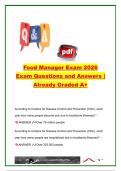
Food Manager Exam 2026
Exam Questions and Answers |
Already Graded A+


According to Centers for Disease Control and Prevention (CDC), each

year how many people become sick due to foodborne illnesses? -

ANSWER ✔✔Over 76 million people


According to Centers for Disease Control and Prevention (CDC), each

year how many people are hospitalized due to foodborne illnesses? -

ANSWER ✔✔Over 325,000 people

,According to Centers for Disease Control and Prevention (CDC), each

year how many people die due to foodborne illnesses? - ANSWER

✔✔Over 5,000 people


What are the two types of foodborne illnesses? - ANSWER

✔✔Foodborne infection & foodborne intoxication


What type of foodborne illness is produced by the ingestion of living,

harmful organisms present in food? - ANSWER ✔✔Foodborne

infection

In foodborne infections, how are harmful organisms inside food not

killed? - ANSWER ✔✔Not cooking food products to their required

temperatures

What type of foodborne illness has a delayed onset meaning you do not

get sick right away? - ANSWER ✔✔Foodborne infections


What are two bacteria most associated with foodborne infection? -

ANSWER ✔✔Salmonella and E. Coli


What type of foodborne illness is produced by ingestion of bacterial

toxins or excrements that are present in food before it is consumed? -

ANSWER ✔✔Foodborne intoxication

, What type of foodborne illness may occur from consuming foods that

contain chemicals from cleaning agents, pesticides, or certain metals? -

ANSWER ✔✔Foodborne intoxication


What type of foodborne illness may occur when leaving potentially

hazardous food products at room temperature, exposing it to the

Temperature Danger Zone (TDZ)? - ANSWER ✔✔Foodborne

intoxication


What are waste or by-products of bacteria? - ANSWER ✔✔Toxins


The symptoms of what type of foodborne illness have a rapid onset,

meaning they occur rapidly within a few hours? - ANSWER

✔✔Foodborne intoxication


What are the two bacteria associated with foodborne intoxication? -

ANSWER ✔✔Staphylococcus Aureus and Clostridium Botulinum


Poultry should be cooked to an internal temperature of how many

degrees and for how many seconds? - ANSWER ✔✔165 degrees F

for 15 seconds

Ground beef should be cooked to an internal temperature of how many

degrees for how many seconds? - ANSWER ✔✔155 degrees F for

15 seconds

COPYRIGHT©PROFFKERRYMARTIN 2025/2026. YEAR PUBLISHED 2026. COMPANY REGISTRATION NUMBER: 619652435. TERMS OF USE.
PRIVACY STATEMENT. ALL RIGHTS RESERVED

Escuela, estudio y materia

Institución
Food Manager
Grado
Food Manager

Información del documento

Subido en
5 de junio de 2026
Número de páginas
17
Escrito en
2025/2026
Tipo
Examen
Contiene
Preguntas y respuestas

Temas

$18.99
Accede al documento completo:

¿Documento equivocado? Cámbialo gratis Dentro de los 14 días posteriores a la compra y antes de descargarlo, puedes elegir otro documento. Puedes gastar el importe de nuevo.
Escrito por estudiantes que aprobaron
Inmediatamente disponible después del pago
Leer en línea o como PDF


Documento también disponible en un lote

Conoce al vendedor

Seller avatar
Los indicadores de reputación están sujetos a la cantidad de artículos vendidos por una tarifa y las reseñas que ha recibido por esos documentos. Hay tres niveles: Bronce, Plata y Oro. Cuanto mayor reputación, más podrás confiar en la calidad del trabajo del vendedor.
PROFFKERRYMARTIN Liberty University
Seguir Necesitas iniciar sesión para seguir a otros usuarios o asignaturas
Vendido
258
Miembro desde
1 año
Número de seguidores
7
Documentos
10635
Última venta
18 horas hace
KERRYMARTIN

KERRYMARTIN EXAM HUB Assignments, Case Studies, Research, Essay writing service, Questions and Answers, Discussions etc. for students who want to see results twice as fast. I have done papers of various topics and complexities. I am punctual and always submit work on-deadline. I write engaging and informative content on all subjects. Send me your research papers, case studies, psychology papers, etc, and I’ll do them to the best of my abilities. Writing is my passion when it comes to academic work. I’ve got a good sense of structure and enjoy finding interesting ways to deliver information in any given paper. I love impressing clients with my work, and I am very punctual about deadlines. Send me your assignment and I’ll take it to the next level. I strive for my content to be of the highest quality. Your wishes come first— send me your requirements and I’ll make a piece of work with fresh ideas, consistent structure, and following the academic formatting rules. For every student you refer to me with an order that is completed and paid transparently, I will do one assignment for you, free of charge!!!!!!!!!!!!

Lee mas Leer menos
3.4

48 reseñas

5
20
4
5
3
10
2
2
1
11

Por qué los estudiantes eligen Stuvia

Creado por compañeros estudiantes, verificado por reseñas

Calidad en la que puedes confiar: escrito por estudiantes que aprobaron y evaluado por otros que han usado estos resúmenes.

¿No estás satisfecho? Elige otro documento

¡No te preocupes! Puedes elegir directamente otro documento que se ajuste mejor a lo que buscas.

Paga como quieras, empieza a estudiar al instante

Sin suscripción, sin compromisos. Paga como estés acostumbrado con tarjeta de crédito y descarga tu documento PDF inmediatamente.

Student with book image

“Comprado, descargado y aprobado. Así de fácil puede ser.”

Alisha Student

Preguntas frecuentes
