

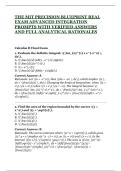
THE MIT PRECISION BLUEPRINT REAL
EXAM ADVANCED INTEGRATION
PROMPTS WITH VERIFIED ANSWERS
AND FULL ANALYTICAL RATIONALES
Calculus II Final Exam
1. Evaluate the definite integral: \(\int_{0}^{1} x e^{-x^2} \,
dx\).
A. \(\frac{1}{2}\left(1 - e^{-1}\right)\)
B. \(\frac{1}{2}e^{-1}\)
C. \(1 - e^{-1}\)
D. \(\frac{1}{2}\left(e - 1\right)\)
Correct Answer: A
Rationale: Let \(u = -x^2\), then \(du = -2x \, dx\), which implies \(x \,
dx = -\frac{1}{2} \, du\). Changing the limits of integration: when \(x =
0\), \(u = 0\); when \(x = 1\), \(u = -1\). The integral becomes \(-
\frac{1}{2} \int_{0}^{-1} e^u \, du = \frac{1}{2} \int_{-1}^{0} e^u \,
du = \frac{1}{2} \left[e^u\right]_{-1}^{0} = \frac{1}{2}\left(1 - e^{-
1}\right)\).
2. Find the area of the region bounded by the curves \(y =
x^2\) and \(y = \sqrt{x}\).
A. \(\frac{1}{2}\)
B. \(\frac{1}{3}\)
C. \(\frac{1}{4}\)
D. \(\frac{2}{3}\)
Correct Answer: B
Rationale: The curves intersect where \(x^2 = \sqrt{x}\), which gives
\(x^4 = x \implies x(x^3 - 1) = 0\), so \(x = 0\) and \(x = 1\). In the
interval \([0, 1]\), \(\sqrt{x} \geq x^2\). The area is \(\int_{0}^{1}
\left(\sqrt{x} - x^2\right) \, dx = \left[\frac{2}{3}x^{3/2} -
\frac{1}{3}x^3\right]_{0}^{1} = \frac{2}{3} - \frac{1}{3} =
\frac{1}{3}\).
,3. Evaluate the indefinite integral using integration by parts:
\(\int x \cos(x) \, dx\).
A. \(x \sin(x) + \cos(x) + C\)
B. \(x \sin(x) - \cos(x) + C\)
C. \(-x \sin(x) + \cos(x) + C\)
D. \(x \cos(x) + \sin(x) + C\)
Correct Answer: A
Rationale: Let \(u = x\) and \(dv = \cos(x) \, dx\). Then \(du = dx\) and
\(v = \sin(x)\). Using the integration by parts formula \(\int u \, dv =
uv - \int v \, du\), we get \(x \sin(x) - \int \sin(x) \, dx = x \sin(x) - (-
\cos(x)) + C = x \sin(x) + \cos(x) + C\).
4. Determine the volume of the solid generated by revolving
the region bounded by \(y = x^3\), \(y = 0\), and \(x = 2\)
about the x-axis.
A. \(\frac{128\pi }{7}\)
B. \(\frac{64\pi }{7}\)
C. \(\frac{32\pi }{5}\)
D. \(\frac{256\pi }{7}\)
Correct Answer: A
Rationale: Using the disk method, the volume \(V = \pi \int_{a}^{b}
[f(x)]^2 \, dx\). Here, \(V = \pi \int_{0}^{2} (x^3)^2 \, dx = \pi
\int_{0}^{2} x^6 \, dx = \pi \left[\frac{x^7}{7}\right]_{0}^{2} = \pi
\left(\frac{128}{7} - 0\right) = \frac{128\pi}{7}\). [1]
5. Evaluate the improper integral: \(\int_{1}^{\infty}
\frac{1}{x^3} \, dx\).
A. \(1\)
B. \(\frac{1}{2}\)
C. \(2\)
D. Diverges
*Correct Answer: B
Rationale: The improper integral is defined as \(\lim_{t \to \infty}
\int_{1}^{t} x^{-3} \, dx = \lim_{t \to \infty} \left[-
\frac{1}{2x^2}\right]_{1}^{t} = \lim_{t \to \infty} \left(-
,\frac{1}{2t^2} + \frac{1}{2}\right) = 0 + \frac{1}{2} = \frac{1}{2}\).
Since the limit exists and is finite, the integral converges to
\(\frac{1}{2}\).
6. Which of the following substitutions is most appropriate to
evaluate \(\int \frac{1}{x^2 \sqrt{4 - x^2}} \, dx\)?
A. \(x = 2 \tan(\theta)\)
B. \(x = 2 \sec(\theta)\)
C. \(x = 2 \sin(\theta)\)
D. \(x = 4 \sin(\theta)\)
Correct Answer: C
Rationale: The integrand contains an expression of the form
\(\sqrt{a^{2}-x^{2}}\) where \(a = 2\). The standard trigonometric
substitution for this form is \(x = a \sin(\theta)\), hence \(x = 2
\sin(\theta)\) is the correct choice because it simplifies the radical via
the identity \(4 - 4\sin^2(\theta) = 4\cos^2(\theta)\).
7. Find the partial fraction decomposition form for the
integrand: \(\int \frac{2x + 1}{(x-1)^2(x^2 + 1)} \, dx\).
A. \(\frac{A}{x-1} + \frac{B}{(x-1)^2} + \frac{Cx + D}{x^2 + 1}\)
B. \(\frac{A}{x-1} + \frac{B}{x-1} + \frac{C}{x^2 + 1}\)
C. \(\frac{A}{(x-1)^2} + \frac{Bx + C}{x^2 + 1}\)
D. \(\frac{A}{x-1} + \frac{B}{(x-1)^2} + \frac{C}{x + 1} + \frac{D}{x -
1}\)
Correct Answer: A
Rationale: The denominator contains a repeated linear factor \((x-
1)^2\) and an irreducible quadratic factor \((x^2+1)\). The repeated
linear factor requires terms for each power up to its multiplicity:
\(\frac{A}{x-1} + \frac{B}{(x-1)^2}\). The irreducible quadratic factor
requires a linear numerator: \(\frac{Cx+D}{x^{2}+1}\). Combining
these gives option A.
8. Find the length of the arc of the curve \(y =
\frac{2}{3}x^{3/2}\) from \(x = 0\) to \(x = 3\).
A. \(\frac{14}{3}\)
B. \(\frac{16}{3}\)
, C. \(\frac{26}{3}\)
D. \(4\)
Correct Answer: A
Rationale: The arc length formula is \(L = \int_{a}^{b} \sqrt{1 +
\left(\frac{dy}{dx}\right)^2} \, dx\). Here, \(\frac{dy}{dx} =
\frac{2}{3} \cdot \frac{3}{2}x^{1/2} = x^{1/2}\). Thus, \(L =
\int_{0}^{3} \sqrt{1 + x} \, dx\). Let \(u = 1+x\), then \(du = dx\). The
limits change from \([0,3]\) to \([1,4]\). \(L = \int_{1}^{4} u^{1/2} \,
du = \left[\frac{2}{3}u^{3/2}\right]_{1}^{4} = \frac{2}{3}(4^{3/2} -
1^{3/2}) = \frac{2}{3}(8 - 1) = \frac{14}{3}\).
9. Determine whether the sequence \(a_n = \frac{3n^2 +
5}{2n^2 - n}\) converges, and if so, find its limit.
A. Converges to \(0\)
B. Converges to \(\frac{3}{2}\)
C. Converges to \(3\)
D. Diverges
Correct Answer: B
Rationale: To find the limit of the sequence as \(n \to \infty\), divide the
numerator and the denominator by the highest power of \(n\) in the
denominator, which is \(n^{2}\): \(\lim_{n \to \infty} \frac{3 +
5/n^2}{2 - 1/n} = \frac{3 + 0}{2 - 0} = \frac{3}{2}\). Since the limit is a
finite number, the sequence converges to \(\frac{3}{2}\).
10. Evaluate the geometric series: \(\sum_{n=1}^{\infty} 3
\left(\frac{2}{5}\right)^{n-1}\).
A. \(5\)
B. \(\frac{5}{2}\)
C. \(2\)
D. \(\frac{15}{2}\)
Correct Answer: A
Rationale: A geometric series \(\sum_{n=1}^{\infty} a r^{n-1}\)
converges if \(\vert{}r\vert{} < 1\), and its sum is given by \(S =
\frac{a}{1 - r}\). For this series, the first term \(a = 3\) (when \(n=1\))
and the common ratio \(r = \frac{2}{5}\). Since
\(\left\vert{}\frac{2}{5}\right\vert{} < 1\), the sum is \(S = \frac{3}{1 -
2/5} = \frac{3}{3/5} = 3 \cdot \frac{5}{3} = 5\).
EXAM ADVANCED INTEGRATION
PROMPTS WITH VERIFIED ANSWERS
AND FULL ANALYTICAL RATIONALES
Calculus II Final Exam
1. Evaluate the definite integral: \(\int_{0}^{1} x e^{-x^2} \,
dx\).
A. \(\frac{1}{2}\left(1 - e^{-1}\right)\)
B. \(\frac{1}{2}e^{-1}\)
C. \(1 - e^{-1}\)
D. \(\frac{1}{2}\left(e - 1\right)\)
Correct Answer: A
Rationale: Let \(u = -x^2\), then \(du = -2x \, dx\), which implies \(x \,
dx = -\frac{1}{2} \, du\). Changing the limits of integration: when \(x =
0\), \(u = 0\); when \(x = 1\), \(u = -1\). The integral becomes \(-
\frac{1}{2} \int_{0}^{-1} e^u \, du = \frac{1}{2} \int_{-1}^{0} e^u \,
du = \frac{1}{2} \left[e^u\right]_{-1}^{0} = \frac{1}{2}\left(1 - e^{-
1}\right)\).
2. Find the area of the region bounded by the curves \(y =
x^2\) and \(y = \sqrt{x}\).
A. \(\frac{1}{2}\)
B. \(\frac{1}{3}\)
C. \(\frac{1}{4}\)
D. \(\frac{2}{3}\)
Correct Answer: B
Rationale: The curves intersect where \(x^2 = \sqrt{x}\), which gives
\(x^4 = x \implies x(x^3 - 1) = 0\), so \(x = 0\) and \(x = 1\). In the
interval \([0, 1]\), \(\sqrt{x} \geq x^2\). The area is \(\int_{0}^{1}
\left(\sqrt{x} - x^2\right) \, dx = \left[\frac{2}{3}x^{3/2} -
\frac{1}{3}x^3\right]_{0}^{1} = \frac{2}{3} - \frac{1}{3} =
\frac{1}{3}\).
,3. Evaluate the indefinite integral using integration by parts:
\(\int x \cos(x) \, dx\).
A. \(x \sin(x) + \cos(x) + C\)
B. \(x \sin(x) - \cos(x) + C\)
C. \(-x \sin(x) + \cos(x) + C\)
D. \(x \cos(x) + \sin(x) + C\)
Correct Answer: A
Rationale: Let \(u = x\) and \(dv = \cos(x) \, dx\). Then \(du = dx\) and
\(v = \sin(x)\). Using the integration by parts formula \(\int u \, dv =
uv - \int v \, du\), we get \(x \sin(x) - \int \sin(x) \, dx = x \sin(x) - (-
\cos(x)) + C = x \sin(x) + \cos(x) + C\).
4. Determine the volume of the solid generated by revolving
the region bounded by \(y = x^3\), \(y = 0\), and \(x = 2\)
about the x-axis.
A. \(\frac{128\pi }{7}\)
B. \(\frac{64\pi }{7}\)
C. \(\frac{32\pi }{5}\)
D. \(\frac{256\pi }{7}\)
Correct Answer: A
Rationale: Using the disk method, the volume \(V = \pi \int_{a}^{b}
[f(x)]^2 \, dx\). Here, \(V = \pi \int_{0}^{2} (x^3)^2 \, dx = \pi
\int_{0}^{2} x^6 \, dx = \pi \left[\frac{x^7}{7}\right]_{0}^{2} = \pi
\left(\frac{128}{7} - 0\right) = \frac{128\pi}{7}\). [1]
5. Evaluate the improper integral: \(\int_{1}^{\infty}
\frac{1}{x^3} \, dx\).
A. \(1\)
B. \(\frac{1}{2}\)
C. \(2\)
D. Diverges
*Correct Answer: B
Rationale: The improper integral is defined as \(\lim_{t \to \infty}
\int_{1}^{t} x^{-3} \, dx = \lim_{t \to \infty} \left[-
\frac{1}{2x^2}\right]_{1}^{t} = \lim_{t \to \infty} \left(-
,\frac{1}{2t^2} + \frac{1}{2}\right) = 0 + \frac{1}{2} = \frac{1}{2}\).
Since the limit exists and is finite, the integral converges to
\(\frac{1}{2}\).
6. Which of the following substitutions is most appropriate to
evaluate \(\int \frac{1}{x^2 \sqrt{4 - x^2}} \, dx\)?
A. \(x = 2 \tan(\theta)\)
B. \(x = 2 \sec(\theta)\)
C. \(x = 2 \sin(\theta)\)
D. \(x = 4 \sin(\theta)\)
Correct Answer: C
Rationale: The integrand contains an expression of the form
\(\sqrt{a^{2}-x^{2}}\) where \(a = 2\). The standard trigonometric
substitution for this form is \(x = a \sin(\theta)\), hence \(x = 2
\sin(\theta)\) is the correct choice because it simplifies the radical via
the identity \(4 - 4\sin^2(\theta) = 4\cos^2(\theta)\).
7. Find the partial fraction decomposition form for the
integrand: \(\int \frac{2x + 1}{(x-1)^2(x^2 + 1)} \, dx\).
A. \(\frac{A}{x-1} + \frac{B}{(x-1)^2} + \frac{Cx + D}{x^2 + 1}\)
B. \(\frac{A}{x-1} + \frac{B}{x-1} + \frac{C}{x^2 + 1}\)
C. \(\frac{A}{(x-1)^2} + \frac{Bx + C}{x^2 + 1}\)
D. \(\frac{A}{x-1} + \frac{B}{(x-1)^2} + \frac{C}{x + 1} + \frac{D}{x -
1}\)
Correct Answer: A
Rationale: The denominator contains a repeated linear factor \((x-
1)^2\) and an irreducible quadratic factor \((x^2+1)\). The repeated
linear factor requires terms for each power up to its multiplicity:
\(\frac{A}{x-1} + \frac{B}{(x-1)^2}\). The irreducible quadratic factor
requires a linear numerator: \(\frac{Cx+D}{x^{2}+1}\). Combining
these gives option A.
8. Find the length of the arc of the curve \(y =
\frac{2}{3}x^{3/2}\) from \(x = 0\) to \(x = 3\).
A. \(\frac{14}{3}\)
B. \(\frac{16}{3}\)
, C. \(\frac{26}{3}\)
D. \(4\)
Correct Answer: A
Rationale: The arc length formula is \(L = \int_{a}^{b} \sqrt{1 +
\left(\frac{dy}{dx}\right)^2} \, dx\). Here, \(\frac{dy}{dx} =
\frac{2}{3} \cdot \frac{3}{2}x^{1/2} = x^{1/2}\). Thus, \(L =
\int_{0}^{3} \sqrt{1 + x} \, dx\). Let \(u = 1+x\), then \(du = dx\). The
limits change from \([0,3]\) to \([1,4]\). \(L = \int_{1}^{4} u^{1/2} \,
du = \left[\frac{2}{3}u^{3/2}\right]_{1}^{4} = \frac{2}{3}(4^{3/2} -
1^{3/2}) = \frac{2}{3}(8 - 1) = \frac{14}{3}\).
9. Determine whether the sequence \(a_n = \frac{3n^2 +
5}{2n^2 - n}\) converges, and if so, find its limit.
A. Converges to \(0\)
B. Converges to \(\frac{3}{2}\)
C. Converges to \(3\)
D. Diverges
Correct Answer: B
Rationale: To find the limit of the sequence as \(n \to \infty\), divide the
numerator and the denominator by the highest power of \(n\) in the
denominator, which is \(n^{2}\): \(\lim_{n \to \infty} \frac{3 +
5/n^2}{2 - 1/n} = \frac{3 + 0}{2 - 0} = \frac{3}{2}\). Since the limit is a
finite number, the sequence converges to \(\frac{3}{2}\).
10. Evaluate the geometric series: \(\sum_{n=1}^{\infty} 3
\left(\frac{2}{5}\right)^{n-1}\).
A. \(5\)
B. \(\frac{5}{2}\)
C. \(2\)
D. \(\frac{15}{2}\)
Correct Answer: A
Rationale: A geometric series \(\sum_{n=1}^{\infty} a r^{n-1}\)
converges if \(\vert{}r\vert{} < 1\), and its sum is given by \(S =
\frac{a}{1 - r}\). For this series, the first term \(a = 3\) (when \(n=1\))
and the common ratio \(r = \frac{2}{5}\). Since
\(\left\vert{}\frac{2}{5}\right\vert{} < 1\), the sum is \(S = \frac{3}{1 -
2/5} = \frac{3}{3/5} = 3 \cdot \frac{5}{3} = 5\).

