

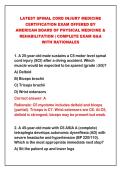
LATEST SPINAL CORD INJURY MEDICINE
CERTIFICATION EXAM OFFERED BY
AMERICAN BOARD OF PHYSICAL MEDICINE &
REHABILITATION | COMPLETE EXAM Q&A
WITH RATIONALES
1. A 25-year-old male sustains a C5 motor level spinal
cord injury (SCI) after a diving accident. Which
muscle would be expected to be spared (grade ≥3/5)?
A) Deltoid
B) Biceps brachii
C) Triceps brachii
D) Wrist extensors
Correct answer: A
Rationale: C5 myotome includes deltoid and biceps
(partial). Triceps is C7. Wrist extensors are C6. At C5,
deltoid is strongest; biceps may be present but weak.
2. A 45-year-old male with C6 ASIA A (complete)
tetraplegia develops autonomic dysreflexia (AD) with
severe headache and hypertension (BP 220/110).
Which is the most appropriate immediate next step?
A) Sit the patient up and lower legs
,B) Administer IV nitroglycerin
C) Administer oral clonidine
D) Perform bladder catheterization to check for
obstruction
Correct answer: A
Rationale: Immediate first step in AD is to sit the
patient up (head of bed) and lower legs to decrease
blood pressure by orthostasis, then remove noxious
stimulus (bladder, bowel).
3. A 30-year-old male with T4 ASIA A (complete)
paraplegia develops acute shortness of breath and
hypoxemia on postoperative day 1 after spinal fusion.
Which is the most likely diagnosis?
A) Pulmonary embolism (PE)
B) Atelectasis
C) Pneumonia
D) Autonomic dysreflexia
Correct answer: A
Rationale: SCI patients have high risk of venous
thromboembolism (VTE). Acute hypoxemia after
surgery should raise suspicion for PE. D-dimer is less
reliable; CT angiography is diagnostic.
,4. A 20-year-old female with C7 ASIA A (complete)
tetraplegia is 3 months post-injury. She reports
episodes of flushing, diaphoresis, and headache
triggered by bladder distention. Which is the first-line
preventive medication for autonomic dysreflexia?
A) Nifedipine
B) Nitroglycerin patch
C) Botulinum toxin to the bladder
D) Alpha-blocker (terazosin)
Correct answer: C
Rationale: Prevention of AD focuses on removing
triggers. Intravesical botulinum toxin for neurogenic
detrusor overactivity reduces intravesical pressure
and AD episodes.
5. A 55-year-old male with chronic T10 ASIA A
(complete) paraplegia (15 years post-injury) develops
new-onset swelling and erythema of the right lower
leg. Doppler ultrasound shows deep vein thrombosis
(DVT). Which is the most appropriate long-term
anticoagulation?
A) Warfarin (INR 2-3)
B) Aspirin 81 mg daily
C) Rivaroxaban
, D) No anticoagulation (chronic SCI has lower
recurrence risk)
Correct answer: C
Rationale: Direct oral anticoagulants (rivaroxaban,
apixaban) are effective and have fewer drug
interactions and no INR monitoring, preferred for
DVT in SCI.
6. A 28-year-old male with C5 ASIA A (complete)
tetraplegia is 1 week post-injury and has a fever of
38.5°C. Urinalysis shows WBC 50/hpf. Which is the
most appropriate next step?
A) Start empiric antibiotics pending culture
B) Obtain urine culture and start antibiotics only if
positive
C) No treatment; fever is common after SCI
D) Acetaminophen only
Correct answer: A
Rationale: SCI patients with fever and pyuria should
be treated empirically for urinary tract infection due
to risk of urosepsis and autonomic dysreflexia.
7. A 40-year-old female with T4 ASIA A (complete)
paraplegia (5 years post-injury) reports chronic
CERTIFICATION EXAM OFFERED BY
AMERICAN BOARD OF PHYSICAL MEDICINE &
REHABILITATION | COMPLETE EXAM Q&A
WITH RATIONALES
1. A 25-year-old male sustains a C5 motor level spinal
cord injury (SCI) after a diving accident. Which
muscle would be expected to be spared (grade ≥3/5)?
A) Deltoid
B) Biceps brachii
C) Triceps brachii
D) Wrist extensors
Correct answer: A
Rationale: C5 myotome includes deltoid and biceps
(partial). Triceps is C7. Wrist extensors are C6. At C5,
deltoid is strongest; biceps may be present but weak.
2. A 45-year-old male with C6 ASIA A (complete)
tetraplegia develops autonomic dysreflexia (AD) with
severe headache and hypertension (BP 220/110).
Which is the most appropriate immediate next step?
A) Sit the patient up and lower legs
,B) Administer IV nitroglycerin
C) Administer oral clonidine
D) Perform bladder catheterization to check for
obstruction
Correct answer: A
Rationale: Immediate first step in AD is to sit the
patient up (head of bed) and lower legs to decrease
blood pressure by orthostasis, then remove noxious
stimulus (bladder, bowel).
3. A 30-year-old male with T4 ASIA A (complete)
paraplegia develops acute shortness of breath and
hypoxemia on postoperative day 1 after spinal fusion.
Which is the most likely diagnosis?
A) Pulmonary embolism (PE)
B) Atelectasis
C) Pneumonia
D) Autonomic dysreflexia
Correct answer: A
Rationale: SCI patients have high risk of venous
thromboembolism (VTE). Acute hypoxemia after
surgery should raise suspicion for PE. D-dimer is less
reliable; CT angiography is diagnostic.
,4. A 20-year-old female with C7 ASIA A (complete)
tetraplegia is 3 months post-injury. She reports
episodes of flushing, diaphoresis, and headache
triggered by bladder distention. Which is the first-line
preventive medication for autonomic dysreflexia?
A) Nifedipine
B) Nitroglycerin patch
C) Botulinum toxin to the bladder
D) Alpha-blocker (terazosin)
Correct answer: C
Rationale: Prevention of AD focuses on removing
triggers. Intravesical botulinum toxin for neurogenic
detrusor overactivity reduces intravesical pressure
and AD episodes.
5. A 55-year-old male with chronic T10 ASIA A
(complete) paraplegia (15 years post-injury) develops
new-onset swelling and erythema of the right lower
leg. Doppler ultrasound shows deep vein thrombosis
(DVT). Which is the most appropriate long-term
anticoagulation?
A) Warfarin (INR 2-3)
B) Aspirin 81 mg daily
C) Rivaroxaban
, D) No anticoagulation (chronic SCI has lower
recurrence risk)
Correct answer: C
Rationale: Direct oral anticoagulants (rivaroxaban,
apixaban) are effective and have fewer drug
interactions and no INR monitoring, preferred for
DVT in SCI.
6. A 28-year-old male with C5 ASIA A (complete)
tetraplegia is 1 week post-injury and has a fever of
38.5°C. Urinalysis shows WBC 50/hpf. Which is the
most appropriate next step?
A) Start empiric antibiotics pending culture
B) Obtain urine culture and start antibiotics only if
positive
C) No treatment; fever is common after SCI
D) Acetaminophen only
Correct answer: A
Rationale: SCI patients with fever and pyuria should
be treated empirically for urinary tract infection due
to risk of urosepsis and autonomic dysreflexia.
7. A 40-year-old female with T4 ASIA A (complete)
paraplegia (5 years post-injury) reports chronic

