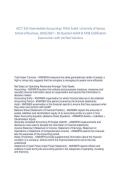
NR-222: Health & Wellness – Final Exam
Question Bank
150+ Multiple Choice Questions with Answers
and Detailed Rationales
Course Note: NR-222 Health & Wellness is a foundational
nursing course focusing on health promotion, disease
prevention, models of health, patient education, and
professional nursing concepts. This question bank is based on
the Chamberlain University curriculum and covers all major
topics tested on the final examination .
Topic 1: Foundations of Health & Wellness (Questions 1-25)
1. According to the World Health Organization (WHO), health
is defined as:
a) The absence of disease or illness
b) A state of complete physical, mental, and social well-being
c) The ability to perform activities of daily living
d) A state determined solely by genetic factors
Answer: b
,Rationale: The WHO (1948) defines health as "a state of
complete physical, mental, and social well-being and not merely
the absence of disease or infirmity." This is a holistic definition
that remains the standard in nursing education .
2. Which model of health defines health as the absence of
illness, signs, and symptoms of disease?
a) Eudaimonistic model
b) Adaptive model
c) Clinical model
d) Role performance model
Answer: c
Rationale: The clinical model defines health as the absence of
illness, signs, and symptoms of disease. It does not emphasize
prevention or wellness, making it the most expensive model
today .
3. A patient states, "I can't go to work because of my back
pain." Which health model is reflected by this statement?
a) Clinical model
b) Adaptive model
c) Eudaimonistic model
d) Role performance model
Answer: d
,Rationale: The role performance model defines health by the
ability to perform social roles, such as working, parenting, or
maintaining family responsibilities. This patient is defining their
health status based on inability to work .
4. Which model of health is defined by "the ability to adjust
positively to social, mental, and psychological change"?
a) Clinical model
b) Adaptive model
c) Role performance model
d) Eudaimonistic model
Answer: b
Rationale: The adaptive model defines health as the ability to
adjust positively to social, mental, and psychological change.
Illness occurs when the person is unable to adjust .
5. A patient with a new diagnosis of diabetes is learning to
give insulin injections. Which domain of learning is being
used?
a) Cognitive
b) Affective
c) Psychomotor
d) Analytical
Answer: c
, Rationale: The psychomotor domain involves acquiring motor
skills through demonstration and return demonstration.
Cognitive involves knowledge, while affective involves feelings,
values, and attitudes .
6. A nurse is teaching a patient about healthy eating. Which
model of health focuses on the absence of disease?
a) Eudaimonistic model
b) Adaptive model
c) Clinical model
d) Role performance model
Answer: c
Rationale: The clinical model defines health as the absence of
illness, signs, and symptoms of disease. It does not emphasize
prevention or wellness .
7. The primary focus of health promotion is to:
a) Treat disease once it occurs
b) Prevent disease and promote wellness
c) Diagnose disease in early stages
d) Cure chronic conditions
Answer: b
Rationale: Health promotion emphasizes proactive strategies to
maintain wellness and prevent illness. It enables people to
increase control over their health .
Question Bank
150+ Multiple Choice Questions with Answers
and Detailed Rationales
Course Note: NR-222 Health & Wellness is a foundational
nursing course focusing on health promotion, disease
prevention, models of health, patient education, and
professional nursing concepts. This question bank is based on
the Chamberlain University curriculum and covers all major
topics tested on the final examination .
Topic 1: Foundations of Health & Wellness (Questions 1-25)
1. According to the World Health Organization (WHO), health
is defined as:
a) The absence of disease or illness
b) A state of complete physical, mental, and social well-being
c) The ability to perform activities of daily living
d) A state determined solely by genetic factors
Answer: b
,Rationale: The WHO (1948) defines health as "a state of
complete physical, mental, and social well-being and not merely
the absence of disease or infirmity." This is a holistic definition
that remains the standard in nursing education .
2. Which model of health defines health as the absence of
illness, signs, and symptoms of disease?
a) Eudaimonistic model
b) Adaptive model
c) Clinical model
d) Role performance model
Answer: c
Rationale: The clinical model defines health as the absence of
illness, signs, and symptoms of disease. It does not emphasize
prevention or wellness, making it the most expensive model
today .
3. A patient states, "I can't go to work because of my back
pain." Which health model is reflected by this statement?
a) Clinical model
b) Adaptive model
c) Eudaimonistic model
d) Role performance model
Answer: d
,Rationale: The role performance model defines health by the
ability to perform social roles, such as working, parenting, or
maintaining family responsibilities. This patient is defining their
health status based on inability to work .
4. Which model of health is defined by "the ability to adjust
positively to social, mental, and psychological change"?
a) Clinical model
b) Adaptive model
c) Role performance model
d) Eudaimonistic model
Answer: b
Rationale: The adaptive model defines health as the ability to
adjust positively to social, mental, and psychological change.
Illness occurs when the person is unable to adjust .
5. A patient with a new diagnosis of diabetes is learning to
give insulin injections. Which domain of learning is being
used?
a) Cognitive
b) Affective
c) Psychomotor
d) Analytical
Answer: c
, Rationale: The psychomotor domain involves acquiring motor
skills through demonstration and return demonstration.
Cognitive involves knowledge, while affective involves feelings,
values, and attitudes .
6. A nurse is teaching a patient about healthy eating. Which
model of health focuses on the absence of disease?
a) Eudaimonistic model
b) Adaptive model
c) Clinical model
d) Role performance model
Answer: c
Rationale: The clinical model defines health as the absence of
illness, signs, and symptoms of disease. It does not emphasize
prevention or wellness .
7. The primary focus of health promotion is to:
a) Treat disease once it occurs
b) Prevent disease and promote wellness
c) Diagnose disease in early stages
d) Cure chronic conditions
Answer: b
Rationale: Health promotion emphasizes proactive strategies to
maintain wellness and prevent illness. It enables people to
increase control over their health .