

BIOL 251 Human Anatomy & Physiolo
| W LAB Module 1 & 2 Practical Exam
Questions & Answers.
BIOL 251 — Modules 1-2
LAB PRACTICAL EXAM
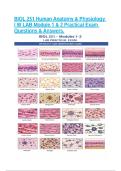
HISTOLOGY SLIDE IDENTIFICATION GUIDE
simple Columnar Epithelium stratified Squamous Epithelium
Dense Regular Connective Tissue
Compact Bone Spongy Bone Trabeculae Smooth Muscle
Cardiac Muscle Skeletal Muscle Multipolar Neuron Oligodendrocytes
Basement Membrane
Astrocytes M Reticular Tissue
,Question 1
Slide shows a single layer of flat cells lining a blood vessel.
« Answer: Simple squamous epithelium
- Rationale: Single layer of flattened cells facilitates diffusion.
Question 2
Slide shows cube-shaped cells with large nuclei lining a gland duct.
« Answer: Simple cuboidal epithelium
- Rationale: Cube-shaped cells function in secretion and absorption.
Question 3
Slide shows column-shaped cells with microvilli lining the small intestine.
« Answer: Simple columnar epithelium
- Rationale: Microvilli increase surface area for absorption.
Question 4
Slide shows stratified layers of flat cells in areas of high abrasion (e.g., esophagus).
« Answer: Stratified squamous epithelium
- Rationale: Multiple layers protectagainst mechanical stress.
, Question 5
Slide shows ciliated cells with goblet cells lining the respiratory tract.
« Answer: Pseudostratified ciliated columnar epithelium
- Rationale: Cilia move mucus, goblet cells secrete mucus.
Question 6
Slide shows multiple layers of rounded and flattened cells lining the urinary
bladder.
« Answer: Transitional epithelium
- Rationale: Transitional epithelium stretches to accommodate urine.
Question 7
Slide shows collagen fibers in parallel bundles connecting muscle to bone.
« Answer: Dense regular connective tissue
- Rationale: Fibers arranged parallel for tensile strength (tendons, ligaments).
Question 8
Slide shows dense connective tissue with fibers arranged irregularly in multiple
directions.
« Answer: Dense irregular connective tissue
- Rationale: Resists stress from multiple directions (dermis).
| W LAB Module 1 & 2 Practical Exam
Questions & Answers.
BIOL 251 — Modules 1-2
LAB PRACTICAL EXAM
HISTOLOGY SLIDE IDENTIFICATION GUIDE
simple Columnar Epithelium stratified Squamous Epithelium
Dense Regular Connective Tissue
Compact Bone Spongy Bone Trabeculae Smooth Muscle
Cardiac Muscle Skeletal Muscle Multipolar Neuron Oligodendrocytes
Basement Membrane
Astrocytes M Reticular Tissue
,Question 1
Slide shows a single layer of flat cells lining a blood vessel.
« Answer: Simple squamous epithelium
- Rationale: Single layer of flattened cells facilitates diffusion.
Question 2
Slide shows cube-shaped cells with large nuclei lining a gland duct.
« Answer: Simple cuboidal epithelium
- Rationale: Cube-shaped cells function in secretion and absorption.
Question 3
Slide shows column-shaped cells with microvilli lining the small intestine.
« Answer: Simple columnar epithelium
- Rationale: Microvilli increase surface area for absorption.
Question 4
Slide shows stratified layers of flat cells in areas of high abrasion (e.g., esophagus).
« Answer: Stratified squamous epithelium
- Rationale: Multiple layers protectagainst mechanical stress.
, Question 5
Slide shows ciliated cells with goblet cells lining the respiratory tract.
« Answer: Pseudostratified ciliated columnar epithelium
- Rationale: Cilia move mucus, goblet cells secrete mucus.
Question 6
Slide shows multiple layers of rounded and flattened cells lining the urinary
bladder.
« Answer: Transitional epithelium
- Rationale: Transitional epithelium stretches to accommodate urine.
Question 7
Slide shows collagen fibers in parallel bundles connecting muscle to bone.
« Answer: Dense regular connective tissue
- Rationale: Fibers arranged parallel for tensile strength (tendons, ligaments).
Question 8
Slide shows dense connective tissue with fibers arranged irregularly in multiple
directions.
« Answer: Dense irregular connective tissue
- Rationale: Resists stress from multiple directions (dermis).

