

Strategic Marketing Management — Study Guide
1. Foundations: What is Strategic Marketing?
1.1 Strategic vs Tactical Marketing Decisions
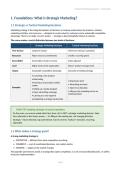
Marketing strategy is the integrated pattern of decisions a company makes about its products, markets,
marketing activities, and resources — designed to create value for customers and a sustainable competitive
advantage. There is no single 'correct' answer — strategy is about thoughtful choices in context.
The course makes a crucial distinction between two levels of decisions:
Strategic Marketing Decisions Tactical Marketing Decisions
Time horizon Long-term (years) Short-term (annual / quarterly)
Resources Major resource commitments Smaller, recurring spend
Reversibility Irreversible or hard to reverse Easily adjusted
Level Higher levels of the organization Brand / product manager level
Output Sustainable competitive advantage Execution of existing strategy
• Launching a new product
• Rebranding
• Brand price level
• Entering a new product-market
combo • Advertising by brand
Examples • Sales force allocation
• Setting up a loyalty program
• Major advertising campaign • Filling in the marketing mix for an
existing product
• Catering to a new segment
• Establishing a strategic partnership
📝 EXAM TIP: Spotting strategic vs tactical questions
On the exam, you may be asked which item from a list is NOT a strategic marketing decision. Sales
force allocation is the classic answer — it's filling in the existing mix, not changing direction.
Strategic = future direction, big commitment, hard to reverse. Tactical = execution, recurring,
adjustable.
1.2 What makes a strategy good?
A strong marketing strategy is:
• DISTINCTIVE — different from what competitors are doing
• COHERENT — a set of coordinated decisions, not random tactics
• DYNAMIC — adapts as the market changes
The opposite (and what to avoid): a strategy that copies competitors, is a set of uncoordinated tactics, or suffers
from poor implementation.
Page 1
, Strategic Marketing Management — Study Guide
🧠 MEMORY AID: D-C-D
DISTINCTIVE · COHERENT · DYNAMIC
If a strategy lacks any of these three, it won't produce sustainable competitive advantage.
-----------------------------------------------------------------------------------------------------------------------------------------------------
2. Strategic Decision Making
This is the most exam-heavy topic. Rob Smith organized it as four big questions: How do we build organizational
knowledge? How do we get help deciding? How do we stay responsive? How do we think rationally?
🧠 MEMORY AID: The 4 pillars of strategic decision making
1. ACCUMULATE knowledge → Organizational learning
2. GET HELP → Wisdom of crowds, data, MMSS
3. BE RESPONSIVE → Business cycles, game theory, implementation intentions
4. THINK RATIONALLY → Expected value calculations + avoid 12 cognitive biases
Mnemonic: "A-G-B-T" = Always Get Better Thinking
2.1 Organizational Learning
"The ability to learn faster than your competitors may be the only sustainable competitive advantage." — De
Geus, 1988
Organizational learning = the process of improving organizational actions through better knowledge and
understanding (Chadwick & Raver 2015). This is a high-priority exam topic.
Three core distinctions
Distinction What it means Why it matters
Individual learning is necessary but
Individual vs NOT sufficient. Without You need mechanisms (meetings,
Organizational sharing/transferring, the org doesn't documents, training) to spread
learning learn. It's more than the sum of the individual insights across the org.
parts.
Explicit = can be codified (manuals, Tacit is harder to transfer BUT also
Explicit vs Tacit procedures, forms). Tacit = 'know- harder to imitate → key competitive
knowledge how', personal, context-specific, hard advantage. Transfer requires social
to communicate. interaction.
Single-loop = solving problems within
Double-loop is generative learning —
current assumptions. Double-loop =
Single-loop vs Double- questioning long-held beliefs about
questioning the assumptions
loop learning your business is hard but vital in
themselves (mission, customers,
turbulent markets.
strategy).
⭐ The 4-Step Learning Process (Huber 1991; Slater & Narver 1995)
Page 2
, Strategic Marketing Management — Study Guide
⚠️
KEY: HIGH PROBABILITY EXAM QUESTION
The 4-step organizational learning process appears explicitly in the practice exam. You must be able
to NAME each step and APPLY it to a marketing case (e.g., "How would Sonos use this to learn
about young consumers?").
Each step must be NAMED EXPLICITLY in your answer — losing points for skipping the name.
Ste
Name What happens Example application
p
Gather information — from
experience, market research, Talk to young consumers in focus
1 ACQUISITION competitive intelligence, surveys, groups about how they listen to
experiments. Exploitation = internal, music.
Exploration = external.
Share that info with others in the firm
— formal (presentations, training, Share insights with R&D, product,
2 DISSEMINATION cross-functional teams) or informal and brand teams via a
(chats). Informal works best for presentation or Slack channel.
uncertain problems.
Agree together on what the Discuss together: does this mean
SHARED information MEANS. Need conflict we need a new product, or just
3
INTERPRETATION resolution, formal meetings, better marketing of the current
alternative options discussed. line?
Behavioral change. Apply the
knowledge: directly to solve a Decide to launch the Portable
4 UTILIZATION problem, to shift managerial Party — and design the marketing
perspectives, or to increase campaign using the new insights.
satisfaction with a change.
🧠 MEMORY AID: "A-D-S-U" — A Dog Saves Us
ACQUISITION → DISSEMINATION → SHARED INTERPRETATION → UTILIZATION
Tip: when asked to apply these to a case, write ONE sentence per step, each starting with the step
name in bold.
Culture & Climate for Learning (Slater & Narver 1995)
Culture = deeply rooted values and beliefs that provide norms. It's the foundation of learning.
Climate = the structures and processes that facilitate desired behaviors.
They must be complementary — values without structures fail, structures without values become bureaucratic.
Four skills managers should develop in themselves and employees:
1. Individual learning effectiveness — learn through ELABORATION (relating new info to existing knowledge
in long-term memory). Beats simple rehearsal.
2. Social interaction & communication skills — informal interaction enhances learning, especially of tacit
knowledge. Cross-functional teams, open offices, social spaces help.
Page 3
, Strategic Marketing Management — Study Guide
3. Conflict resolution — conflict is inevitable AND positive if managed well. Use structured processes
(dialectical inquiry, devil's advocate). Argumentation often backfires.
4. Facilitation / Helpfulness — create cultures and climates of knowledge-sharing. Givers > Takers > Matchers
in long-term performance. Facilitative leadership starts at the top.
⭐ Gottman's 4 Horsemen of the Marriage Apocalypse
These are the four conflict-resolution behaviors to AVOID. They predict relationship failure (originally for
marriages, applied to teams). Worth memorizing — appeared in the past exam.
Horseman What it looks like
Attacking the person's character (not the behavior). "You always...", "You
1. CRITICISM
never..."
2. CONTEMPT Disrespect, mockery, sarcasm, eye-rolling. Worst predictor of breakup.
3. DEFENSIVENESS Refusing to take responsibility, playing the victim, counter-attacking.
4. STONEWALLING Withdrawing, shutting down, refusing to engage. The silent treatment.
🧠 MEMORY AID: "C-C-D-S" Horsemen
Criticism · Contempt · Defensiveness · Stonewalling
If asked to name TWO (as in the past exam), pick the two with the most distinct definitions:
CONTEMPT (mockery) and STONEWALLING (silent treatment) are easiest to define cleanly.
Bonus concepts you may see
• Psychological T-Accounts — coworkers mentally track 'gives' (credits) and 'takes' (debits) in relationships.
The balance determines motivation to continue. BUT — these accounts are biased (we remember what we
gave, forget what we received).
• Givers / Takers / Matchers (Adam Grant) — Givers perform BEST and WORST in life; Takers and Matchers
are in between. Helpfulness culture starts at the top with facilitative leadership.
• The Roman / Loci Method — elaboration learning technique linking new info to spatial memory.
2.2 Get Help Deciding
Wisdom of the Crowd
When facing a decision, the options are:
• Follow your gut (intuition)
• Follow your analysis
• Follow the expert (or HiPPO = Highest Paid Person's Opinion)
• Have the group decide together (compromise)
• Take the average — often beats expert forecasts AND group discussion, IF opinions are diverse,
independent, and averageable.
• Take a weighted average — weighted by experience OR by predictions of the distribution (e.g., "Bayesian
truth serum" or "Surprising-popularity" methods).
Page 4
1. Foundations: What is Strategic Marketing?
1.1 Strategic vs Tactical Marketing Decisions
Marketing strategy is the integrated pattern of decisions a company makes about its products, markets,
marketing activities, and resources — designed to create value for customers and a sustainable competitive
advantage. There is no single 'correct' answer — strategy is about thoughtful choices in context.
The course makes a crucial distinction between two levels of decisions:
Strategic Marketing Decisions Tactical Marketing Decisions
Time horizon Long-term (years) Short-term (annual / quarterly)
Resources Major resource commitments Smaller, recurring spend
Reversibility Irreversible or hard to reverse Easily adjusted
Level Higher levels of the organization Brand / product manager level
Output Sustainable competitive advantage Execution of existing strategy
• Launching a new product
• Rebranding
• Brand price level
• Entering a new product-market
combo • Advertising by brand
Examples • Sales force allocation
• Setting up a loyalty program
• Major advertising campaign • Filling in the marketing mix for an
existing product
• Catering to a new segment
• Establishing a strategic partnership
📝 EXAM TIP: Spotting strategic vs tactical questions
On the exam, you may be asked which item from a list is NOT a strategic marketing decision. Sales
force allocation is the classic answer — it's filling in the existing mix, not changing direction.
Strategic = future direction, big commitment, hard to reverse. Tactical = execution, recurring,
adjustable.
1.2 What makes a strategy good?
A strong marketing strategy is:
• DISTINCTIVE — different from what competitors are doing
• COHERENT — a set of coordinated decisions, not random tactics
• DYNAMIC — adapts as the market changes
The opposite (and what to avoid): a strategy that copies competitors, is a set of uncoordinated tactics, or suffers
from poor implementation.
Page 1
, Strategic Marketing Management — Study Guide
🧠 MEMORY AID: D-C-D
DISTINCTIVE · COHERENT · DYNAMIC
If a strategy lacks any of these three, it won't produce sustainable competitive advantage.
-----------------------------------------------------------------------------------------------------------------------------------------------------
2. Strategic Decision Making
This is the most exam-heavy topic. Rob Smith organized it as four big questions: How do we build organizational
knowledge? How do we get help deciding? How do we stay responsive? How do we think rationally?
🧠 MEMORY AID: The 4 pillars of strategic decision making
1. ACCUMULATE knowledge → Organizational learning
2. GET HELP → Wisdom of crowds, data, MMSS
3. BE RESPONSIVE → Business cycles, game theory, implementation intentions
4. THINK RATIONALLY → Expected value calculations + avoid 12 cognitive biases
Mnemonic: "A-G-B-T" = Always Get Better Thinking
2.1 Organizational Learning
"The ability to learn faster than your competitors may be the only sustainable competitive advantage." — De
Geus, 1988
Organizational learning = the process of improving organizational actions through better knowledge and
understanding (Chadwick & Raver 2015). This is a high-priority exam topic.
Three core distinctions
Distinction What it means Why it matters
Individual learning is necessary but
Individual vs NOT sufficient. Without You need mechanisms (meetings,
Organizational sharing/transferring, the org doesn't documents, training) to spread
learning learn. It's more than the sum of the individual insights across the org.
parts.
Explicit = can be codified (manuals, Tacit is harder to transfer BUT also
Explicit vs Tacit procedures, forms). Tacit = 'know- harder to imitate → key competitive
knowledge how', personal, context-specific, hard advantage. Transfer requires social
to communicate. interaction.
Single-loop = solving problems within
Double-loop is generative learning —
current assumptions. Double-loop =
Single-loop vs Double- questioning long-held beliefs about
questioning the assumptions
loop learning your business is hard but vital in
themselves (mission, customers,
turbulent markets.
strategy).
⭐ The 4-Step Learning Process (Huber 1991; Slater & Narver 1995)
Page 2
, Strategic Marketing Management — Study Guide
⚠️
KEY: HIGH PROBABILITY EXAM QUESTION
The 4-step organizational learning process appears explicitly in the practice exam. You must be able
to NAME each step and APPLY it to a marketing case (e.g., "How would Sonos use this to learn
about young consumers?").
Each step must be NAMED EXPLICITLY in your answer — losing points for skipping the name.
Ste
Name What happens Example application
p
Gather information — from
experience, market research, Talk to young consumers in focus
1 ACQUISITION competitive intelligence, surveys, groups about how they listen to
experiments. Exploitation = internal, music.
Exploration = external.
Share that info with others in the firm
— formal (presentations, training, Share insights with R&D, product,
2 DISSEMINATION cross-functional teams) or informal and brand teams via a
(chats). Informal works best for presentation or Slack channel.
uncertain problems.
Agree together on what the Discuss together: does this mean
SHARED information MEANS. Need conflict we need a new product, or just
3
INTERPRETATION resolution, formal meetings, better marketing of the current
alternative options discussed. line?
Behavioral change. Apply the
knowledge: directly to solve a Decide to launch the Portable
4 UTILIZATION problem, to shift managerial Party — and design the marketing
perspectives, or to increase campaign using the new insights.
satisfaction with a change.
🧠 MEMORY AID: "A-D-S-U" — A Dog Saves Us
ACQUISITION → DISSEMINATION → SHARED INTERPRETATION → UTILIZATION
Tip: when asked to apply these to a case, write ONE sentence per step, each starting with the step
name in bold.
Culture & Climate for Learning (Slater & Narver 1995)
Culture = deeply rooted values and beliefs that provide norms. It's the foundation of learning.
Climate = the structures and processes that facilitate desired behaviors.
They must be complementary — values without structures fail, structures without values become bureaucratic.
Four skills managers should develop in themselves and employees:
1. Individual learning effectiveness — learn through ELABORATION (relating new info to existing knowledge
in long-term memory). Beats simple rehearsal.
2. Social interaction & communication skills — informal interaction enhances learning, especially of tacit
knowledge. Cross-functional teams, open offices, social spaces help.
Page 3
, Strategic Marketing Management — Study Guide
3. Conflict resolution — conflict is inevitable AND positive if managed well. Use structured processes
(dialectical inquiry, devil's advocate). Argumentation often backfires.
4. Facilitation / Helpfulness — create cultures and climates of knowledge-sharing. Givers > Takers > Matchers
in long-term performance. Facilitative leadership starts at the top.
⭐ Gottman's 4 Horsemen of the Marriage Apocalypse
These are the four conflict-resolution behaviors to AVOID. They predict relationship failure (originally for
marriages, applied to teams). Worth memorizing — appeared in the past exam.
Horseman What it looks like
Attacking the person's character (not the behavior). "You always...", "You
1. CRITICISM
never..."
2. CONTEMPT Disrespect, mockery, sarcasm, eye-rolling. Worst predictor of breakup.
3. DEFENSIVENESS Refusing to take responsibility, playing the victim, counter-attacking.
4. STONEWALLING Withdrawing, shutting down, refusing to engage. The silent treatment.
🧠 MEMORY AID: "C-C-D-S" Horsemen
Criticism · Contempt · Defensiveness · Stonewalling
If asked to name TWO (as in the past exam), pick the two with the most distinct definitions:
CONTEMPT (mockery) and STONEWALLING (silent treatment) are easiest to define cleanly.
Bonus concepts you may see
• Psychological T-Accounts — coworkers mentally track 'gives' (credits) and 'takes' (debits) in relationships.
The balance determines motivation to continue. BUT — these accounts are biased (we remember what we
gave, forget what we received).
• Givers / Takers / Matchers (Adam Grant) — Givers perform BEST and WORST in life; Takers and Matchers
are in between. Helpfulness culture starts at the top with facilitative leadership.
• The Roman / Loci Method — elaboration learning technique linking new info to spatial memory.
2.2 Get Help Deciding
Wisdom of the Crowd
When facing a decision, the options are:
• Follow your gut (intuition)
• Follow your analysis
• Follow the expert (or HiPPO = Highest Paid Person's Opinion)
• Have the group decide together (compromise)
• Take the average — often beats expert forecasts AND group discussion, IF opinions are diverse,
independent, and averageable.
• Take a weighted average — weighted by experience OR by predictions of the distribution (e.g., "Bayesian
truth serum" or "Surprising-popularity" methods).
Page 4

