

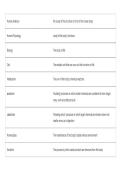
Human Anatomy the study of the structure or form of the human body
Human Physiology study of the body's functions
Biology The study of life
Cell The smallest unit that can carry out the functions of life
Metabolism The sum of the body's chemical reactions
anabolism "building" processes in which smaller chemicals are combined to form larger
ones, such as building muscle
catabolism "breaking down" processes in which larger chemicals are broken down into
smaller ones, as in digestion
Homeostasis The maintenance of the body's stable internal environment
Excretion The process by which waste products are removed from the body
, Growth When more anabolism takes place than catabolism, an increase in the size of
individual cells and/or an increase in the number of cells
Responsiveness or irritability The property of living organisms by which they sense and react to changes in
their environment
Motility The movement of a cell or tissue
Reproduction The production of new cells within an organism or the production of offspring
produces new cells Growth wound repair
chemical level of organization Smallest level of structural organization, Foundation for living things, tiny atoms
to molecules (two and thousands of atoms)
cellular level of organization Contain organelles with specific functions
cell function related to cell structure
cells respond to local environment
cells of body coordinated and controlled to work together
Human Physiology study of the body's functions
Biology The study of life
Cell The smallest unit that can carry out the functions of life
Metabolism The sum of the body's chemical reactions
anabolism "building" processes in which smaller chemicals are combined to form larger
ones, such as building muscle
catabolism "breaking down" processes in which larger chemicals are broken down into
smaller ones, as in digestion
Homeostasis The maintenance of the body's stable internal environment
Excretion The process by which waste products are removed from the body
, Growth When more anabolism takes place than catabolism, an increase in the size of
individual cells and/or an increase in the number of cells
Responsiveness or irritability The property of living organisms by which they sense and react to changes in
their environment
Motility The movement of a cell or tissue
Reproduction The production of new cells within an organism or the production of offspring
produces new cells Growth wound repair
chemical level of organization Smallest level of structural organization, Foundation for living things, tiny atoms
to molecules (two and thousands of atoms)
cellular level of organization Contain organelles with specific functions
cell function related to cell structure
cells respond to local environment
cells of body coordinated and controlled to work together

