

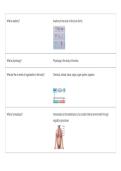
What is anatomy? Anatomy is the study of structure (form).
What is physiology? Physiology is the study of function.
What are the six levels of organization in the body? Chemical, cellular, tissue, organ, organ system, organism.
What is homeostasis? Homeostasis is the maintenance of a constant internal environment through
regulatory processes.
, What are the two types of homeostasis? Dynamic equilibrium and steady state.
What is the anatomical position? The standard position of the body used as a reference point, standing upright,
facing forward, arms at the sides with palms facing forward.
What are directional terms in anatomy? Terms used to describe the location of body structures in relation to other
structures (e.g., superior, inferior, anterior, posterior).
What are the three major planes of the body? Sagittal, frontal (coronal), and transverse planes.
What are the three major ways to cut an organ? Longitudinal, transverse, and oblique sections.
What are the four quadrants of the abdomen? Right upper, right lower, left upper, left lower quadrants.
What are the nine regions of the abdomen? Right hypochondriac, epigastric, left hypochondriac, right lumbar, umbilical, left
lumbar, right iliac, hypogastric, left iliac regions.
What are the major body cavities? Dorsal cavity (cranial and spinal) and ventral cavity (thoracic and abdominopelvic).
What is physiology? Physiology is the study of function.
What are the six levels of organization in the body? Chemical, cellular, tissue, organ, organ system, organism.
What is homeostasis? Homeostasis is the maintenance of a constant internal environment through
regulatory processes.
, What are the two types of homeostasis? Dynamic equilibrium and steady state.
What is the anatomical position? The standard position of the body used as a reference point, standing upright,
facing forward, arms at the sides with palms facing forward.
What are directional terms in anatomy? Terms used to describe the location of body structures in relation to other
structures (e.g., superior, inferior, anterior, posterior).
What are the three major planes of the body? Sagittal, frontal (coronal), and transverse planes.
What are the three major ways to cut an organ? Longitudinal, transverse, and oblique sections.
What are the four quadrants of the abdomen? Right upper, right lower, left upper, left lower quadrants.
What are the nine regions of the abdomen? Right hypochondriac, epigastric, left hypochondriac, right lumbar, umbilical, left
lumbar, right iliac, hypogastric, left iliac regions.
What are the major body cavities? Dorsal cavity (cranial and spinal) and ventral cavity (thoracic and abdominopelvic).

