

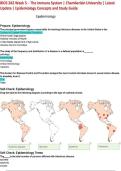
BIOS 242 Week 5 – The Immune System & Epidemiology Concepts | Chamberlain University | Latest Updated Study Guide
Strengthen your understanding of immunology and disease prevention with this comprehensive BIOS 242 Week 5 – The Immune System & Epidemiology Concepts Study Guide developed specifically for students enrolled in Fundamentals of Microbiology at Chamberlain University. This latest updated study resource provides a detailed review of the essential concepts related to the human immune system, host defenses, epidemiology, infectious disease transmission, immune responses, and public health principles commonly covered during Week 5 coursework and assessments. Designed to support exam preparation, weekly assignments, discussion posts, laboratory activities, and quizzes, this study guide presents complex microbiology and immunology concepts in a simplified and organized format. Students will gain a deeper understanding of how the body's defense mechanisms identify, respond to, and eliminate pathogens while learning how epidemiologists track, investigate, and control disease outbreaks within populations. The guide begins with an in-depth exploration of epidemiology, the scientific study of the frequency, distribution, and causes of diseases within defined populations. Learners will review important epidemiological terminology including incidence, prevalence, morbidity, mortality, endemic diseases, epidemics, pandemics, and sporadic outbreaks. The material also explains the role of major public health organizations such as the Centers for Disease Control and Prevention (CDC) and the World Health Organization (WHO) in monitoring and controlling infectious diseases worldwide. Students will learn how infectious diseases spread through populations, the factors that influence transmission rates, and the methods used to investigate outbreaks. Topics include reservoirs of infection, portals of entry and exit, vectors, disease surveillance, biosafety levels, infection control strategies, and public health interventions. These concepts are critical for understanding disease prevention and healthcare safety practices. A major focus of Week 5 is the human immune system and its ability to defend the body against invading microorganisms. This study guide provides a thorough review of innate immunity, which serves as the body's first line of defense against pathogens. Students will examine physical barriers such as skin and mucous membranes, chemical defenses including lysozyme and stomach acid, and biological defenses that prevent microbial colonization. The guide also covers inflammatory responses, fever, phagocytosis, complement proteins, interferons, and natural killer cells. The resource further explores the cells and mechanisms involved in innate immune protection. Learners will review the functions of neutrophils, macrophages, eosinophils, basophils, monocytes, and dendritic cells. Detailed explanations help students understand how these cells recognize pathogens, engulf foreign materials, and initiate immune responses. The study guide emphasizes the importance of phagocytosis and cellular communication in protecting the body from infection. In addition to innate immunity, this updated guide examines adaptive immunity, which provides highly specific and long-lasting protection against pathogens. Students will learn about antigens, antibodies, B lymphocytes, T lymphocytes, plasma cells, memory cells, and immune tolerance. The guide explains how adaptive immunity develops following infection or vaccination and how immune memory contributes to long-term disease protection. Special attention is given to humoral and cell-mediated immunity. Students will review the roles of helper T cells, cytotoxic T cells, regulatory T cells, antigen-presenting cells, and major histocompatibility complex (MHC) molecules. Clear explanations help learners distinguish between antibody-mediated and cell-mediated immune responses while understanding how each contributes to pathogen elimination. The study guide also examines immunoglobulin classes including IgG, IgA, IgM, IgE, and IgD. Learners will understand the unique functions of each antibody type and their importance in infection control, allergic reactions, mucosal protection, and maternal immunity. The material further explains primary and secondary immune responses, vaccination principles, artificial immunity, passive immunity, and active immunity. Laboratory and clinical applications are incorporated throughout the guide to strengthen practical understanding. Students will explore immunology simulations, pathogen-host interactions, immune cell functions, and the relationship between community immunity and global health. The content supports laboratory learning objectives focused on pathogen invasion, immune recognition, antibody production, and disease prevention. This resource is particularly valuable for nursing students, healthcare professionals, allied health learners, and microbiology students seeking to improve academic performance. Important concepts are organized into easy-to-review sections that highlight commonly tested material while promoting deeper understanding of immune system function and epidemiological principles.
Información del documento
- Subido en
- 31 de mayo de 2026
- Número de páginas
- 10
- Escrito en
- 2025/2026
- Tipo
- Examen
- Contiene
- Preguntas y respuestas

