

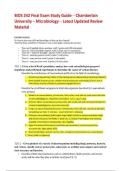
BIOS 242 Final Exam Study Guide – Chamberlain University Microbiology (Latest Updated Review Material)
BIOS 242 Final Exam Study Guide – Chamberlain University Microbiology (Latest Updated Review Material) Prepare for success in BIOS 242: Fundamentals of Microbiology with Lab at Chamberlain University with this comprehensive Final Exam Study Guide designed to help students master essential microbiology concepts and confidently approach their final examination. This updated review resource consolidates the most important topics covered throughout the course, including microbial cell structure, metabolism, genetics, immunology, infectious diseases, laboratory techniques, microbial growth, antimicrobial therapies, and host defense mechanisms. The guide is structured to simplify complex microbiological principles while reinforcing critical concepts frequently tested on exams. This study guide serves as an all-in-one review tool for nursing, healthcare, and allied health students seeking a streamlined approach to exam preparation. Students can strengthen their understanding of bacterial anatomy, cellular processes, microbial classification, staining procedures, laboratory identification methods, and the mechanisms of pathogenic microorganisms. Comprehensive explanations help bridge the gap between theory and clinical application, ensuring learners can connect microbiology concepts to real-world healthcare scenarios. Key areas covered include the history and foundations of microbiology, the contributions of major scientists such as Louis Pasteur and Robert Koch, the role of microorganisms in human health, and the importance of microbial diversity. The guide also explores the Last Universal Common Ancestor (LUCA), microbial evolution, and the significance of microorganisms in environmental and medical microbiology. These foundational concepts establish a strong framework for understanding advanced microbiological principles encountered throughout the course. Students will benefit from detailed reviews of prokaryotic and eukaryotic cell structures, including cell walls, capsules, flagella, pili, ribosomes, plasma membranes, and genetic material. The study guide explains how structural differences influence microbial function, pathogenicity, and susceptibility to antimicrobial agents. Clear diagrams and concise summaries support visual learning and long-term retention of critical information frequently assessed on BIOS 242 examinations. Laboratory-focused content is a major component of this resource. The guide reviews essential microbiology lab techniques such as aseptic technique, microscopy, staining procedures, microbial culturing, colony morphology identification, and biochemical testing. Students can reinforce their understanding of Gram staining, acid-fast staining, endospore staining, and capsule staining while learning the principles behind differential and selective media used in microbial identification. Laboratory competencies are explained in a practical manner to support both theoretical understanding and laboratory success. Microbial growth and metabolism receive extensive coverage, including nutritional requirements, growth phases, oxygen classifications, enzyme function, ATP production, cellular respiration, fermentation, and environmental factors affecting microbial survival. Students gain a thorough understanding of how microorganisms obtain energy, reproduce, and adapt to changing environments. Special attention is given to microbial growth curves, generation times, and methods used to control microbial populations in healthcare settings. The genetics section provides a detailed overview of DNA structure, replication, transcription, translation, mutation mechanisms, horizontal gene transfer, plasmids, and genetic engineering applications. Students can strengthen their understanding of microbial heredity and the mechanisms responsible for antibiotic resistance development. These concepts are particularly important for understanding emerging infectious diseases and modern microbiological research. Immunology content is presented in a clear and organized format, covering innate immunity, adaptive immunity, antigen-antibody interactions, vaccination principles, hypersensitivity reactions, and immune system disorders. The guide explains how the body recognizes and responds to pathogens while highlighting the role of vaccines in disease prevention and public health. Clinical examples help students connect immunological principles to nursing and healthcare practice. Infectious disease concepts include pathogen transmission, epidemiology, disease progression, virulence factors, and major microbial diseases affecting body systems. Students review bacterial, viral, fungal, and parasitic infections while learning diagnostic methods, treatment strategies, and prevention measures. Special emphasis is placed on healthcare-associated infections, infection control procedures, and evidence-based practices used to reduce disease transmission in clinical environments. The antimicrobial therapy section covers antibiotics, antiviral medications, antifungal agents, resistance mechanisms, susceptibility testing, and antimicrobial stewardship. Students learn how various medications target microbial structures and processes while exploring the challenges associated with drug resistance and emerging pathogens. These topics are highly relevant to contemporary healthcare practice and frequently appear on microbiology examinations. Designed for efficient studying, this BIOS 242 Final Exam Study Guide includes concise chapter summaries, key terms, concept reviews, memory aids, practice questions, and exam-focused content. Whether preparing weeks in advance or conducting a final review before the exam, students can use this resource to identify knowledge gaps, reinforce essential concepts, and improve overall exam readiness. The organized format promotes active learning and supports retention of high-yield microbiology content. Ideal for nursing students, healthcare professionals, pre-nursing majors, and allied health learners, this updated review material serves as a valuable companion throughout the BIOS 242 course. By combining foundational microbiology knowledge with practical clinical applications, the guide helps students develop the confidence and competence necessary to excel academically and professionally. With comprehensive coverage of the most important microbiology topics, this resource is an excellent tool for achieving strong final exam performance and long-term mastery of microbiological principles.
Información del documento
- Subido en
- 31 de mayo de 2026
- Número de páginas
- 18
- Escrito en
- 2025/2026
- Tipo
- Examen
- Contiene
- Preguntas y respuestas

