

IGCSE PSYCHOLOGY · CAMBRIDGE INTERNATIONAL
Language, Thought &
Communication
Complete Revision Notes · Topic 4 · Detailed Study Guide
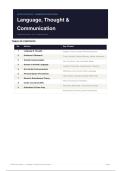
TABLE OF CONTENTS
No. Section Key Content
1 Language & Thought Piaget's Theory vs Sapir-Whorf Hypothesis
2 Evidence & Research Colour Studies, Cultural Memory, Native Americans
3 Animal Communication
Four Functions, Von Frisch Bee Study
4 Human vs Animal Language
Hockett's Properties, Displacement, Planning
5 Non-Verbal Communication
Definitions, Eye Contact, Body Language
6 Personal Space (Proxemics)
Hall's Zones, Cultural & Gender Differences
7 Darwin's Evolutionary Theory
NVC as Evolved and Adaptive
8 Innate vs Learned NVC
Neonates, Blind-Deaf, Yuki Emoticon Study
9 Evaluation & Exam Prep
Key Studies Summary, Essay Frameworks
IGCSE Psychology — Language, Thought & Communication Page 1
, Language & Thought: The Relationship
Language is a system of symbols, sounds, and Thought is the mental process of thinking, forming
1 rules used by humans to communicate thoughts, ideas, solving problems, understanding information,
ideas, feelings, and information to others. and making decisions in the mind.
Key Question: What is the relationship between language and thought? Two major psychological theories
offer opposing views — Piaget argues thought drives language, while Sapir and Whorf argue language
shapes thought. Understanding both is essential for IGCSE Psychology.
1.1 Introduction to the Language-Thought Debate
The relationship between language and thought is one of psychology's oldest and most debated questions. Can
we think without language? Do different languages lead to different ways of thinking? These questions matter
practically — they affect how we understand child development, education, cultural differences, and even
intelligence. Two main theories dominate this debate.
PIAGET'S THEORY SAPIR-WHORF
THOUGHT Language
drives VS shapes
LANGUAGE THOUGHT
The two dominant theories of the language-thought relationship
1.2 Piaget's Theory — Language Depends on Thought 1936
Jean Piaget (1896–1980) — Cognitive Development Precedes Language
Core Argument: Children must first develop a mental concept or schema before they can acquire the
word for it. Cognition leads, language follows. Language is a symbolic tool for expressing already-formed
thought — it does not create thought.
Piaget's Four Stages of Cognitive Development:
•Sensorimotor (0–2 years):
Infants explore the world through senses and actions. Object permanence(understanding
objects exist even when out of sight) develops before any language. This is pure cognitive
development without language.
•Preoperational (2–7 years): Children begin using language to represent objects and events. Egocentric
speech — talking aloud to themselves — is prominent. Piaget argued this reflects thinking-in-progress being
externalised as speech, not language driving thought.
•Concrete Operational (7–11 years): Children master conservation (understanding that quantity stays the
same despite changes in appearance). They must cognitively grasp this before they can describe it.
•Formal Operational (11+): Abstract thinking develops. Language becomes richer, but only because abstract
cognitive schemas have first formed.
Key Evidence Supporting Piaget:
•Object permanence: Infants at 4–8 months show surprise when objects 'disappear' — demonstrating
cognitive understanding before any vocabulary. The concept of 'continuity' precedes any word for it.
•Pre-linguistic problem solving: Babies and many animals solve spatial problems without language,
showing cognition is possible without words.
•Vygotsky's counter: Lev Vygotsky (1962) disagreed with Piaget, arguing that egocentric speech is social
speech turned inward — that language actually scaffolds thought. This remains a rich debate.
Practical Implication: If Piaget is right, the best way to improve children's thinking is to enrich their
experiences and cognitive challenges — not just expand their vocabulary.
IGCSE Psychology — Language, Thought & Communication Page 2
,
Language, Thought &
Communication
Complete Revision Notes · Topic 4 · Detailed Study Guide
TABLE OF CONTENTS
No. Section Key Content
1 Language & Thought Piaget's Theory vs Sapir-Whorf Hypothesis
2 Evidence & Research Colour Studies, Cultural Memory, Native Americans
3 Animal Communication
Four Functions, Von Frisch Bee Study
4 Human vs Animal Language
Hockett's Properties, Displacement, Planning
5 Non-Verbal Communication
Definitions, Eye Contact, Body Language
6 Personal Space (Proxemics)
Hall's Zones, Cultural & Gender Differences
7 Darwin's Evolutionary Theory
NVC as Evolved and Adaptive
8 Innate vs Learned NVC
Neonates, Blind-Deaf, Yuki Emoticon Study
9 Evaluation & Exam Prep
Key Studies Summary, Essay Frameworks
IGCSE Psychology — Language, Thought & Communication Page 1
, Language & Thought: The Relationship
Language is a system of symbols, sounds, and Thought is the mental process of thinking, forming
1 rules used by humans to communicate thoughts, ideas, solving problems, understanding information,
ideas, feelings, and information to others. and making decisions in the mind.
Key Question: What is the relationship between language and thought? Two major psychological theories
offer opposing views — Piaget argues thought drives language, while Sapir and Whorf argue language
shapes thought. Understanding both is essential for IGCSE Psychology.
1.1 Introduction to the Language-Thought Debate
The relationship between language and thought is one of psychology's oldest and most debated questions. Can
we think without language? Do different languages lead to different ways of thinking? These questions matter
practically — they affect how we understand child development, education, cultural differences, and even
intelligence. Two main theories dominate this debate.
PIAGET'S THEORY SAPIR-WHORF
THOUGHT Language
drives VS shapes
LANGUAGE THOUGHT
The two dominant theories of the language-thought relationship
1.2 Piaget's Theory — Language Depends on Thought 1936
Jean Piaget (1896–1980) — Cognitive Development Precedes Language
Core Argument: Children must first develop a mental concept or schema before they can acquire the
word for it. Cognition leads, language follows. Language is a symbolic tool for expressing already-formed
thought — it does not create thought.
Piaget's Four Stages of Cognitive Development:
•Sensorimotor (0–2 years):
Infants explore the world through senses and actions. Object permanence(understanding
objects exist even when out of sight) develops before any language. This is pure cognitive
development without language.
•Preoperational (2–7 years): Children begin using language to represent objects and events. Egocentric
speech — talking aloud to themselves — is prominent. Piaget argued this reflects thinking-in-progress being
externalised as speech, not language driving thought.
•Concrete Operational (7–11 years): Children master conservation (understanding that quantity stays the
same despite changes in appearance). They must cognitively grasp this before they can describe it.
•Formal Operational (11+): Abstract thinking develops. Language becomes richer, but only because abstract
cognitive schemas have first formed.
Key Evidence Supporting Piaget:
•Object permanence: Infants at 4–8 months show surprise when objects 'disappear' — demonstrating
cognitive understanding before any vocabulary. The concept of 'continuity' precedes any word for it.
•Pre-linguistic problem solving: Babies and many animals solve spatial problems without language,
showing cognition is possible without words.
•Vygotsky's counter: Lev Vygotsky (1962) disagreed with Piaget, arguing that egocentric speech is social
speech turned inward — that language actually scaffolds thought. This remains a rich debate.
Practical Implication: If Piaget is right, the best way to improve children's thinking is to enrich their
experiences and cognitive challenges — not just expand their vocabulary.
IGCSE Psychology — Language, Thought & Communication Page 2
,

