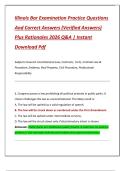
ILLINOIS BAR EXAM – PRACTICE QUESTIONS AND CORRECT ANSWERS (VERIFIED ANSWERS)
PLUS RATIONALES 2026 Q&A | INSTANT DOWNLOAD PDF.
Core Domains
- Constitutional Law
- Contracts and Sales
- Criminal Law and Procedure
- Evidence
- Real Property
- Torts
- Civil Procedure
- Professional Responsibility
Introduction
The purpose of this examination is to evaluate the legal knowledge, analytical skills, and profes
SECTION ONE: QUESTIONS 1–100
1. A homeowner and a contractor entered into a written contract for the construction of a deck for
$10,000. After the contractor completed half of the deck, he informed the homeowner that due to an
increase in the cost of lumber, he would need an additional $2,000 to finish the job. The homeowner,
desperate to have the deck completed for an upcoming party, agreed in writing to pay the extra
$2,000. Upon completion of the deck, the homeowner paid the contractor $10,000 but refused to pay
the additional $2,000. If the contractor sues for the $2,000, who will prevail?
A. The contractor, because the modification was in writing and signed by the homeowner.
B. The contractor, because the increased cost of lumber constituted an unforeseeable difficulty.
,C. The homeowner, because the contractor was under a preexisting duty to build the deck for $10,000.
D. The homeowner, because a contract modification always requires fresh consideration on both sides.
🟢 Correct answer: C
🔴 Explanation: 🔴 RATIONALE: Under the common law rule governing services and construction
contracts, a modification requires new consideration to be enforceable. The contractor had a preexisting
legal duty to complete the deck for the original price, and the lumber cost increase does not rise to the
level of an unpredicted, extraordinary difficulty sufficient to excuse performance or justify a consideration-
free modification.
2. A pedestrian was struck by a car while crossing a street within a designated crosswalk. The
pedestrian sued the driver for negligence. At trial, the pedestrian seeks to introduce testimony from a
bystander who states that five minutes after the accident, the driver walked over to the pedestrian
and said, "I'm so sorry, I was texting my wife and didn't see the light turn red. Let me pay for your
hospital bills." The driver's attorney objects to the admission of the statement. How should the court
rule regarding the statement about paying hospital bills?
A. Admissible, because it constitutes an admission by a party-opponent.
B. Admissible, because it is part of an excited utterance made right after the accident.
C. Inadmissible, because statements offering to pay medical expenses are excluded on public policy
grounds.
D. Inadmissible, because the statement is hearsay not falling within any recognized exception.
🟢 Correct answer: C
🔴 Explanation: 🔴 RATIONALE: Federal Rule of Evidence 409 (and matching state standards) excludes
evidence of offering to pay medical or hospital expenses to prove liability for the injury. While the
accompanying admission of texting ("I was texting my wife...") is severable and admissible as a party-
opponent statement, the explicit offer to pay the bills must be excluded.
3. A defendant was arrested and charged with armed robbery. During the trial, the prosecution called
the defendant's spouse to testify about seeing the defendant hide a bloody ski mask and a bag of
cash in their basement the night the robbery took place. The defendant objects, asserting the martial
, communications privilege, while the spouse is willing to testify. How should the court rule on the
admissibility of this testimony?
A. Admissible, because the spouse is willing to testify and holds the privilege in criminal cases.
B. Admissible, because the observation of physical acts does not constitute a confidential communication.
C. Inadmissible, because the defendant holds the privilege and can prevent the spouse from testifying to
confidential matters.
D. Inadmissible, because the privilege automatically bars all spousal testimony against a defendant in a
criminal proceeding.
🟢 Correct answer: B
🔴 Explanation: 🔴 RATIONALE: The confidential marital communications privilege protects
communications made in confidence during the marriage. However, a spouse’s observation of the other
spouse's physical actions, such as hiding items in a basement, is considered an act rather than a
communication, and therefore falls outside the protection of the privilege.
4. A developer purchased a large tract of land with the intention of building a residential subdivision.
The local zoning ordinance permitted only single-family homes with a minimum lot size of one acre.
The developer filed a petition with the local zoning board requesting a variance to allow for half-acre
lots, arguing that the topography of the land made one-acre lots economically unfeasible. The board
denied the variance. The developer then filed a lawsuit in federal court claiming that the zoning
ordinance constitutes a regulatory taking without just compensation. Is the developer likely to
prevail?
A. Yes, because the restriction significantly diminishes the economic value of the developer's investment
property.
B. Yes, because zoning boards cannot enforce ordinances that result in individual financial hardship.
C. No, because the ordinance leaves the developer with an economically viable use of the land as single-
family homes on one-acre lots.
D. No, because regulatory takings actions cannot be brought against local municipal zoning boards in
federal court.
, 🟢 Correct answer: C
🔴 Explanation: 🔴 RATIONALE: A regulatory taking occurs only if a government regulation deprives an
owner of all economically beneficial use of the property (a categorical taking) or deeply interferes with
distinct investment-backed expectations under a balancing test. Because the developer can still build
single-family homes on one-acre lots, the property retains significant economic viability, meaning no
taking has occurred.
5. An entrepreneur mailed a signed letter to a manufacturer on May 1 stating, "I offer to buy 500
widgets from you for $5,000. This offer will remain open until May 15." The manufacturer received
the letter on May 3. On May 6, the entrepreneur changed his mind and mailed a revocation to the
manufacturer. On May 7, before receiving the revocation, the manufacturer mailed a letter of
acceptance. The manufacturer received the entrepreneur's revocation on May 8, and the
entrepreneur received the manufacturer's acceptance on May 9. Was a valid contract formed?
A. Yes, because the entrepreneur promised to keep the offer open until May 15.
B. Yes, because the acceptance was mailed before the revocation became effective upon receipt.
C. No, because the entrepreneur revoked the offer before the acceptance was received.
D. No, because there was no consideration given to keep the offer open until May 15.
🟢 Correct answer: B
🔴 Explanation: 🔴 RATIONALE: Under the mailbox rule, an acceptance is effective upon dispatch,
whereas a revocation is only effective upon receipt by the offeree. Since the manufacturer dispatched the
acceptance on May 7 before receiving the revocation on May 8, a binding contract was formed at the
moment of mailing. The promise to keep the offer open was not a firm offer because the entrepreneur is
not a merchant offering to sell goods under UCC 2-205, making it revocable, but it was not revoked in
time.
6. A state legislature passed a statute requiring all commercial trucks operating on its highways to be
equipped with a specific, highly expensive type of retroreflective safety numbering on the rear doors.
The stated purpose was to reduce nighttime collisions. A federal highway safety regulation already
mandated standard reflective stripping on all commercial interstate vehicles. A nationwide trucking
PLUS RATIONALES 2026 Q&A | INSTANT DOWNLOAD PDF.
Core Domains
- Constitutional Law
- Contracts and Sales
- Criminal Law and Procedure
- Evidence
- Real Property
- Torts
- Civil Procedure
- Professional Responsibility
Introduction
The purpose of this examination is to evaluate the legal knowledge, analytical skills, and profes
SECTION ONE: QUESTIONS 1–100
1. A homeowner and a contractor entered into a written contract for the construction of a deck for
$10,000. After the contractor completed half of the deck, he informed the homeowner that due to an
increase in the cost of lumber, he would need an additional $2,000 to finish the job. The homeowner,
desperate to have the deck completed for an upcoming party, agreed in writing to pay the extra
$2,000. Upon completion of the deck, the homeowner paid the contractor $10,000 but refused to pay
the additional $2,000. If the contractor sues for the $2,000, who will prevail?
A. The contractor, because the modification was in writing and signed by the homeowner.
B. The contractor, because the increased cost of lumber constituted an unforeseeable difficulty.
,C. The homeowner, because the contractor was under a preexisting duty to build the deck for $10,000.
D. The homeowner, because a contract modification always requires fresh consideration on both sides.
🟢 Correct answer: C
🔴 Explanation: 🔴 RATIONALE: Under the common law rule governing services and construction
contracts, a modification requires new consideration to be enforceable. The contractor had a preexisting
legal duty to complete the deck for the original price, and the lumber cost increase does not rise to the
level of an unpredicted, extraordinary difficulty sufficient to excuse performance or justify a consideration-
free modification.
2. A pedestrian was struck by a car while crossing a street within a designated crosswalk. The
pedestrian sued the driver for negligence. At trial, the pedestrian seeks to introduce testimony from a
bystander who states that five minutes after the accident, the driver walked over to the pedestrian
and said, "I'm so sorry, I was texting my wife and didn't see the light turn red. Let me pay for your
hospital bills." The driver's attorney objects to the admission of the statement. How should the court
rule regarding the statement about paying hospital bills?
A. Admissible, because it constitutes an admission by a party-opponent.
B. Admissible, because it is part of an excited utterance made right after the accident.
C. Inadmissible, because statements offering to pay medical expenses are excluded on public policy
grounds.
D. Inadmissible, because the statement is hearsay not falling within any recognized exception.
🟢 Correct answer: C
🔴 Explanation: 🔴 RATIONALE: Federal Rule of Evidence 409 (and matching state standards) excludes
evidence of offering to pay medical or hospital expenses to prove liability for the injury. While the
accompanying admission of texting ("I was texting my wife...") is severable and admissible as a party-
opponent statement, the explicit offer to pay the bills must be excluded.
3. A defendant was arrested and charged with armed robbery. During the trial, the prosecution called
the defendant's spouse to testify about seeing the defendant hide a bloody ski mask and a bag of
cash in their basement the night the robbery took place. The defendant objects, asserting the martial
, communications privilege, while the spouse is willing to testify. How should the court rule on the
admissibility of this testimony?
A. Admissible, because the spouse is willing to testify and holds the privilege in criminal cases.
B. Admissible, because the observation of physical acts does not constitute a confidential communication.
C. Inadmissible, because the defendant holds the privilege and can prevent the spouse from testifying to
confidential matters.
D. Inadmissible, because the privilege automatically bars all spousal testimony against a defendant in a
criminal proceeding.
🟢 Correct answer: B
🔴 Explanation: 🔴 RATIONALE: The confidential marital communications privilege protects
communications made in confidence during the marriage. However, a spouse’s observation of the other
spouse's physical actions, such as hiding items in a basement, is considered an act rather than a
communication, and therefore falls outside the protection of the privilege.
4. A developer purchased a large tract of land with the intention of building a residential subdivision.
The local zoning ordinance permitted only single-family homes with a minimum lot size of one acre.
The developer filed a petition with the local zoning board requesting a variance to allow for half-acre
lots, arguing that the topography of the land made one-acre lots economically unfeasible. The board
denied the variance. The developer then filed a lawsuit in federal court claiming that the zoning
ordinance constitutes a regulatory taking without just compensation. Is the developer likely to
prevail?
A. Yes, because the restriction significantly diminishes the economic value of the developer's investment
property.
B. Yes, because zoning boards cannot enforce ordinances that result in individual financial hardship.
C. No, because the ordinance leaves the developer with an economically viable use of the land as single-
family homes on one-acre lots.
D. No, because regulatory takings actions cannot be brought against local municipal zoning boards in
federal court.
, 🟢 Correct answer: C
🔴 Explanation: 🔴 RATIONALE: A regulatory taking occurs only if a government regulation deprives an
owner of all economically beneficial use of the property (a categorical taking) or deeply interferes with
distinct investment-backed expectations under a balancing test. Because the developer can still build
single-family homes on one-acre lots, the property retains significant economic viability, meaning no
taking has occurred.
5. An entrepreneur mailed a signed letter to a manufacturer on May 1 stating, "I offer to buy 500
widgets from you for $5,000. This offer will remain open until May 15." The manufacturer received
the letter on May 3. On May 6, the entrepreneur changed his mind and mailed a revocation to the
manufacturer. On May 7, before receiving the revocation, the manufacturer mailed a letter of
acceptance. The manufacturer received the entrepreneur's revocation on May 8, and the
entrepreneur received the manufacturer's acceptance on May 9. Was a valid contract formed?
A. Yes, because the entrepreneur promised to keep the offer open until May 15.
B. Yes, because the acceptance was mailed before the revocation became effective upon receipt.
C. No, because the entrepreneur revoked the offer before the acceptance was received.
D. No, because there was no consideration given to keep the offer open until May 15.
🟢 Correct answer: B
🔴 Explanation: 🔴 RATIONALE: Under the mailbox rule, an acceptance is effective upon dispatch,
whereas a revocation is only effective upon receipt by the offeree. Since the manufacturer dispatched the
acceptance on May 7 before receiving the revocation on May 8, a binding contract was formed at the
moment of mailing. The promise to keep the offer open was not a firm offer because the entrepreneur is
not a merchant offering to sell goods under UCC 2-205, making it revocable, but it was not revoked in
time.
6. A state legislature passed a statute requiring all commercial trucks operating on its highways to be
equipped with a specific, highly expensive type of retroreflective safety numbering on the rear doors.
The stated purpose was to reduce nighttime collisions. A federal highway safety regulation already
mandated standard reflective stripping on all commercial interstate vehicles. A nationwide trucking