International economics
Chapter 1 : Gravity / Is the world flat?
Although we are living in a globalizing society, we are still a relatively close
Economy since we still observe a lot of trade barriers (the world is not flat). So we
have to measure the openness of a country or world.
Openness Openness ratio = World imports/World GDP
ratio - It measures how large international trade is relative to
total global production
- A higher ratio means countries rely more on trade
- If the ratio increases : the world is becoming more
integrated through trade
- If the ratio decreases : trade becomes less important
relative to production
1.1 World import/GDP : evidence that measures the openness of a country
Evolution of the ratio (1960-2010)
The graph show two lines
1. All trade (black line)
2. Excluding oil (red line)
What do we observe :
- The ratio rises from about 10-
12% in 1960
- To around 25-30% in 2010
Conclusions : openness clearly
increased over time
The world economy became more
integrated – sometimes described as a
“flatter world”.
Why exclude oil?
Oil is often excluded because :
1) Oil prices are very volatile
2) Oil shocks ‘1970s, 2008) can create large spikes in trade values
3) Oil trade reflects price movements, not necessarily deeper integration
What is a “flat world” or openness?
A flat world = no trade barriers (maximum openness) , no discrimination between
domestic and foreign goods. In theory :
- Countries would consumer goods proportional to their share of world
production
- Trade would be much higher than today, but even then, the ratio would not
be 100% because not everything is traded.
1
,Benchmark for Openness – Helpman (1987) :
Idea = compare the real world to an ideal world without trade barriers.
Assumptions :
o No tariffs or transport costs
o No discrimination between domestic and foreign goods
o Foreign goods are as accessible and desirable as domestic ones
Implication : Each country consumes in proportion to its share of world GDP.
Example : If Belgium is 0.5% of world GDP, it consumers 0.5% of China’s output,
0.5% of Portugal’s output, ... .
- This is the maximum openness benchmark (most open world possible with no
trade barriers, no preference for domestic goods, ..) :
If actual trade is below this level, it means that 1) borders still matter 2)
people prefer domestic goods (home bias). So the world is not fully
integrated.
Defining the benchmark :
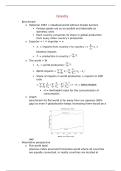
Notations
Imports
Imports/GDP
i≠n Because you do not take your own production
The Import = the world production so the first part of the equation is 1 and the
other one we can call H which is the concentration of consumption.
2
,Globalization Gap :
Plot : Openness vs Benchmark (1-H)
What do we see?
(1)Large level difference / large Gap
o Benchmark : about 80-90%
o Actual openness : about 15-30%
Big difference (around 60 p)- : this show borders
and home bias still strongly limit trade.
(2) Evolution over time
o Openness increases over time. But
compared to the benchmark, the gap does
not shrink much.
o So, even with globalization, the world is
not much closer to a fully integrated,
borderless economy.
1.2 Bilateral trade frictions : Alternative perspective : Flat world ideal
Trade between countries without impact of bilateral frictions :
It is the share of production of partner in overall GDP in relation to that of the
exporter.
3
, Conclusion : The world if far from the flat-word ideal. 1) Trade is rising faster than
GDP 2) Globalization gap much wider than the total increase in openness 3)
Distance deters trade even more than in the 1950s.
1.3 Force of the gravity
Trade and economic size :
Bigger EU countries : 1) import more from New Zealand and 2) export more to
New Zealand. Country size (GDP) is an important determinant of trade flows.
Relationship between EU imports from New-
Zealand and GDP in billion USD :
There is a positive linear relationship :
- Bigger EU countries (higher GDP) import
more from New Zealand than smaller
countries
- The line of best fit is upward sloping
Relationship between EU exports to New-
Zealand and GDP in billion USD :
There is a positive relationship :
- Bigger EU countries export more to New
Zealand than smaller countries.
Why New Zealand? NZ is very far from
Europe, so :
- Distance is large and similar for all EU
countries
- differences in trade mainly reflect country
size (GDP).
Trade and distance
Normalizing by GDP : On the vertical axis, trade is divided by GDP this removes
the effect of country size. We now focus only on how distance affects trade.
Relationship between trade and
distance :
(left = import, right = export)
We observe a negative linear
relationship :
- the cloud of points is decreasing
- the best-fit line slopes downward
If distance did not matter, the line
would be flat. But it is clearly
downward sloping
4
Chapter 1 : Gravity / Is the world flat?
Although we are living in a globalizing society, we are still a relatively close
Economy since we still observe a lot of trade barriers (the world is not flat). So we
have to measure the openness of a country or world.
Openness Openness ratio = World imports/World GDP
ratio - It measures how large international trade is relative to
total global production
- A higher ratio means countries rely more on trade
- If the ratio increases : the world is becoming more
integrated through trade
- If the ratio decreases : trade becomes less important
relative to production
1.1 World import/GDP : evidence that measures the openness of a country
Evolution of the ratio (1960-2010)
The graph show two lines
1. All trade (black line)
2. Excluding oil (red line)
What do we observe :
- The ratio rises from about 10-
12% in 1960
- To around 25-30% in 2010
Conclusions : openness clearly
increased over time
The world economy became more
integrated – sometimes described as a
“flatter world”.
Why exclude oil?
Oil is often excluded because :
1) Oil prices are very volatile
2) Oil shocks ‘1970s, 2008) can create large spikes in trade values
3) Oil trade reflects price movements, not necessarily deeper integration
What is a “flat world” or openness?
A flat world = no trade barriers (maximum openness) , no discrimination between
domestic and foreign goods. In theory :
- Countries would consumer goods proportional to their share of world
production
- Trade would be much higher than today, but even then, the ratio would not
be 100% because not everything is traded.
1
,Benchmark for Openness – Helpman (1987) :
Idea = compare the real world to an ideal world without trade barriers.
Assumptions :
o No tariffs or transport costs
o No discrimination between domestic and foreign goods
o Foreign goods are as accessible and desirable as domestic ones
Implication : Each country consumes in proportion to its share of world GDP.
Example : If Belgium is 0.5% of world GDP, it consumers 0.5% of China’s output,
0.5% of Portugal’s output, ... .
- This is the maximum openness benchmark (most open world possible with no
trade barriers, no preference for domestic goods, ..) :
If actual trade is below this level, it means that 1) borders still matter 2)
people prefer domestic goods (home bias). So the world is not fully
integrated.
Defining the benchmark :
Notations
Imports
Imports/GDP
i≠n Because you do not take your own production
The Import = the world production so the first part of the equation is 1 and the
other one we can call H which is the concentration of consumption.
2
,Globalization Gap :
Plot : Openness vs Benchmark (1-H)
What do we see?
(1)Large level difference / large Gap
o Benchmark : about 80-90%
o Actual openness : about 15-30%
Big difference (around 60 p)- : this show borders
and home bias still strongly limit trade.
(2) Evolution over time
o Openness increases over time. But
compared to the benchmark, the gap does
not shrink much.
o So, even with globalization, the world is
not much closer to a fully integrated,
borderless economy.
1.2 Bilateral trade frictions : Alternative perspective : Flat world ideal
Trade between countries without impact of bilateral frictions :
It is the share of production of partner in overall GDP in relation to that of the
exporter.
3
, Conclusion : The world if far from the flat-word ideal. 1) Trade is rising faster than
GDP 2) Globalization gap much wider than the total increase in openness 3)
Distance deters trade even more than in the 1950s.
1.3 Force of the gravity
Trade and economic size :
Bigger EU countries : 1) import more from New Zealand and 2) export more to
New Zealand. Country size (GDP) is an important determinant of trade flows.
Relationship between EU imports from New-
Zealand and GDP in billion USD :
There is a positive linear relationship :
- Bigger EU countries (higher GDP) import
more from New Zealand than smaller
countries
- The line of best fit is upward sloping
Relationship between EU exports to New-
Zealand and GDP in billion USD :
There is a positive relationship :
- Bigger EU countries export more to New
Zealand than smaller countries.
Why New Zealand? NZ is very far from
Europe, so :
- Distance is large and similar for all EU
countries
- differences in trade mainly reflect country
size (GDP).
Trade and distance
Normalizing by GDP : On the vertical axis, trade is divided by GDP this removes
the effect of country size. We now focus only on how distance affects trade.
Relationship between trade and
distance :
(left = import, right = export)
We observe a negative linear
relationship :
- the cloud of points is decreasing
- the best-fit line slopes downward
If distance did not matter, the line
would be flat. But it is clearly
downward sloping
4