

OpenStax Biology 2e Instructor Answer Guide
Biology 2e
Unit 5: Biological Diversity
Chapter 27: Introduction to Animal Diversity
Visual Connection Questions
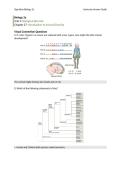
1. If a Hox 13 gene in a mouse was replaced with a Hox 1 gene, how might this alter animal
development?
The animal might develop two heads and no tail.
2. Which of the following statements is false?
c. Acoela and Cnidaria both possess radial symmetry.
, OpenStax Biology 2e Instructor Answer Guide
3. Which of the following statements about diploblasts and triploblasts is false?
d. The mesoderm gives rise to the central nervous system.
Review Questions
4. Which of the following is not a feature common to most animals?
b. asexual reproduction
5. During embryonic development, unique cell layers develop and distinguish during a stage
called ________.
c. the gastrula stage
6. Which of the following phenotypes would most likely be the result of a Hox gene mutation?
d. two fewer appendages than normal
7. Which of the following organism is most likely to be a diploblast?
c. jellyfish
8. Which of the following is not possible?
b. diploblastic eucoelomate
9. An animal whose development is marked by radial cleavage and enterocoely is ________.
a. a deuterostome
10. Consulting the modern phylogenetic tree of animals, which of the following would not
constitute a clade?
c. Parazoa
11. Which of the following is thought to be the most closely related to the common animal
ancestor?
b. protist cells
Biology 2e
Unit 5: Biological Diversity
Chapter 27: Introduction to Animal Diversity
Visual Connection Questions
1. If a Hox 13 gene in a mouse was replaced with a Hox 1 gene, how might this alter animal
development?
The animal might develop two heads and no tail.
2. Which of the following statements is false?
c. Acoela and Cnidaria both possess radial symmetry.
, OpenStax Biology 2e Instructor Answer Guide
3. Which of the following statements about diploblasts and triploblasts is false?
d. The mesoderm gives rise to the central nervous system.
Review Questions
4. Which of the following is not a feature common to most animals?
b. asexual reproduction
5. During embryonic development, unique cell layers develop and distinguish during a stage
called ________.
c. the gastrula stage
6. Which of the following phenotypes would most likely be the result of a Hox gene mutation?
d. two fewer appendages than normal
7. Which of the following organism is most likely to be a diploblast?
c. jellyfish
8. Which of the following is not possible?
b. diploblastic eucoelomate
9. An animal whose development is marked by radial cleavage and enterocoely is ________.
a. a deuterostome
10. Consulting the modern phylogenetic tree of animals, which of the following would not
constitute a clade?
c. Parazoa
11. Which of the following is thought to be the most closely related to the common animal
ancestor?
b. protist cells

