

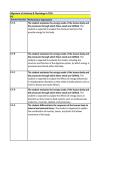
Alignment of Anatomy & Physiology to TEKS
HS
Standard Number Performance Expectation
C-5-A The student evaluates the energy needs of the human body and
the processes through which these needs are fulfilled. The
student is expected to analyze the chemical reactions that
provide energy for the body.
C-5-B The student evaluates the energy needs of the human body and
the processes through which these needs are fulfilled. The
student is expected to evaluate the modes, including the
structure and function of the digestive system, by which energy is
processed and stored within the body.
C-5-C The student evaluates the energy needs of the human body and
the processes through which these needs are fulfilled. The
student is expected to analyze the effects of energy deficiencies
in malabsorption disorders as they relate to body systems such as
Crohn's disease and cystic fibrosis.
C-5-D The student evaluates the energy needs of the human body and
the processes through which these needs are fulfilled. The
student is expected to analyze the effects of energy excess in
disorders as they relate to body systems such as cardiovascular,
endocrine, muscular, skeletal, and pulmonary.
C-6-A The student differentiates the responses of the human body to
internal and external forces. The student is expected to explain
the coordination of muscles, bones, and joints that allows
movement of the body;
,C-6-B The student differentiates the responses of the human body to
internal and external forces. The student is expected to
investigate and report the uses of various diagnostic and
therapeutic technologies.
C-6-C The student differentiates the responses of the human body to
internal and external forces. The student is expected to interpret
normal and abnormal contractility conditions such as in edema,
glaucoma, aneurysms, and hemorrhage.
C-6-D The student differentiates the responses of the human body to
internal and external forces. The student is expected to analyze
and describe the effects of pressure, movement, torque, tension,
and elasticity on the human body.
C-6-E The student differentiates the responses of the human body to
internal and external forces. The student is expected to perform
an investigation to determine causes and effects of force variance
and communicate findings.
C-7-A The student examines the body processes that maintain
homeostasis. The student is expected to investigate and describe
the integration of the chemical and physical processes, including
equilibrium, temperature, pH balance, chemical reactions, passive
transport, active transport, and biofeedback, that contribute to
homeostasis.
, C-7-B The student examines the body processes that maintain
homeostasis. The student is expected to determine the
consequences of the failure to maintain homeostasis.
C-8-A The student examines the electrical conduction processes and
interactions. The student is expected to illustrate conduction
systems such as nerve transmission or muscle stimulation.
C-8-B The student examines the electrical conduction processes and
interactions. The student is expected to investigate the
therapeutic uses and effects of external sources of electricity on
the body system.
C-8-C The student examines the electrical conduction processes and
interactions. The student is expected to evaluate the application
of advanced technologies such as electroencephalogram,
electrocardiogram, bionics, transcutaneous electrical nerve
stimulation, and cardioversion.
C-9-A The student explores the body's transport systems. The student
is expected to analyze the physical, chemical, and biological
properties of transport systems, including circulatory, respiratory,
and excretory;
C-9-B The student explores the body's transport systems. The student
is expected to determine the factors that alter the normal
functions of transport systems.
HS
Standard Number Performance Expectation
C-5-A The student evaluates the energy needs of the human body and
the processes through which these needs are fulfilled. The
student is expected to analyze the chemical reactions that
provide energy for the body.
C-5-B The student evaluates the energy needs of the human body and
the processes through which these needs are fulfilled. The
student is expected to evaluate the modes, including the
structure and function of the digestive system, by which energy is
processed and stored within the body.
C-5-C The student evaluates the energy needs of the human body and
the processes through which these needs are fulfilled. The
student is expected to analyze the effects of energy deficiencies
in malabsorption disorders as they relate to body systems such as
Crohn's disease and cystic fibrosis.
C-5-D The student evaluates the energy needs of the human body and
the processes through which these needs are fulfilled. The
student is expected to analyze the effects of energy excess in
disorders as they relate to body systems such as cardiovascular,
endocrine, muscular, skeletal, and pulmonary.
C-6-A The student differentiates the responses of the human body to
internal and external forces. The student is expected to explain
the coordination of muscles, bones, and joints that allows
movement of the body;
,C-6-B The student differentiates the responses of the human body to
internal and external forces. The student is expected to
investigate and report the uses of various diagnostic and
therapeutic technologies.
C-6-C The student differentiates the responses of the human body to
internal and external forces. The student is expected to interpret
normal and abnormal contractility conditions such as in edema,
glaucoma, aneurysms, and hemorrhage.
C-6-D The student differentiates the responses of the human body to
internal and external forces. The student is expected to analyze
and describe the effects of pressure, movement, torque, tension,
and elasticity on the human body.
C-6-E The student differentiates the responses of the human body to
internal and external forces. The student is expected to perform
an investigation to determine causes and effects of force variance
and communicate findings.
C-7-A The student examines the body processes that maintain
homeostasis. The student is expected to investigate and describe
the integration of the chemical and physical processes, including
equilibrium, temperature, pH balance, chemical reactions, passive
transport, active transport, and biofeedback, that contribute to
homeostasis.
, C-7-B The student examines the body processes that maintain
homeostasis. The student is expected to determine the
consequences of the failure to maintain homeostasis.
C-8-A The student examines the electrical conduction processes and
interactions. The student is expected to illustrate conduction
systems such as nerve transmission or muscle stimulation.
C-8-B The student examines the electrical conduction processes and
interactions. The student is expected to investigate the
therapeutic uses and effects of external sources of electricity on
the body system.
C-8-C The student examines the electrical conduction processes and
interactions. The student is expected to evaluate the application
of advanced technologies such as electroencephalogram,
electrocardiogram, bionics, transcutaneous electrical nerve
stimulation, and cardioversion.
C-9-A The student explores the body's transport systems. The student
is expected to analyze the physical, chemical, and biological
properties of transport systems, including circulatory, respiratory,
and excretory;
C-9-B The student explores the body's transport systems. The student
is expected to determine the factors that alter the normal
functions of transport systems.

