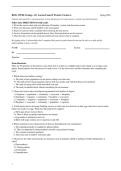
BIOL 355 B0: Ecology - Dr. Larson Exam #1 Practice Version A Spring 2026
Original study packet for exam preparation. Not an official university exam and not a copied exam-bank document.
Follow these DIRECTIONS for full credit:
1. Fill out the answer sheet with your full name, ID number, version, and discussion section.
2. Write your full name and ID number on the exam packet.
3. Read every answer choice carefully before choosing the best answer.
4. Answer all questions on the attached answer sheet. Each question has one best answer.
5. After the exam, review your work and confirm that your answer sheet is complete.
By signing below, I acknowledge that I completed this practice packet honestly and used it only as a study aid for
understanding ecology concepts.
NAME Section:
B#
Signature
Exam directions:
There are 50 questions on this practice exam. Each item is written in a multiple-choice style similar to an ecology exam
packet. Starred options show the answer for study review. Use the answer key and brief rationales after completing the
exam.
1. Which choice best defines ecology?
a. The study of how populations of one species change over time only
*b. The study of how living organisms interact with one another and with their physical environment
c. The study of energy flow inside individual cells only
d. The study of inherited traits without considering the environment
2. Choose the correct order of biological organization from smallest to largest.
*a. Organism -> population -> community -> ecosystem -> biosphere
b. Population -> organism -> community -> biosphere -> ecosystem
c. Community -> organism -> population -> ecosystem -> biosphere
d. Biosphere -> ecosystem -> community -> population -> organism
3. A bird species shows increasing fledgling success as clutch size rises from two to four eggs, then lower success when
clutch size reaches six eggs. What does this pattern best support?
a. More eggs always increase fitness
*b. There is likely an optimal reproductive investment
c. Egg number is unrelated to survival
d. Birds with larger clutches never experience trade-offs
4. Which statement is most characteristic of deep-sea hydrothermal vent communities?
a. They depend primarily on sunlight for photosynthesis
*b. They are supported by chemosynthetic microbes using chemical energy
c. They contain no primary producers
d. They form only in shallow freshwater lakes
5. The process by which some bacteria use chemicals such as hydrogen sulfide or methane to build carbohydrates is
called:
a. Photosynthesis
*b. Chemosynthesis
c. Fermentation
d. Eutrophication
1
, 6. In ecology and physiology, gas exchange most directly refers to:
*a. The exchange of oxygen and carbon dioxide between an organism and its environment
b. The conversion of nitrogen gas into ammonia by bacteria
c. The evaporation of liquid water from leaves
d. The release of methane from decomposing wetlands only
7. Which statement about water's thermal properties is TRUE?
*a. High specific heat helps water resist rapid temperature change
b. Low specific heat makes aquatic habitats heat instantly
c. Water has no effect on climate moderation
d. Water's thermal properties matter only in deserts
8. A lake receives a large input of nitrogen and phosphorus from farm runoff. Which outcome is most likely?
a. Lower algal growth and higher oxygen
*b. Eutrophication followed by oxygen depletion
c. Immediate loss of all nutrients
d. Permanent elimination of decomposers
9. Which factor is abiotic?
a. Predation by a hawk
b. Competition between grasses
*c. Soil moisture
d. Mutualism between a plant and pollinator
10. A population grows rapidly when resources are abundant and no limiting factors are acting strongly. The early growth
pattern is best described as:
*a. Exponential growth
b. Logistic leveling only
c. Random extinction
d. Secondary succession
11. In the logistic growth model, K represents:
a. The mutation rate
*b. Carrying capacity
c. Gross primary productivity
d. The number of trophic levels
12. A density-dependent limiting factor is one whose effect:
a. Weakens as population density rises
*b. Becomes stronger or changes with population density
c. Never involves living organisms
d. Occurs only after volcanic eruptions
13. Which example is density-independent?
*a. A freeze that kills many insects regardless of local density
b. A contagious disease spreading faster in a crowded herd
c. Competition for nesting sites as population density rises
d. Territorial conflict increasing with density
14. A survivorship curve with high early mortality and few individuals reaching adulthood is Type:
a. I
b. II
*c. III
d. IV
2
Original study packet for exam preparation. Not an official university exam and not a copied exam-bank document.
Follow these DIRECTIONS for full credit:
1. Fill out the answer sheet with your full name, ID number, version, and discussion section.
2. Write your full name and ID number on the exam packet.
3. Read every answer choice carefully before choosing the best answer.
4. Answer all questions on the attached answer sheet. Each question has one best answer.
5. After the exam, review your work and confirm that your answer sheet is complete.
By signing below, I acknowledge that I completed this practice packet honestly and used it only as a study aid for
understanding ecology concepts.
NAME Section:
B#
Signature
Exam directions:
There are 50 questions on this practice exam. Each item is written in a multiple-choice style similar to an ecology exam
packet. Starred options show the answer for study review. Use the answer key and brief rationales after completing the
exam.
1. Which choice best defines ecology?
a. The study of how populations of one species change over time only
*b. The study of how living organisms interact with one another and with their physical environment
c. The study of energy flow inside individual cells only
d. The study of inherited traits without considering the environment
2. Choose the correct order of biological organization from smallest to largest.
*a. Organism -> population -> community -> ecosystem -> biosphere
b. Population -> organism -> community -> biosphere -> ecosystem
c. Community -> organism -> population -> ecosystem -> biosphere
d. Biosphere -> ecosystem -> community -> population -> organism
3. A bird species shows increasing fledgling success as clutch size rises from two to four eggs, then lower success when
clutch size reaches six eggs. What does this pattern best support?
a. More eggs always increase fitness
*b. There is likely an optimal reproductive investment
c. Egg number is unrelated to survival
d. Birds with larger clutches never experience trade-offs
4. Which statement is most characteristic of deep-sea hydrothermal vent communities?
a. They depend primarily on sunlight for photosynthesis
*b. They are supported by chemosynthetic microbes using chemical energy
c. They contain no primary producers
d. They form only in shallow freshwater lakes
5. The process by which some bacteria use chemicals such as hydrogen sulfide or methane to build carbohydrates is
called:
a. Photosynthesis
*b. Chemosynthesis
c. Fermentation
d. Eutrophication
1
, 6. In ecology and physiology, gas exchange most directly refers to:
*a. The exchange of oxygen and carbon dioxide between an organism and its environment
b. The conversion of nitrogen gas into ammonia by bacteria
c. The evaporation of liquid water from leaves
d. The release of methane from decomposing wetlands only
7. Which statement about water's thermal properties is TRUE?
*a. High specific heat helps water resist rapid temperature change
b. Low specific heat makes aquatic habitats heat instantly
c. Water has no effect on climate moderation
d. Water's thermal properties matter only in deserts
8. A lake receives a large input of nitrogen and phosphorus from farm runoff. Which outcome is most likely?
a. Lower algal growth and higher oxygen
*b. Eutrophication followed by oxygen depletion
c. Immediate loss of all nutrients
d. Permanent elimination of decomposers
9. Which factor is abiotic?
a. Predation by a hawk
b. Competition between grasses
*c. Soil moisture
d. Mutualism between a plant and pollinator
10. A population grows rapidly when resources are abundant and no limiting factors are acting strongly. The early growth
pattern is best described as:
*a. Exponential growth
b. Logistic leveling only
c. Random extinction
d. Secondary succession
11. In the logistic growth model, K represents:
a. The mutation rate
*b. Carrying capacity
c. Gross primary productivity
d. The number of trophic levels
12. A density-dependent limiting factor is one whose effect:
a. Weakens as population density rises
*b. Becomes stronger or changes with population density
c. Never involves living organisms
d. Occurs only after volcanic eruptions
13. Which example is density-independent?
*a. A freeze that kills many insects regardless of local density
b. A contagious disease spreading faster in a crowded herd
c. Competition for nesting sites as population density rises
d. Territorial conflict increasing with density
14. A survivorship curve with high early mortality and few individuals reaching adulthood is Type:
a. I
b. II
*c. III
d. IV
2