CM TRAINING - AAAE LATEST
EXAM QUESTIONS AND
ANSWERS 2026 – 2027
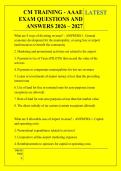
What are 8 ways of diverting revenue? - ANSWERS-1. General
economic development for the municipality, or using fees or airport
land/resources to benefit the community
2. Marketing and promotional activities not related to the airport.
3. Payment in Lie of Taxes (PILOTS) that exceed the value of the
services
4. Payments to compensate municipalities for lost tax revenues
5. Loans or investments of airport money at less than the prevailing
interest rate
6. Use of land for free or nominal rents for aero purposes (some
exceptions are allowed)
7. Rent of land for non-aero purposes at less than fair market value
8. The direct subsidy of air carriers (certain exceptions allowed)
What are 8 allowable uses of airport revenue? - ANSWERS-1. Capital
and operating costs
2. Promotional expenditures related to air travel
3. Cooperative airline-airport marketing expenses
4. Reimbursements to sponsors for capital or operating costs
END OF
PAGE
1
, CM TRAINING - AAAE LATEST
EXAM QUESTIONS AND
ANSWERS 2026 – 2027
5. Support of community activities that promote or are related to the
airport
6. Certain mass transit projects located on airport property
7. Costs incurred by governments for services to the airport (eg fire,
police)
8. Lobbying and attorney fees that support the airport
Grant Assurance #26, Reports and Inspections - ANSWERS-Requires
sponsors to annually report their budget
Who must submit Form 5100-126, Financial Government Payment
Report, and Form 5100-127, Operating and Financial Summary. -
ANSWERS-Commercial service airports enplaning 2,500 or more
passengers
Grant Assurance #24, Fee and Rental Structure - ANSWERS-Requires
the sponsor to set fees, lease rates, and other charges so that the airport is
as self-sustaining as possible. Airports may NOT set rents, fees, etc
based on the cost of airport property improvements or noise mitigation
programs that were paid for with federal funds
END OF
PAGE
2
, CM TRAINING - AAAE LATEST
EXAM QUESTIONS AND
ANSWERS 2026 – 2027
Self Sustainability on airports - ANSWERS-Required by the Airport and
Airway Improvement Act of 1982
To maintain the utility of federal investment in the airport, and relates to
the principle that those not using aviation shouldn't have to pay for it
Aeronautical rates - ANSWERS-Charges for the use of movement areas
and associated costs (eg snow removal) must be at least a level to cover
the cost of providing such facilities (fair and reasonable)
Non-aeronautical rates - ANSWERS-Charges for non-movement area
must be based on fair market value. Exceptions include property for
community purposes if no longer needed by airport, non-profit (Civil Air
Patrol, aviation educational programs), transit projects accessing airport,
private transit systems where service is extremely limited, military
(National Guard)
END OF
PAGE
3
, CM TRAINING - AAAE LATEST
EXAM QUESTIONS AND
ANSWERS 2026 – 2027
FAA's Rates and Charges Policy - ANSWERS-Provides guidance on
setting of fess to ensure they are fair, reasonable, and not unjustly
discriminatory.
FAA relies on the sponsor to oversee compliance, charges must attempt
to make the airport as self-sustaining as possible, can only expend
money on allowable purposes, charges must not discriminate against
foreign carriers
What are the 4 types of rate setting at airports? - ANSWERS-1. Residual
- the airline(s) cover the additional expenses of the airport
2. Compensatory - sponsor assumes all liability for airport costs, and
retains all revenue
3. Hybrid - combo of Residual and Compensatory that can result in the
airlines sharing in airport revenue
4. Public subsidy - local government agency offsets the difference
between the revenue and expenses by subsidizing the airport's operation
What is a rate base? - ANSWERS-The total of all costs associated with
providing airfield facilities and services. Reasonable methodologies may
END OF
PAGE
4
EXAM QUESTIONS AND
ANSWERS 2026 – 2027
What are 8 ways of diverting revenue? - ANSWERS-1. General
economic development for the municipality, or using fees or airport
land/resources to benefit the community
2. Marketing and promotional activities not related to the airport.
3. Payment in Lie of Taxes (PILOTS) that exceed the value of the
services
4. Payments to compensate municipalities for lost tax revenues
5. Loans or investments of airport money at less than the prevailing
interest rate
6. Use of land for free or nominal rents for aero purposes (some
exceptions are allowed)
7. Rent of land for non-aero purposes at less than fair market value
8. The direct subsidy of air carriers (certain exceptions allowed)
What are 8 allowable uses of airport revenue? - ANSWERS-1. Capital
and operating costs
2. Promotional expenditures related to air travel
3. Cooperative airline-airport marketing expenses
4. Reimbursements to sponsors for capital or operating costs
END OF
PAGE
1
, CM TRAINING - AAAE LATEST
EXAM QUESTIONS AND
ANSWERS 2026 – 2027
5. Support of community activities that promote or are related to the
airport
6. Certain mass transit projects located on airport property
7. Costs incurred by governments for services to the airport (eg fire,
police)
8. Lobbying and attorney fees that support the airport
Grant Assurance #26, Reports and Inspections - ANSWERS-Requires
sponsors to annually report their budget
Who must submit Form 5100-126, Financial Government Payment
Report, and Form 5100-127, Operating and Financial Summary. -
ANSWERS-Commercial service airports enplaning 2,500 or more
passengers
Grant Assurance #24, Fee and Rental Structure - ANSWERS-Requires
the sponsor to set fees, lease rates, and other charges so that the airport is
as self-sustaining as possible. Airports may NOT set rents, fees, etc
based on the cost of airport property improvements or noise mitigation
programs that were paid for with federal funds
END OF
PAGE
2
, CM TRAINING - AAAE LATEST
EXAM QUESTIONS AND
ANSWERS 2026 – 2027
Self Sustainability on airports - ANSWERS-Required by the Airport and
Airway Improvement Act of 1982
To maintain the utility of federal investment in the airport, and relates to
the principle that those not using aviation shouldn't have to pay for it
Aeronautical rates - ANSWERS-Charges for the use of movement areas
and associated costs (eg snow removal) must be at least a level to cover
the cost of providing such facilities (fair and reasonable)
Non-aeronautical rates - ANSWERS-Charges for non-movement area
must be based on fair market value. Exceptions include property for
community purposes if no longer needed by airport, non-profit (Civil Air
Patrol, aviation educational programs), transit projects accessing airport,
private transit systems where service is extremely limited, military
(National Guard)
END OF
PAGE
3
, CM TRAINING - AAAE LATEST
EXAM QUESTIONS AND
ANSWERS 2026 – 2027
FAA's Rates and Charges Policy - ANSWERS-Provides guidance on
setting of fess to ensure they are fair, reasonable, and not unjustly
discriminatory.
FAA relies on the sponsor to oversee compliance, charges must attempt
to make the airport as self-sustaining as possible, can only expend
money on allowable purposes, charges must not discriminate against
foreign carriers
What are the 4 types of rate setting at airports? - ANSWERS-1. Residual
- the airline(s) cover the additional expenses of the airport
2. Compensatory - sponsor assumes all liability for airport costs, and
retains all revenue
3. Hybrid - combo of Residual and Compensatory that can result in the
airlines sharing in airport revenue
4. Public subsidy - local government agency offsets the difference
between the revenue and expenses by subsidizing the airport's operation
What is a rate base? - ANSWERS-The total of all costs associated with
providing airfield facilities and services. Reasonable methodologies may
END OF
PAGE
4