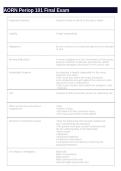
AORN Periop 101 Final Exam
Indemnity Payment Payment made on behalf of the policy holder
Liability A legal responsibility
Negligence An act or failure to act that deviates from the standard
of care
Nursing Malpractice A nurse's negligence or any intentional act that causes
physical, financial, emotional, psychosocial, and/or
cognitive damage to the person in the nurse's care
Respondeat Superior An employer is legally responsible for the nurse
employee only when:
o The nurse acts within the scope of practice
o Any allegations brought against the nurse occurred
during the nurse's employment
o The nurse's actions were within the employer's best
interests.
Tort A breach of duty to another person as outlined by law
What are the four elements of •Duty
malpractice? •Breach of duty
•The breach of duty caused an injury
•The injury was harmful to the patient
Elements of Informed Consent •Must be obtained by the licensed professional
who is performing the procedure
•The patient must give consent voluntarily with
the full understanding of all implications
•Must include
o Diagnosis
o Proposed treatment
o Treatment alternatives
o Consequences of accepting or declining the
proposed treatment
Five Rights of Delegation Right task
Right circumstance
Right person
Right communication and
direction Right supervision and
, evaluation
Four types of patient privacy health care •Medical information
providers and personnel have an ethical •Physical exposure
and legal responsibility to always •Personal privacy
maintain •Electronic privacy
Eight factors to consider before •Patient's age
determining what anesthetic to use for a •Length & type of surgery
particular patient •Patient & surgeon preferences
•Patient's co-existing diseases
•Patient's mental & psychological status
•Patient's previous experiences with anesthesia
•Plans & protocols for postoperative pain management
•Position of the patient during surgery
The American Society of •Clear liquids - stop 2 hours before surgery
Anesthesiologist's NPO Guidelines •Breast milk - stop 4 hours before surgery
•Infant formula - stop 6 hours before surgery
•Light meal (toast & a clear liquid) - stop 6 hours
before surgery
•Fried foods, fatty foods, meat - stop 8 hours before
surgery
Circulator RN duties during Induction of • Cricoid pressure application is not released until
the anesthesia and assisting anesthesia endotracheal (ET) tube cuff is inflated, tube
placement is professional with Cricoid Pressure confirmed, and anesthesia provider has
given a verbal
confirmation to the nurse that the cricoid pressure
can be released.
•If intubation or ventilation of the patient becomes
difficult, the perioperative nurse should retrieve
additional airway equipment and supplies.
General anesthesia • A drug-induced reversible state of unconsciousness
•Results in amnesia, analgesia, and loss of
responsiveness, decreased stress response, and loss
of skeletal muscle reflexes to a varying degree
Regional anesthesia • An injection of local anesthetics near nerve fibers that
causes reversible loss of sensation over an area of the
body
•Examples include spinal, epidural, and peripheral
nerve blocks.
Monitored anesthesia care (MAC) An anesthesia provider monitors the patient,
administers sedatives and other agents as needed,
and provides medical services as required.
Moderate sedation •The administration of sedative, analgesic, and/or
anxiolytic agents by a physician or by a nurse under
physician supervision
•Depending on state laws and hospital policies, an
RN may administer moderate sedation.
,Local anesthesia •The infiltration or topical administration of
agents to anesthetize a part of the body
•The perioperative nurse provides patient
monitoring and supportive care.
Phases of general anesthesia • Phase I: Induction
o IV medications and inhalational agents are
administered by the anesthesia provider.
•Phase II: Maintenance
o Medications and inhalational agents are administered
to keep the patient anesthetized.
•Phase III: Emergence o At the end of the procedure,
the anesthetic agents are discontinued or reversed
to allow the patient to wake up.
Anesthesia Reversal agents: Muscle 1. neostigmine
relaxants: 2. edrophonium.
Note: There is no reversal agent for succinylcholine
Anesthesia Reversal agents: reversal agent for rocuronium, vecuronium, and
Sugammadex: pancuronium
Anesthesia Reversal agents: Flumazenil
Benzodiazepines: Midazolam
Anesthesia Reversal agents: Narcotics: Naloxone
Fentanyl:
Patients at Increased Risk for •Older adults
Hypothermia •Infants and children
•Women
•Patients with lower-than-normal body weight
Medical Conditions Associated with •Hypothyroidism
Increased Risk for Hypothermia •Hypoglycemia
•Burns
•Trauma
•Hypotension
•Congestive heart failure
•Cardiac vessel disease
, Signs of Malignant Hyperthermia (MH) • ΜΗ is triggered by inhalation anesthetic gases and
succinylcholine
•Increased end-tidal carbon dioxide is the most specific
sign of MH.
•Other signs include skeletal muscle rigidity,
ventricular dysrhythmia, skin mottling, and
hyperthermia.
Medical professionals who can provide • Anesthesiologists
anesthesia services are: • Certified registered nurse anesthetists (CRNAs)
• Anesthesiologist assistants (AAs)
Surgical Safety Checklist Includes: • Μοbility
•Preexisting health conditions
•Planned duration of the procedure.
•Type of anesthesia
The Preoperative Nurse Visit Should Include: • Introduce yourself and ask your patient how they
would like to be addressed.
•Confirm your patient's identity with two patient
identifier
•If your patient discusses suicidal thoughts during
the preoperative visit, report this immediately by
following your facility's policy and procedure. t
•Use the same scale for pain assessment throughout all
patien care areas.
•Consider all elements of patient care needs prior to
surgery.
•Consider how the required surgical position may
impact a current condition that the patient contends
with.
A Medication Assessment Should Include: • Prescription medications
•Herbal preparations:
o may accentuate the toxicity of anesthetics.
o interfere with drug metabolism or clearance.
o might affect bleeding times.
•Recreational/street drugs
*It is also important to ask if the patient is using any
recreational/street drugs. Close observation must be
maintained for symptoms of withdrawal, especially
during and after long procedures.
•Drugs, alcohol, and smoking can alter lab values or
system assessment. A chemically dependent patient
who is recovering may have concerns about medication
he or she is given.
•Patient risk factors due to alcoholism include:
- Lowered immunity
- Prolonged bleeding times
Indemnity Payment Payment made on behalf of the policy holder
Liability A legal responsibility
Negligence An act or failure to act that deviates from the standard
of care
Nursing Malpractice A nurse's negligence or any intentional act that causes
physical, financial, emotional, psychosocial, and/or
cognitive damage to the person in the nurse's care
Respondeat Superior An employer is legally responsible for the nurse
employee only when:
o The nurse acts within the scope of practice
o Any allegations brought against the nurse occurred
during the nurse's employment
o The nurse's actions were within the employer's best
interests.
Tort A breach of duty to another person as outlined by law
What are the four elements of •Duty
malpractice? •Breach of duty
•The breach of duty caused an injury
•The injury was harmful to the patient
Elements of Informed Consent •Must be obtained by the licensed professional
who is performing the procedure
•The patient must give consent voluntarily with
the full understanding of all implications
•Must include
o Diagnosis
o Proposed treatment
o Treatment alternatives
o Consequences of accepting or declining the
proposed treatment
Five Rights of Delegation Right task
Right circumstance
Right person
Right communication and
direction Right supervision and
, evaluation
Four types of patient privacy health care •Medical information
providers and personnel have an ethical •Physical exposure
and legal responsibility to always •Personal privacy
maintain •Electronic privacy
Eight factors to consider before •Patient's age
determining what anesthetic to use for a •Length & type of surgery
particular patient •Patient & surgeon preferences
•Patient's co-existing diseases
•Patient's mental & psychological status
•Patient's previous experiences with anesthesia
•Plans & protocols for postoperative pain management
•Position of the patient during surgery
The American Society of •Clear liquids - stop 2 hours before surgery
Anesthesiologist's NPO Guidelines •Breast milk - stop 4 hours before surgery
•Infant formula - stop 6 hours before surgery
•Light meal (toast & a clear liquid) - stop 6 hours
before surgery
•Fried foods, fatty foods, meat - stop 8 hours before
surgery
Circulator RN duties during Induction of • Cricoid pressure application is not released until
the anesthesia and assisting anesthesia endotracheal (ET) tube cuff is inflated, tube
placement is professional with Cricoid Pressure confirmed, and anesthesia provider has
given a verbal
confirmation to the nurse that the cricoid pressure
can be released.
•If intubation or ventilation of the patient becomes
difficult, the perioperative nurse should retrieve
additional airway equipment and supplies.
General anesthesia • A drug-induced reversible state of unconsciousness
•Results in amnesia, analgesia, and loss of
responsiveness, decreased stress response, and loss
of skeletal muscle reflexes to a varying degree
Regional anesthesia • An injection of local anesthetics near nerve fibers that
causes reversible loss of sensation over an area of the
body
•Examples include spinal, epidural, and peripheral
nerve blocks.
Monitored anesthesia care (MAC) An anesthesia provider monitors the patient,
administers sedatives and other agents as needed,
and provides medical services as required.
Moderate sedation •The administration of sedative, analgesic, and/or
anxiolytic agents by a physician or by a nurse under
physician supervision
•Depending on state laws and hospital policies, an
RN may administer moderate sedation.
,Local anesthesia •The infiltration or topical administration of
agents to anesthetize a part of the body
•The perioperative nurse provides patient
monitoring and supportive care.
Phases of general anesthesia • Phase I: Induction
o IV medications and inhalational agents are
administered by the anesthesia provider.
•Phase II: Maintenance
o Medications and inhalational agents are administered
to keep the patient anesthetized.
•Phase III: Emergence o At the end of the procedure,
the anesthetic agents are discontinued or reversed
to allow the patient to wake up.
Anesthesia Reversal agents: Muscle 1. neostigmine
relaxants: 2. edrophonium.
Note: There is no reversal agent for succinylcholine
Anesthesia Reversal agents: reversal agent for rocuronium, vecuronium, and
Sugammadex: pancuronium
Anesthesia Reversal agents: Flumazenil
Benzodiazepines: Midazolam
Anesthesia Reversal agents: Narcotics: Naloxone
Fentanyl:
Patients at Increased Risk for •Older adults
Hypothermia •Infants and children
•Women
•Patients with lower-than-normal body weight
Medical Conditions Associated with •Hypothyroidism
Increased Risk for Hypothermia •Hypoglycemia
•Burns
•Trauma
•Hypotension
•Congestive heart failure
•Cardiac vessel disease
, Signs of Malignant Hyperthermia (MH) • ΜΗ is triggered by inhalation anesthetic gases and
succinylcholine
•Increased end-tidal carbon dioxide is the most specific
sign of MH.
•Other signs include skeletal muscle rigidity,
ventricular dysrhythmia, skin mottling, and
hyperthermia.
Medical professionals who can provide • Anesthesiologists
anesthesia services are: • Certified registered nurse anesthetists (CRNAs)
• Anesthesiologist assistants (AAs)
Surgical Safety Checklist Includes: • Μοbility
•Preexisting health conditions
•Planned duration of the procedure.
•Type of anesthesia
The Preoperative Nurse Visit Should Include: • Introduce yourself and ask your patient how they
would like to be addressed.
•Confirm your patient's identity with two patient
identifier
•If your patient discusses suicidal thoughts during
the preoperative visit, report this immediately by
following your facility's policy and procedure. t
•Use the same scale for pain assessment throughout all
patien care areas.
•Consider all elements of patient care needs prior to
surgery.
•Consider how the required surgical position may
impact a current condition that the patient contends
with.
A Medication Assessment Should Include: • Prescription medications
•Herbal preparations:
o may accentuate the toxicity of anesthetics.
o interfere with drug metabolism or clearance.
o might affect bleeding times.
•Recreational/street drugs
*It is also important to ask if the patient is using any
recreational/street drugs. Close observation must be
maintained for symptoms of withdrawal, especially
during and after long procedures.
•Drugs, alcohol, and smoking can alter lab values or
system assessment. A chemically dependent patient
who is recovering may have concerns about medication
he or she is given.
•Patient risk factors due to alcoholism include:
- Lowered immunity
- Prolonged bleeding times