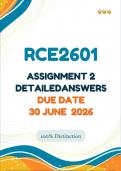
,OPM1501 ASSIGNMENT 2
DUE DATE: 5 JUNE 2026
QUESTION 1.1
Transforming the Teaching and Learning of Measurement in the Intermediate Phase
Mathematics teaching in South African schools has traditionally relied heavily on teacher-
centred methods where learners memorise rules, procedures and formulas without fully
understanding the concepts behind them. Modern approaches encourage learner
participation, collaboration and meaningful learning experiences (OPM1501 Study Guide,
2026). This is especially important in the teaching of measurement in the Intermediate
Phase because measurement concepts are closely connected to everyday life.
Traditional teaching methods usually involve the teacher explaining formulas on the board
while learners copy notes and complete repetitive textbook exercises. In many classrooms,
learners are expected to memorise procedures such as converting units or calculating
perimeter without understanding why they are performing those calculations. Learners
often become passive recipients of information instead of active participants in the learning
process. The OPM1501 Study Guide (2026) explains that meaningful learning occurs when
learners actively engage with concepts and develop understanding through participation
and discussion.
From my own learning experience at school, measurement lessons were mainly taught
through memorisation. For example, when learning about perimeter and area, the teacher
wrote formulas on the board and instructed learners to apply them to textbook exercises.
Many learners memorised the formulas without understanding what perimeter or area
actually meant. Some learners could solve problems in class but struggled to apply the
, knowledge to real-life situations. This demonstrated that traditional teaching methods
focused more on procedural knowledge than conceptual understanding.
The CAPS curriculum encourages learner-centred teaching approaches where learners
participate actively in the learning process (OPM1501 Study Guide, 2026). In the teaching of
measurement, learners should handle objects, estimate measurements, compare sizes and
investigate relationships between units. Such activities help learners connect Mathematics
to their daily experiences and improve understanding.
One effective learner-centred approach is the use of concrete materials. Learners in the
Intermediate Phase understand concepts better when they interact physically with objects
and practical activities (OPM1501 Study Guide, 2026). For example, when teaching length,
learners can measure desks, books or classroom walls using rulers and tape measures.
Instead of simply memorising that one metre equals one hundred centimetres, learners
discover the relationship themselves through practical investigation. This makes learning
more meaningful and enjoyable.
Another important approach is cooperative learning. Learners can work together in groups
to solve problems and discuss ideas. Group activities encourage communication, teamwork
and peer learning. For instance, learners can work in groups to measure the classroom floor
and calculate its perimeter and area. Through discussion and collaboration, learners explain
their reasoning and learn from one another. The OPM1501 Study Guide (2026) highlights
that social interaction and discussion support deeper understanding in Mathematics
learning.
Problem-solving and inquiry-based learning are also important in teaching measurement.
Instead of giving learners direct instructions, teachers can present real-life problems that
learners must investigate and solve. For example, learners may be asked to determine how
much paint is needed to paint a classroom wall. Learners would need to measure the wall,
calculate the area and estimate the quantity of paint required. Such activities help learners
DUE DATE: 5 JUNE 2026
QUESTION 1.1
Transforming the Teaching and Learning of Measurement in the Intermediate Phase
Mathematics teaching in South African schools has traditionally relied heavily on teacher-
centred methods where learners memorise rules, procedures and formulas without fully
understanding the concepts behind them. Modern approaches encourage learner
participation, collaboration and meaningful learning experiences (OPM1501 Study Guide,
2026). This is especially important in the teaching of measurement in the Intermediate
Phase because measurement concepts are closely connected to everyday life.
Traditional teaching methods usually involve the teacher explaining formulas on the board
while learners copy notes and complete repetitive textbook exercises. In many classrooms,
learners are expected to memorise procedures such as converting units or calculating
perimeter without understanding why they are performing those calculations. Learners
often become passive recipients of information instead of active participants in the learning
process. The OPM1501 Study Guide (2026) explains that meaningful learning occurs when
learners actively engage with concepts and develop understanding through participation
and discussion.
From my own learning experience at school, measurement lessons were mainly taught
through memorisation. For example, when learning about perimeter and area, the teacher
wrote formulas on the board and instructed learners to apply them to textbook exercises.
Many learners memorised the formulas without understanding what perimeter or area
actually meant. Some learners could solve problems in class but struggled to apply the
, knowledge to real-life situations. This demonstrated that traditional teaching methods
focused more on procedural knowledge than conceptual understanding.
The CAPS curriculum encourages learner-centred teaching approaches where learners
participate actively in the learning process (OPM1501 Study Guide, 2026). In the teaching of
measurement, learners should handle objects, estimate measurements, compare sizes and
investigate relationships between units. Such activities help learners connect Mathematics
to their daily experiences and improve understanding.
One effective learner-centred approach is the use of concrete materials. Learners in the
Intermediate Phase understand concepts better when they interact physically with objects
and practical activities (OPM1501 Study Guide, 2026). For example, when teaching length,
learners can measure desks, books or classroom walls using rulers and tape measures.
Instead of simply memorising that one metre equals one hundred centimetres, learners
discover the relationship themselves through practical investigation. This makes learning
more meaningful and enjoyable.
Another important approach is cooperative learning. Learners can work together in groups
to solve problems and discuss ideas. Group activities encourage communication, teamwork
and peer learning. For instance, learners can work in groups to measure the classroom floor
and calculate its perimeter and area. Through discussion and collaboration, learners explain
their reasoning and learn from one another. The OPM1501 Study Guide (2026) highlights
that social interaction and discussion support deeper understanding in Mathematics
learning.
Problem-solving and inquiry-based learning are also important in teaching measurement.
Instead of giving learners direct instructions, teachers can present real-life problems that
learners must investigate and solve. For example, learners may be asked to determine how
much paint is needed to paint a classroom wall. Learners would need to measure the wall,
calculate the area and estimate the quantity of paint required. Such activities help learners