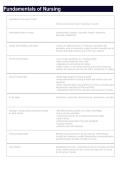
Fundamentals of Nursing
origination of the word "nurse"
from the latin word "nutrix" meaning to nourish
Interrelated roles of nurses communicator, teacher, counselor, leader, researcher,
advocate, collaborator
coping with disability and death nurses use optimal function of maximum strengths and
potentials, refer to community support systems; provide care to
families and patients during end-of-life care, hospice
The Nursing Process -one of major guidelines for nursing practice
-helps nurses implement their roles
-integrates art and science of nursing
-allows nurses to use critical thinking and clinical reasoning
-defines the areas of care that are within the domain of nursing
Nurse Practice Acts -define legal scope of nursing practice
-create state board of nursing to make and enforce rules and
regulation
-define important terms and activities in nursing, including legal
requirements and titles for RNs and LPNs
- established criteria for the education and licensure of nurses
5 vital signs respirations, pulse rate, blood pressure, temperature, and pain
Nursing is recognized as profession based -well defined body specific and unique knowledge
on what criteria -strong service orientation
-recognized authority by a professional group (ANA)
-code of ethics
-professional organization that sets standards
-ongoing research
-autonomy and self-regulation
Florence Nightingale defined nursing as both an art and science, differentiated
nursing from medicine, created freestanding nursing education,
published books; founder of modern nursing
Clara Barton established red cross; volunteered to care for wounds and feed
union soldiers during civil war; served as supervisor of nurses
for the army of James
,sources of knowledge -traditional ( passed down from generation to generation)
-authoritative- comes from an expert, accepted as truth based
on person's perceived expertise
-scientific (obtained through the scientific method-research)
objective you can see the object
subjective coming from that subject
types of knowledge -science (observing, identifying, describing, investigating, and
explaining events and occurences that are perceived in world)
-philosophy (the study of wisdom, fundamental knowledge, and
the processes used to develop and construct on perception on
life)
-process (a series of actions, changes, or functions intended to
bring about a desired result)
goals of nursing research -improve care in clinical setting
-study ppl and nurse process: education, policy development,
ethics, nursing history
-develop greater autonomy and strength as a profession
-provide evidence-based nursing practice
deductive reasoning examines a general idea and then considers specific actions or
ideas
inductive reasoning one builds from specific ideas or actions to conclusions about
general ideas
health a state of complete physical, mental, and social well-being, not
merely the absence of disease or infirmity
illness the unique response of a person to a disease; an abnormal
process involving changed level of functioning
wellness an active state of being healthy by living a lifestyle promoting
good physical, mental, and emotional health
, nursing theory differentiates nursing from other disciplines and activities in that
it serves the purposes of describing, explaining, predicting, and
controlling desired outcomes of nursing care practices
evidence-based practice (EBP) a problem-solving approach to making clinical decisions, using
the best evidence available; blends both science and art of
nursing so best outcomes are achieved; may consist of specific
nursing interventions or use guidelines established for the care
of patients
steps in implementing EBP Step 1: ask a question about a clinical area of interest or an
intervention
Step 2: collect the most relevant and best evidence
Step 3: Critically appraise the evidence
Step 4: integrate the evidence w/ clinical expertise, patient
preferences, and values in making a decision to change
Step 5: evaluate the practice decision or change
human dimensions that compose the whole physical, intellectual, environmental, spiritual, sociocultural, and
person emotional
acute illness rapid onset of symptoms and lasts only a short time; examples:
cold, diarrhea, pneumonia, appendicitis
chronic illness slow onset, characteristics: permanent change, caused by
change in anatomy, requires special patient education, long
period of care or support; examples: heart disease, diabetes,
lung diseases, and arthritis
stages-of-illness behaviors Stage 1: experiencing symptoms
Stage 2: assuming the sick role
Stage 3: assuming a dependent role
Stage 4: achieving recovery and rehabilitation
primary health promotion directed towards PROMOTING health and PREVENTING the
development of disease processes or injury; example:
immunization clinic, family planning services, accident
prevention education
secondary health promotion focus on SCREENING for early detection of disease with
prompt diagnosis and treatment of any found; example:
assessing children for normal growth and development and
encourage regular medical, dental and vision exams
tertiary health promotion after an illness is diagnosed and treated;
example: teaching a patient with diabetes how to recognize and
prevent complications, refer woman to support group after
removal of breast due to cancer
origination of the word "nurse"
from the latin word "nutrix" meaning to nourish
Interrelated roles of nurses communicator, teacher, counselor, leader, researcher,
advocate, collaborator
coping with disability and death nurses use optimal function of maximum strengths and
potentials, refer to community support systems; provide care to
families and patients during end-of-life care, hospice
The Nursing Process -one of major guidelines for nursing practice
-helps nurses implement their roles
-integrates art and science of nursing
-allows nurses to use critical thinking and clinical reasoning
-defines the areas of care that are within the domain of nursing
Nurse Practice Acts -define legal scope of nursing practice
-create state board of nursing to make and enforce rules and
regulation
-define important terms and activities in nursing, including legal
requirements and titles for RNs and LPNs
- established criteria for the education and licensure of nurses
5 vital signs respirations, pulse rate, blood pressure, temperature, and pain
Nursing is recognized as profession based -well defined body specific and unique knowledge
on what criteria -strong service orientation
-recognized authority by a professional group (ANA)
-code of ethics
-professional organization that sets standards
-ongoing research
-autonomy and self-regulation
Florence Nightingale defined nursing as both an art and science, differentiated
nursing from medicine, created freestanding nursing education,
published books; founder of modern nursing
Clara Barton established red cross; volunteered to care for wounds and feed
union soldiers during civil war; served as supervisor of nurses
for the army of James
,sources of knowledge -traditional ( passed down from generation to generation)
-authoritative- comes from an expert, accepted as truth based
on person's perceived expertise
-scientific (obtained through the scientific method-research)
objective you can see the object
subjective coming from that subject
types of knowledge -science (observing, identifying, describing, investigating, and
explaining events and occurences that are perceived in world)
-philosophy (the study of wisdom, fundamental knowledge, and
the processes used to develop and construct on perception on
life)
-process (a series of actions, changes, or functions intended to
bring about a desired result)
goals of nursing research -improve care in clinical setting
-study ppl and nurse process: education, policy development,
ethics, nursing history
-develop greater autonomy and strength as a profession
-provide evidence-based nursing practice
deductive reasoning examines a general idea and then considers specific actions or
ideas
inductive reasoning one builds from specific ideas or actions to conclusions about
general ideas
health a state of complete physical, mental, and social well-being, not
merely the absence of disease or infirmity
illness the unique response of a person to a disease; an abnormal
process involving changed level of functioning
wellness an active state of being healthy by living a lifestyle promoting
good physical, mental, and emotional health
, nursing theory differentiates nursing from other disciplines and activities in that
it serves the purposes of describing, explaining, predicting, and
controlling desired outcomes of nursing care practices
evidence-based practice (EBP) a problem-solving approach to making clinical decisions, using
the best evidence available; blends both science and art of
nursing so best outcomes are achieved; may consist of specific
nursing interventions or use guidelines established for the care
of patients
steps in implementing EBP Step 1: ask a question about a clinical area of interest or an
intervention
Step 2: collect the most relevant and best evidence
Step 3: Critically appraise the evidence
Step 4: integrate the evidence w/ clinical expertise, patient
preferences, and values in making a decision to change
Step 5: evaluate the practice decision or change
human dimensions that compose the whole physical, intellectual, environmental, spiritual, sociocultural, and
person emotional
acute illness rapid onset of symptoms and lasts only a short time; examples:
cold, diarrhea, pneumonia, appendicitis
chronic illness slow onset, characteristics: permanent change, caused by
change in anatomy, requires special patient education, long
period of care or support; examples: heart disease, diabetes,
lung diseases, and arthritis
stages-of-illness behaviors Stage 1: experiencing symptoms
Stage 2: assuming the sick role
Stage 3: assuming a dependent role
Stage 4: achieving recovery and rehabilitation
primary health promotion directed towards PROMOTING health and PREVENTING the
development of disease processes or injury; example:
immunization clinic, family planning services, accident
prevention education
secondary health promotion focus on SCREENING for early detection of disease with
prompt diagnosis and treatment of any found; example:
assessing children for normal growth and development and
encourage regular medical, dental and vision exams
tertiary health promotion after an illness is diagnosed and treated;
example: teaching a patient with diabetes how to recognize and
prevent complications, refer woman to support group after
removal of breast due to cancer