

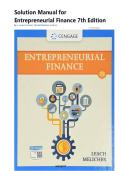
Solution Manual for
Entrepreneurial Finance 7th Edition
by J. Leach (Author), Ronald Melicher (Author)
7th EDITION
wis
epr
of
wiseprof
,SOLUTION MANUAL FOR
Entrepreneurial Finance, 7th Edition J. Chris Leach (Author),
Ronald W. Melicher (Author)
Chapter 1-16 With Cases Products &Spatial Tech
Chapter 1
INTRODUCTION TO FINANCE FOR ENTREPRENEURS
FOCUS
The purpose of this first chapter is to present an overview of what entrepreneurial finance is
about. In doing so we hope to convey to you the importance of understanding and applying
entrepreneurial finance methods and tools to help ensure an entrepreneurial venture is successful.
We present a life cycle approach to the teaching of entrepreneurial finance where we cover
venture operating and financial decisions faced by the entrepreneur as a venture progresses from
an idea through to harvesting the venture.
LEARNING OBJECTIVES
LO 1.1: Characterize the entrepreneurial process.
LO 1.2: Describe entrepreneurship and some characteristics of entrepreneurs.
LO 1.3: Indicate several megatrends providing waves of entrepreneurial opportunities.
wis
LO 1.4: List and describe the seven principles of entrepreneurial finance.
LO 1.5: Discuss entrepreneurial finance and the role of the financial manager.
LO 1.6: Describe the various stages of a successful venture‘s life cycle.
LO 1.7: Identify, by life cycle stage, the relevant types of financing and investors.
LO 1.8: Understand the life cycle approach used in this book.
CHAPTER OUTLINE
1.1 THE ENTREPRENEURIAL PROCESS
1.2 ENTREPRENEURSHIP FUNDAMENTALS
epr
A. Who is an Entrepreneur?
B. Basic Definitions
C. Entrepreneurial Traits or Characteristics
D. Opportunities Exist But Not Without Risks
1.3 SOURCES OF ENTREPRENEURIAL OPPORTUNITIES
A. Societal Changes
B. Demographic Changes
C. Technological Changes
D. Emerging Economies and Global Changes
E. Crises and ―Bubbles‖
of
F. Disruptive Innovation
1
wiseprof
,2 Chapter 6: Managing Cash Flow
1.4 PRINCIPLES OF ENTREPRENEURIAL FINANCE
A. Real, Human, and Financial Capital must be Rented from Owners (Principle #1)
B. Risk and Expected Reward go Hand in Hand (Principle #2)
C. While Accounting is the Language of Business, Cash is the Currency (Principle #3)
D. New Venture Financing Involves Search, Negotiation, and Privacy (Principle #4)
E. A Venture‘s Financial Objective is to Increase Value (Principle #5)
F. It is Dangerous to Assume that People Act Against Their Own Self-Interests
(Principle #6)
G. Venture Character and Reputation can be Assets or Liabilities (Principle #7)
1.5 ROLE OF ENTREPRENEURIAL FINANCE
1.6 THE SUCCESSFUL VENTURE LIFE CYCLE
A. Development Stage
B. Startup Stage
C. Survival Stage
D. Rapid-Growth Stage
E. Early-Maturity Stage
F. Life Cycle Stages and the Entrepreneurial Process
1.7 FINANCING THROUGH THE VENTURE LIFE CYCLE
A. Seed Financing
B. Startup Financing
C. First-Round Financing
D. Second-Round Financing
E. Mezzanine Financing
F. Liquidity-Stage Financing
G. Seasoned Financing
wis
1.8 LIFE CYCLE APPROACH FOR TEACHING ENTREPRENEURIAL FINANCE
SUMMARY
DISCUSSION QUESTIONS AND ANSWERS
1. What is the entrepreneurial process?
The entrepreneurial process comprises: developing opportunities, gathering resources, and
managing and building operations with the goal of creating value.
epr
2. What is entrepreneurship? What are some basic characteristics of entrepreneurs?
Entrepreneurship is the process of changing ideas into commercial opportunities and creating
value. While there is no prototypical entrepreneur, many are good at recognizing
commercial opportunities, tend to be optimistic, and envision a plan for the future.
3. Why do businesses close or cease operating? What are the primary reasons why businesses
fail?
of
wiseprof
, Chapter 6: Managing Cash Flow 3
Nearly one-half of businesses that fail do so because of economic factors including
inadequate sales, insufficient profits, and industry weakness. Many of the economic factors
are directly tied to financing concerns (e.g., insufficient profits for investors). Almost 40
percent of business failures not citing economic factors cite specifically financial causes like
excessive debt and insufficient financial capital. The remaining cited reasons for failure
include a lack of business and managerial experience, business conflicts, family problems,
fraud, and disasters. Many businesses close and fail due to financial trouble which is mostly
related to lack of sales and unsatisfactory profits.
4. What are five megatrend sources or categories for finding entrepreneurial opportunities?
We identify five megatrend categories. They are: (1) societal changes, (2) demographic
changes, (3) technological changes, (4) emerging economies and global changes, and (5)
crises and bubbles.
Under societal changes we discuss the gig economy and the sharing economy. The gig
economy is where individuals accept short-term job assignments or ―gigs‖ instead of having
full-time employment. The sharing economy is where individuals share their assets, such as
homes, vehicles, and personal time, with others to provide a new way for distributing goods
and services.
5. What asset and financial bubbles have occurred recently? How can bubbles and financial
crises lead to entrepreneurial opportunities?
The ―dot.com‖ or Internet bubble burst in 2000. An economic recession that began in 2001
wis
was exacerbated by the 9/11 terrorist attack. The housing asset bubble, fueled by sub-prime
mortgages offered to borrowers who could not afford them, burst in 2006. By the second
half of 2008, a ―perfect financial storm‖ erupted and possible financial collapse became a
reality.
Alternative and renewable energy, accompanied by project credit subsidies, production and
investment tax credits, and loan guarantees benefited as a result of the recent financial crisis.
These developments and other efforts to stimulate economic activity provided many new
entrepreneurial opportunities.
epr
6. What is e-commerce? Why are the Internet economy and e-commerce here to stay?
E-commerce involves the use of electronic means to conduct business online. Activities
include marketing and selling online and electronic retailing.
The internet economy and e-commerce are here to stay. We will never do business the same
way we did before the Internet and the Web. Many business plans were funded with the
belief that part of the benefit could be captured by sellers (producers and retailers).
However, we now know that the Web so effectively facilitates price competition that it is
hard for suppliers and retailers to protect margins. E-commerce may not deliver the margins
once conjectured, but the Internet is still one of the most radical innovations in our lifetime.
of
wiseprof
Entrepreneurial Finance 7th Edition
by J. Leach (Author), Ronald Melicher (Author)
7th EDITION
wis
epr
of
wiseprof
,SOLUTION MANUAL FOR
Entrepreneurial Finance, 7th Edition J. Chris Leach (Author),
Ronald W. Melicher (Author)
Chapter 1-16 With Cases Products &Spatial Tech
Chapter 1
INTRODUCTION TO FINANCE FOR ENTREPRENEURS
FOCUS
The purpose of this first chapter is to present an overview of what entrepreneurial finance is
about. In doing so we hope to convey to you the importance of understanding and applying
entrepreneurial finance methods and tools to help ensure an entrepreneurial venture is successful.
We present a life cycle approach to the teaching of entrepreneurial finance where we cover
venture operating and financial decisions faced by the entrepreneur as a venture progresses from
an idea through to harvesting the venture.
LEARNING OBJECTIVES
LO 1.1: Characterize the entrepreneurial process.
LO 1.2: Describe entrepreneurship and some characteristics of entrepreneurs.
LO 1.3: Indicate several megatrends providing waves of entrepreneurial opportunities.
wis
LO 1.4: List and describe the seven principles of entrepreneurial finance.
LO 1.5: Discuss entrepreneurial finance and the role of the financial manager.
LO 1.6: Describe the various stages of a successful venture‘s life cycle.
LO 1.7: Identify, by life cycle stage, the relevant types of financing and investors.
LO 1.8: Understand the life cycle approach used in this book.
CHAPTER OUTLINE
1.1 THE ENTREPRENEURIAL PROCESS
1.2 ENTREPRENEURSHIP FUNDAMENTALS
epr
A. Who is an Entrepreneur?
B. Basic Definitions
C. Entrepreneurial Traits or Characteristics
D. Opportunities Exist But Not Without Risks
1.3 SOURCES OF ENTREPRENEURIAL OPPORTUNITIES
A. Societal Changes
B. Demographic Changes
C. Technological Changes
D. Emerging Economies and Global Changes
E. Crises and ―Bubbles‖
of
F. Disruptive Innovation
1
wiseprof
,2 Chapter 6: Managing Cash Flow
1.4 PRINCIPLES OF ENTREPRENEURIAL FINANCE
A. Real, Human, and Financial Capital must be Rented from Owners (Principle #1)
B. Risk and Expected Reward go Hand in Hand (Principle #2)
C. While Accounting is the Language of Business, Cash is the Currency (Principle #3)
D. New Venture Financing Involves Search, Negotiation, and Privacy (Principle #4)
E. A Venture‘s Financial Objective is to Increase Value (Principle #5)
F. It is Dangerous to Assume that People Act Against Their Own Self-Interests
(Principle #6)
G. Venture Character and Reputation can be Assets or Liabilities (Principle #7)
1.5 ROLE OF ENTREPRENEURIAL FINANCE
1.6 THE SUCCESSFUL VENTURE LIFE CYCLE
A. Development Stage
B. Startup Stage
C. Survival Stage
D. Rapid-Growth Stage
E. Early-Maturity Stage
F. Life Cycle Stages and the Entrepreneurial Process
1.7 FINANCING THROUGH THE VENTURE LIFE CYCLE
A. Seed Financing
B. Startup Financing
C. First-Round Financing
D. Second-Round Financing
E. Mezzanine Financing
F. Liquidity-Stage Financing
G. Seasoned Financing
wis
1.8 LIFE CYCLE APPROACH FOR TEACHING ENTREPRENEURIAL FINANCE
SUMMARY
DISCUSSION QUESTIONS AND ANSWERS
1. What is the entrepreneurial process?
The entrepreneurial process comprises: developing opportunities, gathering resources, and
managing and building operations with the goal of creating value.
epr
2. What is entrepreneurship? What are some basic characteristics of entrepreneurs?
Entrepreneurship is the process of changing ideas into commercial opportunities and creating
value. While there is no prototypical entrepreneur, many are good at recognizing
commercial opportunities, tend to be optimistic, and envision a plan for the future.
3. Why do businesses close or cease operating? What are the primary reasons why businesses
fail?
of
wiseprof
, Chapter 6: Managing Cash Flow 3
Nearly one-half of businesses that fail do so because of economic factors including
inadequate sales, insufficient profits, and industry weakness. Many of the economic factors
are directly tied to financing concerns (e.g., insufficient profits for investors). Almost 40
percent of business failures not citing economic factors cite specifically financial causes like
excessive debt and insufficient financial capital. The remaining cited reasons for failure
include a lack of business and managerial experience, business conflicts, family problems,
fraud, and disasters. Many businesses close and fail due to financial trouble which is mostly
related to lack of sales and unsatisfactory profits.
4. What are five megatrend sources or categories for finding entrepreneurial opportunities?
We identify five megatrend categories. They are: (1) societal changes, (2) demographic
changes, (3) technological changes, (4) emerging economies and global changes, and (5)
crises and bubbles.
Under societal changes we discuss the gig economy and the sharing economy. The gig
economy is where individuals accept short-term job assignments or ―gigs‖ instead of having
full-time employment. The sharing economy is where individuals share their assets, such as
homes, vehicles, and personal time, with others to provide a new way for distributing goods
and services.
5. What asset and financial bubbles have occurred recently? How can bubbles and financial
crises lead to entrepreneurial opportunities?
The ―dot.com‖ or Internet bubble burst in 2000. An economic recession that began in 2001
wis
was exacerbated by the 9/11 terrorist attack. The housing asset bubble, fueled by sub-prime
mortgages offered to borrowers who could not afford them, burst in 2006. By the second
half of 2008, a ―perfect financial storm‖ erupted and possible financial collapse became a
reality.
Alternative and renewable energy, accompanied by project credit subsidies, production and
investment tax credits, and loan guarantees benefited as a result of the recent financial crisis.
These developments and other efforts to stimulate economic activity provided many new
entrepreneurial opportunities.
epr
6. What is e-commerce? Why are the Internet economy and e-commerce here to stay?
E-commerce involves the use of electronic means to conduct business online. Activities
include marketing and selling online and electronic retailing.
The internet economy and e-commerce are here to stay. We will never do business the same
way we did before the Internet and the Web. Many business plans were funded with the
belief that part of the benefit could be captured by sellers (producers and retailers).
However, we now know that the Web so effectively facilitates price competition that it is
hard for suppliers and retailers to protect margins. E-commerce may not deliver the margins
once conjectured, but the Internet is still one of the most radical innovations in our lifetime.
of
wiseprof

