5/18/26, 8:36 AM ASU BIO 201: EXAM 3 EXAM Questions and Answers (Verified Answers) Study Guide (latest version verified for accuracy) | 2025\2…
ASU BIO 201: EXAM 3 EXAM Questions and
Answers (Verified Answers) Study Guide (latest
version verified for accuracy) | 2025\2026 Latest!!
Save Groups
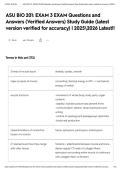
Terms in this set (172)
3 kinds of muscle tissue skeletal, cardiac, smooth
major purpose of muscle converting chemical energy in ATP --> mechanical
energy of motion
muscle functions -movement of: whole body, body parts, organ
contents
-stability: maintain posture and prevent mvmt.
-communication: speech, facial expressions and
writing
-control of openings and passageways: sphincters
-body heat production
characterizations of connective fascia, epimysium, perimysium, endomysium
tissues of a muscle
CT elements and how they merge Tendons = attachments between muscle and bone,
with other tissues dense-regular CT made of collagen fibers,
epimysium surrounding entire muscle is continuous
with collagen fibers of tendons
https://quizlet.com/1181502352/asu-bio-201-exam-3-exam-questions-and-answers-verified-answers-study-guide-latest-version-verified-for-accuracy-… 1/32
,5/18/26, 8:36 AM ASU BIO 201: EXAM 3 EXAM Questions and Answers (Verified Answers) Study Guide (latest version verified for accuracy) | 2025\2…
role of collagen in connective tissues stretches slightly under tension and recoils when
released
-resists excessive stretching and protects muscle
from injury
-returns muscle to resting length
-contribute to power output and muscle efficiency
skeletal muscle shapes (with Fusiform: biceps bracchi, gastrocnemius
examples) Triangular (convergent): pec major, temporalis
Parallel: rectus abdominus, zygomaticus major
Circular: orbicularis oculi, urethral and anal
sphincters
Pennate: rectus femoris, deltoid
ways in which muscle attach to bone Indirect: tendons attach muscle to bone
Direct: fleshy attachment to bone
Some skeletal muscles do not insert on bone, but
in dermis of the skin
how tendons attach muscle to bone collagen fibers fibers of endo-, peri-, and
epimysium continue into the tendon, the tendon
merges into the periosteum of bone
-aponeurosis: tendon is a broad, flat sheet
origin and insertion definition Origin: bony attachment at stationary end of
muscle
Insertion: bony attachment to mobile end of
muscle
functional groups of muscles with for elbow flexion
example Prime mover (agonist): brachialis
Synergist: biceps brachii
Antagonist: triceps brachii
Fixator: rhomboideus
https://quizlet.com/1181502352/asu-bio-201-exam-3-exam-questions-and-answers-verified-answers-study-guide-latest-version-verified-for-accuracy-… 2/32
,5/18/26, 8:36 AM ASU BIO 201: EXAM 3 EXAM Questions and Answers (Verified Answers) Study Guide (latest version verified for accuracy) | 2025\2…
intrinsic vs extrinsic muscles Intrinsic: contained within a region (both origin and
insertion there)
Extrinsic: act on a designated regions, but has
origins elsewhere
characteristics of muscle Responsiveness (excitability): to chemical signals,
stretch and electrical changes across plasma
membrane
Conductivity: local electrical change triggers a
wave of excitation that travels along the muscle
fiber
Contractility: shortens when stimulated
Extensibility: capable of being stretched between
contractions
Elasticity: returns to its original resting length after
being stretched
properties of skeletal muscle voluntary, straitaed muscle attached to one or
more bones
myofiber muscle cell/muscle fiber, composed of myofibrils
myofibrils long protein bundles that occupy the main portion
of the interior of a muscle fiber, composed of
myofilaments
myofilament protein microfilament responsible for muscle cell
contraction, composed of myosin or actin proteins
https://quizlet.com/1181502352/asu-bio-201-exam-3-exam-questions-and-answers-verified-answers-study-guide-latest-version-verified-for-accuracy-… 3/32
, 5/18/26, 8:36 AM ASU BIO 201: EXAM 3 EXAM Questions and Answers (Verified Answers) Study Guide (latest version verified for accuracy) | 2025\2…
functions of each part of a muscle Sarcolemma: plasma membrane of a muscle fiber
fiber Sarcoplasm: cytoplasm of a muscle fiber
Mitochondria: packed in spaces between
myofibrils
Sarcoplasmic reticulum (SR): smooth ER that forms
a network around each myofibril-calcium reservoir
Terminal cisternae: dilated end-sacs of SR which
cross muscle fiber from one side to the other
T tubules: tubular infoldings of the sarcolemma
which penetrate through the cell and emerge on
the other side
Triad: a T tubule and 2 terminal cisterns
Internal proteins: long protein bundles that occupy
the main portion of the sarcoplasm
Multiple nuclei: flattened nuclei pressed against the
inside of the sarcolemma
Glycogen and Myoglobin functions Glycogen: stored in abundance to provide energy
with heightened exercise
Myoglobin: red pigment that stores oxygen
needed for muscle activity
Process of muscle growth and repair Repair by fibrosis rather than regeneration of
functional muscle
3 kinds of myofilaments found in a Thick filaments: myosin proteins
myofibril Thin filaments: primarily actin proteins
Elastic filaments: titin (connectin) proteins
Thick Myofilaments made of several hundred myosin molecules
-shaped like a golf club (2 chains make shaft-like
tail, double globular head)
-heads directed outward in a helical array around
the bundle
https://quizlet.com/1181502352/asu-bio-201-exam-3-exam-questions-and-answers-verified-answers-study-guide-latest-version-verified-for-accuracy-… 4/32
ASU BIO 201: EXAM 3 EXAM Questions and
Answers (Verified Answers) Study Guide (latest
version verified for accuracy) | 2025\2026 Latest!!
Save Groups
Terms in this set (172)
3 kinds of muscle tissue skeletal, cardiac, smooth
major purpose of muscle converting chemical energy in ATP --> mechanical
energy of motion
muscle functions -movement of: whole body, body parts, organ
contents
-stability: maintain posture and prevent mvmt.
-communication: speech, facial expressions and
writing
-control of openings and passageways: sphincters
-body heat production
characterizations of connective fascia, epimysium, perimysium, endomysium
tissues of a muscle
CT elements and how they merge Tendons = attachments between muscle and bone,
with other tissues dense-regular CT made of collagen fibers,
epimysium surrounding entire muscle is continuous
with collagen fibers of tendons
https://quizlet.com/1181502352/asu-bio-201-exam-3-exam-questions-and-answers-verified-answers-study-guide-latest-version-verified-for-accuracy-… 1/32
,5/18/26, 8:36 AM ASU BIO 201: EXAM 3 EXAM Questions and Answers (Verified Answers) Study Guide (latest version verified for accuracy) | 2025\2…
role of collagen in connective tissues stretches slightly under tension and recoils when
released
-resists excessive stretching and protects muscle
from injury
-returns muscle to resting length
-contribute to power output and muscle efficiency
skeletal muscle shapes (with Fusiform: biceps bracchi, gastrocnemius
examples) Triangular (convergent): pec major, temporalis
Parallel: rectus abdominus, zygomaticus major
Circular: orbicularis oculi, urethral and anal
sphincters
Pennate: rectus femoris, deltoid
ways in which muscle attach to bone Indirect: tendons attach muscle to bone
Direct: fleshy attachment to bone
Some skeletal muscles do not insert on bone, but
in dermis of the skin
how tendons attach muscle to bone collagen fibers fibers of endo-, peri-, and
epimysium continue into the tendon, the tendon
merges into the periosteum of bone
-aponeurosis: tendon is a broad, flat sheet
origin and insertion definition Origin: bony attachment at stationary end of
muscle
Insertion: bony attachment to mobile end of
muscle
functional groups of muscles with for elbow flexion
example Prime mover (agonist): brachialis
Synergist: biceps brachii
Antagonist: triceps brachii
Fixator: rhomboideus
https://quizlet.com/1181502352/asu-bio-201-exam-3-exam-questions-and-answers-verified-answers-study-guide-latest-version-verified-for-accuracy-… 2/32
,5/18/26, 8:36 AM ASU BIO 201: EXAM 3 EXAM Questions and Answers (Verified Answers) Study Guide (latest version verified for accuracy) | 2025\2…
intrinsic vs extrinsic muscles Intrinsic: contained within a region (both origin and
insertion there)
Extrinsic: act on a designated regions, but has
origins elsewhere
characteristics of muscle Responsiveness (excitability): to chemical signals,
stretch and electrical changes across plasma
membrane
Conductivity: local electrical change triggers a
wave of excitation that travels along the muscle
fiber
Contractility: shortens when stimulated
Extensibility: capable of being stretched between
contractions
Elasticity: returns to its original resting length after
being stretched
properties of skeletal muscle voluntary, straitaed muscle attached to one or
more bones
myofiber muscle cell/muscle fiber, composed of myofibrils
myofibrils long protein bundles that occupy the main portion
of the interior of a muscle fiber, composed of
myofilaments
myofilament protein microfilament responsible for muscle cell
contraction, composed of myosin or actin proteins
https://quizlet.com/1181502352/asu-bio-201-exam-3-exam-questions-and-answers-verified-answers-study-guide-latest-version-verified-for-accuracy-… 3/32
, 5/18/26, 8:36 AM ASU BIO 201: EXAM 3 EXAM Questions and Answers (Verified Answers) Study Guide (latest version verified for accuracy) | 2025\2…
functions of each part of a muscle Sarcolemma: plasma membrane of a muscle fiber
fiber Sarcoplasm: cytoplasm of a muscle fiber
Mitochondria: packed in spaces between
myofibrils
Sarcoplasmic reticulum (SR): smooth ER that forms
a network around each myofibril-calcium reservoir
Terminal cisternae: dilated end-sacs of SR which
cross muscle fiber from one side to the other
T tubules: tubular infoldings of the sarcolemma
which penetrate through the cell and emerge on
the other side
Triad: a T tubule and 2 terminal cisterns
Internal proteins: long protein bundles that occupy
the main portion of the sarcoplasm
Multiple nuclei: flattened nuclei pressed against the
inside of the sarcolemma
Glycogen and Myoglobin functions Glycogen: stored in abundance to provide energy
with heightened exercise
Myoglobin: red pigment that stores oxygen
needed for muscle activity
Process of muscle growth and repair Repair by fibrosis rather than regeneration of
functional muscle
3 kinds of myofilaments found in a Thick filaments: myosin proteins
myofibril Thin filaments: primarily actin proteins
Elastic filaments: titin (connectin) proteins
Thick Myofilaments made of several hundred myosin molecules
-shaped like a golf club (2 chains make shaft-like
tail, double globular head)
-heads directed outward in a helical array around
the bundle
https://quizlet.com/1181502352/asu-bio-201-exam-3-exam-questions-and-answers-verified-answers-study-guide-latest-version-verified-for-accuracy-… 4/32