1
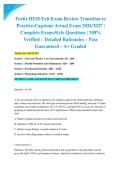
Fortis HESI Exit Exam Review Transition to
Practice-Capstone Actual Exam 2026/2027 |
Complete Exam-Style Questions | 100%
Verified – Detailed Rationales – Pass
Guaranteed – A+ Graded
TABLE OF CONTENTS
Section 1 | Safe and Effective Care Environment | Q1 – Q40
Section 2 | Health Promotion and Maintenance | Q41 – Q80
Section 3 | Psychosocial Integrity | Q81 – Q120
Section 4 | Physiological Integrity | Q121 – Q160
SECTION 1: SAFE AND EFFECTIVE CARE ENVIRONMENT
Question 1 of 160
A 78-year-old male client is admitted to the medical-surgical unit with pneumonia, confusion,
and a urinary tract infection. His vital signs are blood pressure 98/60 mmHg, heart rate 118 bpm,
respiratory rate 26 bpm, temperature 101.4°F (38.6°C), and SpO2 89% on room air. The nurse is
preparing to administer the first dose of IV ciprofloxacin. Which action should the nurse take
first?
A. Obtain a sputum specimen for culture and sensitivity
B. Administer 1000 mL of IV normal saline bolus
C. Initiate oxygen therapy via nasal cannula at 2 L/min
D. Insert an indwelling urinary catheter to monitor output
Correct Answer: C
Rationale: The ABC priority framework dictates that oxygenation is the immediate concern
given the SpO2 of 89% and respiratory distress, which also contributes to the client's confusion.
,2
While fluids and antibiotics are necessary for sepsis and infection, they are secondary to
establishing a stable airway and breathing. Hypoxia accelerates delirium in elderly clients and
must be corrected immediately to prevent further deterioration.
Question 2 of 160
The charge nurse on a telemetry unit is making assignments for the upcoming shift. The team
consists of one RN, one LPN, and one unlicensed assistive personnel (UAP). Which client
should be assigned to the LPN?
A. A 64-year-old client 2 days post myocardial infarction reporting chest discomfort
B. A 55-year-old client with newly diagnosed atrial fibrillation awaiting diltiazem
C. A 70-year-old client with stable heart failure requiring daily weights and furosemide
D. A 40-year-old client complaining of severe headache and slurred speech
Correct Answer: C
Rationale: LPN scope of practice includes stable clients with predictable outcomes, such as a
heart failure client requiring medication administration and routine monitoring like daily
weights. The client with chest discomfort needs immediate RN assessment for potential
reinfarction, the new-onset AFib requires RN assessment and complex medication titration, and
the stroke symptoms require rapid RN response for potential intervention. Prioritizing stable,
task-based care to the LPN allows the RN to manage unstable or complex clients.
Question 3 of 160
A nurse is caring for a client who has just returned from a bronchoscopy. The client is alert but
requesting water. The nurse checks the chart and notes the procedure used conscious sedation
with midazolam. Which action is most appropriate?
A. Allow the client small ice chips to moisten the mouth
B. Check the gag reflex before offering any fluids
C. Position the client in high-Fowler’s position and administer water
D. Maintain NPO status for 24 hours to prevent aspiration
,3
Correct Answer: B
Rationale: The gag reflex may be suppressed after bronchoscopy due to the local anesthetic
sprayed on the pharynx and larynx, so assessing the reflex is mandatory before oral intake to
prevent aspiration. While maintaining NPO status initially is correct, the reflex check determines
when the restriction can be lifted rather than enforcing a blanket 24-hour rule. Client safety
regarding aspiration prevention is the priority over comfort measures like ice chips.
Question 4 of 160
During a disaster drill, the triage nurse is assessing multiple victims of a building collapse. One
victim is conscious, has a compound fracture of the tibia, and is able to walk when assisted.
Another victim is unresponsive with no spontaneous respirations. A third victim has severe chest
trauma and difficulty breathing. Which tag color should the nurse assign to the victim with the
tibial fracture?
A. Red
B. Yellow
C. Green
D. Black
Correct Answer: C
Rationale: The START triage protocol assigns the Green tag (minimal) to victims who are
ambulatory, even with injuries like a fracture, as their status is stable and they can delay
treatment. The Red tag (immediate) is for the client with respiratory distress, and Black tag is for
the deceased client who is not breathing after opening the airway. Prioritizing resources toward
those with life-threatening injuries is essential in mass casualty incidents.
Question 5 of 160
A client is placed on contact precautions for active Clostridioides difficile (C. diff) infection. The
nurse enters the room to administer vancomycin. Which personal protective equipment (PPE) is
required?
, 4
A. Gown and gloves
B. N95 respirator and face shield
C. Gloves and surgical mask
D. Gown, gloves, and N95 respirator
Correct Answer: A
Rationale: Contact precautions require a gown and gloves to prevent contact with infectious
agents or contaminated surfaces in the client's environment. C. diff is spread via spores that
require handwashing with soap and water rather than alcohol-based sanitizers, but respirators are
not indicated as it is not an airborne pathogen. Standard precautions are enhanced by the gown
and gloves to minimize transmission of this hardy organism.
Question 6 of 160
The nurse is caring for a client with a sealed radiation implant for cervical cancer. What
instruction is most critical for the nurse to provide to the unlicensed assistive personnel (UAP)
entering the room?
A. Wear a lead apron when standing near the client
B. Limit time spent in the room to less than 30 minutes per shift
C. Do not enter the room if pregnant and maintain a 6-foot distance
D. Flush the toilet twice after the client uses the bathroom
Correct Answer: C
Rationale: The cardinal principles of radiation safety are time, distance, and shielding, but the
absolute priority is protecting vulnerable individuals like pregnant staff from unnecessary
exposure. While limiting time and maintaining distance are important for all staff, prohibiting
entry for pregnant individuals is a strict safety rule to prevent fetal harm. Lead aprons are
generally not effective against the gamma rays emitted by sealed implants like Cesium-137,
making distance the more effective safety measure.
Question 7 of 160
Fortis HESI Exit Exam Review Transition to
Practice-Capstone Actual Exam 2026/2027 |
Complete Exam-Style Questions | 100%
Verified – Detailed Rationales – Pass
Guaranteed – A+ Graded
TABLE OF CONTENTS
Section 1 | Safe and Effective Care Environment | Q1 – Q40
Section 2 | Health Promotion and Maintenance | Q41 – Q80
Section 3 | Psychosocial Integrity | Q81 – Q120
Section 4 | Physiological Integrity | Q121 – Q160
SECTION 1: SAFE AND EFFECTIVE CARE ENVIRONMENT
Question 1 of 160
A 78-year-old male client is admitted to the medical-surgical unit with pneumonia, confusion,
and a urinary tract infection. His vital signs are blood pressure 98/60 mmHg, heart rate 118 bpm,
respiratory rate 26 bpm, temperature 101.4°F (38.6°C), and SpO2 89% on room air. The nurse is
preparing to administer the first dose of IV ciprofloxacin. Which action should the nurse take
first?
A. Obtain a sputum specimen for culture and sensitivity
B. Administer 1000 mL of IV normal saline bolus
C. Initiate oxygen therapy via nasal cannula at 2 L/min
D. Insert an indwelling urinary catheter to monitor output
Correct Answer: C
Rationale: The ABC priority framework dictates that oxygenation is the immediate concern
given the SpO2 of 89% and respiratory distress, which also contributes to the client's confusion.
,2
While fluids and antibiotics are necessary for sepsis and infection, they are secondary to
establishing a stable airway and breathing. Hypoxia accelerates delirium in elderly clients and
must be corrected immediately to prevent further deterioration.
Question 2 of 160
The charge nurse on a telemetry unit is making assignments for the upcoming shift. The team
consists of one RN, one LPN, and one unlicensed assistive personnel (UAP). Which client
should be assigned to the LPN?
A. A 64-year-old client 2 days post myocardial infarction reporting chest discomfort
B. A 55-year-old client with newly diagnosed atrial fibrillation awaiting diltiazem
C. A 70-year-old client with stable heart failure requiring daily weights and furosemide
D. A 40-year-old client complaining of severe headache and slurred speech
Correct Answer: C
Rationale: LPN scope of practice includes stable clients with predictable outcomes, such as a
heart failure client requiring medication administration and routine monitoring like daily
weights. The client with chest discomfort needs immediate RN assessment for potential
reinfarction, the new-onset AFib requires RN assessment and complex medication titration, and
the stroke symptoms require rapid RN response for potential intervention. Prioritizing stable,
task-based care to the LPN allows the RN to manage unstable or complex clients.
Question 3 of 160
A nurse is caring for a client who has just returned from a bronchoscopy. The client is alert but
requesting water. The nurse checks the chart and notes the procedure used conscious sedation
with midazolam. Which action is most appropriate?
A. Allow the client small ice chips to moisten the mouth
B. Check the gag reflex before offering any fluids
C. Position the client in high-Fowler’s position and administer water
D. Maintain NPO status for 24 hours to prevent aspiration
,3
Correct Answer: B
Rationale: The gag reflex may be suppressed after bronchoscopy due to the local anesthetic
sprayed on the pharynx and larynx, so assessing the reflex is mandatory before oral intake to
prevent aspiration. While maintaining NPO status initially is correct, the reflex check determines
when the restriction can be lifted rather than enforcing a blanket 24-hour rule. Client safety
regarding aspiration prevention is the priority over comfort measures like ice chips.
Question 4 of 160
During a disaster drill, the triage nurse is assessing multiple victims of a building collapse. One
victim is conscious, has a compound fracture of the tibia, and is able to walk when assisted.
Another victim is unresponsive with no spontaneous respirations. A third victim has severe chest
trauma and difficulty breathing. Which tag color should the nurse assign to the victim with the
tibial fracture?
A. Red
B. Yellow
C. Green
D. Black
Correct Answer: C
Rationale: The START triage protocol assigns the Green tag (minimal) to victims who are
ambulatory, even with injuries like a fracture, as their status is stable and they can delay
treatment. The Red tag (immediate) is for the client with respiratory distress, and Black tag is for
the deceased client who is not breathing after opening the airway. Prioritizing resources toward
those with life-threatening injuries is essential in mass casualty incidents.
Question 5 of 160
A client is placed on contact precautions for active Clostridioides difficile (C. diff) infection. The
nurse enters the room to administer vancomycin. Which personal protective equipment (PPE) is
required?
, 4
A. Gown and gloves
B. N95 respirator and face shield
C. Gloves and surgical mask
D. Gown, gloves, and N95 respirator
Correct Answer: A
Rationale: Contact precautions require a gown and gloves to prevent contact with infectious
agents or contaminated surfaces in the client's environment. C. diff is spread via spores that
require handwashing with soap and water rather than alcohol-based sanitizers, but respirators are
not indicated as it is not an airborne pathogen. Standard precautions are enhanced by the gown
and gloves to minimize transmission of this hardy organism.
Question 6 of 160
The nurse is caring for a client with a sealed radiation implant for cervical cancer. What
instruction is most critical for the nurse to provide to the unlicensed assistive personnel (UAP)
entering the room?
A. Wear a lead apron when standing near the client
B. Limit time spent in the room to less than 30 minutes per shift
C. Do not enter the room if pregnant and maintain a 6-foot distance
D. Flush the toilet twice after the client uses the bathroom
Correct Answer: C
Rationale: The cardinal principles of radiation safety are time, distance, and shielding, but the
absolute priority is protecting vulnerable individuals like pregnant staff from unnecessary
exposure. While limiting time and maintaining distance are important for all staff, prohibiting
entry for pregnant individuals is a strict safety rule to prevent fetal harm. Lead aprons are
generally not effective against the gamma rays emitted by sealed implants like Cesium-137,
making distance the more effective safety measure.
Question 7 of 160