

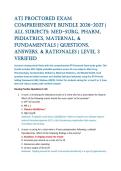
ATI ProcTored exAm
comPrehensIve Bundle 2026-2027 |
All suBjecTs: med-surg, PhArm,
PedIATrIcs, mATernAl, &
FundAmenTAls | QuesTIons,
Answers, & rATIonAles | level 3
verIFIed
Ace your nursing school finals with this comprehensive ATI Proctored Exam study guide. This
bundle includes 250+ highly probable questions across all core subjects: Med -Surg,
Pharmacology, Fundamentals, Pediatrics, Maternal-Newborn, and Mental Health. Each
question features bolded answers and detailed italicized rationales using the ATI Priority-
Setting Framework (ABC, Maslow, ADPIE). Perfect for students aiming for a Level 2 or 3. Save
time and reduce anxiety with verified content!
Nursing Practice Questions (1-10)
1. A nurse is reviewing the laboratory results of a client who has a prescription for heparin.
Which of the following results should the nurse report to the provider?
A. aPTT 65 seconds
B. INR 1.1
C. Platelets 98,000/mm³
D. Hgb 14 g/dL
Rationale: A platelet count below 100,000/mm³ while on heparin can indicate heparin-
induced thrombocytopenia (HIT), a life-threatening complication that requires
immediate intervention.
2. A nurse is caring for a client who is 4 hours postoperative following a subtotal
thyroidectomy. Which of the following findings is the priority?
A. Numbness or tingling around the mouth
B. Incisional pain rated 6 on a scale of 0 to 10
C. Hoarseness when speaking
D. Urinary output of 30 mL/hr
Rationale: Tingling around the mouth (circumoral paresthesia) is a sign of hypocalcemia,
, which can occur if the parathyroid glands are accidentally damaged or removed during a
thyroidectomy, leading to tetany or laryngospasm.
3. A nurse is preparing to administer digoxin to a client. Which of the following findings
should the nurse identify as a manifestation of digoxin toxicity?
A. Hypertension
B. Visual disturbances (yellow-green halos)
C. Photosensitivity
D. Hyperkalemia
Rationale: Common signs of digoxin toxicity include visual changes, nausea, vomiting,
and bradycardia. Monitoring Digoxin levels is critical for client safety.
4. A nurse is caring for a client who has a chest tube. The nurse notes continuous bubbling
in the water seal chamber. Which of the following actions should the nurse take?
A. Check the system for an air leak
B. Increase the suction pressure
C. Document the finding as normal
D. Strip the chest tube tubing
Rationale: Continuous bubbling in the water seal chamber indicates an air leak in the
system; intermittent bubbling during expiration or coughing is expected in a client with a
pneumothorax.
5. A nurse is assessing a client who has a tracheostomy. Which of the following findings
should the nurse prioritize?
A. Copious secretions in the tube
B. Redness at the stoma site
C. Audible stridor upon inspiration
D. Oxygen saturation of 94%
Rationale: Using the ABC (Airway, Breathing, Circulation) framework, stridor indicates a
narrowing of the airway and is an immediate threat to life.
6. A nurse is providing teaching to a client who has a new prescription for lithium
carbonate. Which of the following instructions should the nurse include?
A. Limit sodium intake
B. Maintain a consistent salt and fluid intake
C. Take the medication on an empty stomach
D. Expect weight loss as a common side effect
Rationale: Low sodium levels can cause the kidneys to retain lithium, leading to toxicity.
Consistency is key for Lithium monitoring.
,7. A nurse is evaluating a client who has a prescription for warfarin. Which of the following
laboratory values indicates the medication is effective?
A. aPTT 40 seconds
B. INR 2.5
C. PT 12 seconds
Rationale: For most conditions requiring anticoagulation with warfarin, a therapeutic
INR range is between 2.0 and 3.0.
8. A nurse is caring for a client with a new diagnosis of type 1 diabetes mellitus. Which of
the following should the nurse teach the client to do when they are ill ("Sick Day
Rules")?
A. Stop taking insulin until symptoms resolve
B. Check blood glucose levels every 4 hours
C. Decrease fluid intake
D. Avoid all carbohydrates
Rationale: Illness increases blood glucose levels due to stress hormones; clients must
monitor levels frequently and continue insulin to prevent diabetic ketoacidosis (DKA).
9. A nurse is triaging clients after a mass casualty event. Which client should receive
priority care (Red Tag)?
A. A client with a simple fracture of the radius
B. A client with a large, open head wound and no pulse
C. A client with an obstructed airway and gasping breaths
D. A client with minor abrasions and anxiety
Rationale: Under triage guidelines, "Red Tag" is reserved for clients with life-threatening
injuries who have a high probability of survival if treated immediately.
10. A nurse is preparing to suction a client's tracheostomy. Which of the following actions
should the nurse take first?
A. Insert the catheter without suction
B. Pre-oxygenate the client with 100% oxygen
C. Apply suction while rotating the catheter
D. Clean the inner cannula
Rationale: Pre-oxygenation prevents hypoxia during the suctioning procedure, which
should be limited to 10-15 seconds per pass.
11. A nurse is assessing a client who is at 34 weeks of gestation and has a prescription for
magnesium sulfate. Which of the following findings is the priority?
A. Flushing and sweating
B. Respiratory rate 10/min
, C. Urinary output of 40 mL/hr
D. Absent patellar reflexes
Rationale: According to the ATI ABC Framework, a respiratory rate below 12/min is a
sign of magnesium toxicity and requires immediate cessation of the infusion and
administration of calcium gluconate.
12. A nurse is caring for a newborn immediately following birth. Which of the following
actions is the priority?
A. Administer Vitamin K
B. Dry the newborn and provide skin-to-skin contact
C. Perform a gestational age assessment
D. Apply erythromycin ophthalmic ointment
Rationale: Newborns are at high risk for hypothermia; drying and warming prevents cold
stress, which can lead to metabolic acidosis and respiratory distress.
13. A nurse is assessing a child who has a high fever and is drooling. Which of the following
actions should the nurse take first?
A. Obtain a throat culture
B. Notify the rapid response team
C. Administer an antipyretic
D. Inspect the throat using a tongue blade
Rationale: Drooling and fever are signs of epiglottitis. Inspecting the throat with a
tongue blade can trigger a complete airway obstruction. This is a medical emergency.
14. A nurse is monitoring a client in labor who is receiving oxytocin. The nurse notes late
decelerations on the fetal heart rate monitor. Which of the following actions should the
nurse take first?
A. Increase the IV fluid rate
B. Position the client in a side-lying position
C. Administer oxygen via nonrebreather mask
D. Discontinue the oxytocin infusion
Rationale: While all these actions are part of the protocol for late decelerations, the very
first action should be to improve placental perfusion by turning the client on their side.
15. A nurse is teaching the parent of an infant about introducing solid foods. Which of the
following foods should the nurse recommend first?
A. Mashed bananas
B. Strained carrots
C. Iron-fortified rice cereal
D. Pureed chicken
comPrehensIve Bundle 2026-2027 |
All suBjecTs: med-surg, PhArm,
PedIATrIcs, mATernAl, &
FundAmenTAls | QuesTIons,
Answers, & rATIonAles | level 3
verIFIed
Ace your nursing school finals with this comprehensive ATI Proctored Exam study guide. This
bundle includes 250+ highly probable questions across all core subjects: Med -Surg,
Pharmacology, Fundamentals, Pediatrics, Maternal-Newborn, and Mental Health. Each
question features bolded answers and detailed italicized rationales using the ATI Priority-
Setting Framework (ABC, Maslow, ADPIE). Perfect for students aiming for a Level 2 or 3. Save
time and reduce anxiety with verified content!
Nursing Practice Questions (1-10)
1. A nurse is reviewing the laboratory results of a client who has a prescription for heparin.
Which of the following results should the nurse report to the provider?
A. aPTT 65 seconds
B. INR 1.1
C. Platelets 98,000/mm³
D. Hgb 14 g/dL
Rationale: A platelet count below 100,000/mm³ while on heparin can indicate heparin-
induced thrombocytopenia (HIT), a life-threatening complication that requires
immediate intervention.
2. A nurse is caring for a client who is 4 hours postoperative following a subtotal
thyroidectomy. Which of the following findings is the priority?
A. Numbness or tingling around the mouth
B. Incisional pain rated 6 on a scale of 0 to 10
C. Hoarseness when speaking
D. Urinary output of 30 mL/hr
Rationale: Tingling around the mouth (circumoral paresthesia) is a sign of hypocalcemia,
, which can occur if the parathyroid glands are accidentally damaged or removed during a
thyroidectomy, leading to tetany or laryngospasm.
3. A nurse is preparing to administer digoxin to a client. Which of the following findings
should the nurse identify as a manifestation of digoxin toxicity?
A. Hypertension
B. Visual disturbances (yellow-green halos)
C. Photosensitivity
D. Hyperkalemia
Rationale: Common signs of digoxin toxicity include visual changes, nausea, vomiting,
and bradycardia. Monitoring Digoxin levels is critical for client safety.
4. A nurse is caring for a client who has a chest tube. The nurse notes continuous bubbling
in the water seal chamber. Which of the following actions should the nurse take?
A. Check the system for an air leak
B. Increase the suction pressure
C. Document the finding as normal
D. Strip the chest tube tubing
Rationale: Continuous bubbling in the water seal chamber indicates an air leak in the
system; intermittent bubbling during expiration or coughing is expected in a client with a
pneumothorax.
5. A nurse is assessing a client who has a tracheostomy. Which of the following findings
should the nurse prioritize?
A. Copious secretions in the tube
B. Redness at the stoma site
C. Audible stridor upon inspiration
D. Oxygen saturation of 94%
Rationale: Using the ABC (Airway, Breathing, Circulation) framework, stridor indicates a
narrowing of the airway and is an immediate threat to life.
6. A nurse is providing teaching to a client who has a new prescription for lithium
carbonate. Which of the following instructions should the nurse include?
A. Limit sodium intake
B. Maintain a consistent salt and fluid intake
C. Take the medication on an empty stomach
D. Expect weight loss as a common side effect
Rationale: Low sodium levels can cause the kidneys to retain lithium, leading to toxicity.
Consistency is key for Lithium monitoring.
,7. A nurse is evaluating a client who has a prescription for warfarin. Which of the following
laboratory values indicates the medication is effective?
A. aPTT 40 seconds
B. INR 2.5
C. PT 12 seconds
Rationale: For most conditions requiring anticoagulation with warfarin, a therapeutic
INR range is between 2.0 and 3.0.
8. A nurse is caring for a client with a new diagnosis of type 1 diabetes mellitus. Which of
the following should the nurse teach the client to do when they are ill ("Sick Day
Rules")?
A. Stop taking insulin until symptoms resolve
B. Check blood glucose levels every 4 hours
C. Decrease fluid intake
D. Avoid all carbohydrates
Rationale: Illness increases blood glucose levels due to stress hormones; clients must
monitor levels frequently and continue insulin to prevent diabetic ketoacidosis (DKA).
9. A nurse is triaging clients after a mass casualty event. Which client should receive
priority care (Red Tag)?
A. A client with a simple fracture of the radius
B. A client with a large, open head wound and no pulse
C. A client with an obstructed airway and gasping breaths
D. A client with minor abrasions and anxiety
Rationale: Under triage guidelines, "Red Tag" is reserved for clients with life-threatening
injuries who have a high probability of survival if treated immediately.
10. A nurse is preparing to suction a client's tracheostomy. Which of the following actions
should the nurse take first?
A. Insert the catheter without suction
B. Pre-oxygenate the client with 100% oxygen
C. Apply suction while rotating the catheter
D. Clean the inner cannula
Rationale: Pre-oxygenation prevents hypoxia during the suctioning procedure, which
should be limited to 10-15 seconds per pass.
11. A nurse is assessing a client who is at 34 weeks of gestation and has a prescription for
magnesium sulfate. Which of the following findings is the priority?
A. Flushing and sweating
B. Respiratory rate 10/min
, C. Urinary output of 40 mL/hr
D. Absent patellar reflexes
Rationale: According to the ATI ABC Framework, a respiratory rate below 12/min is a
sign of magnesium toxicity and requires immediate cessation of the infusion and
administration of calcium gluconate.
12. A nurse is caring for a newborn immediately following birth. Which of the following
actions is the priority?
A. Administer Vitamin K
B. Dry the newborn and provide skin-to-skin contact
C. Perform a gestational age assessment
D. Apply erythromycin ophthalmic ointment
Rationale: Newborns are at high risk for hypothermia; drying and warming prevents cold
stress, which can lead to metabolic acidosis and respiratory distress.
13. A nurse is assessing a child who has a high fever and is drooling. Which of the following
actions should the nurse take first?
A. Obtain a throat culture
B. Notify the rapid response team
C. Administer an antipyretic
D. Inspect the throat using a tongue blade
Rationale: Drooling and fever are signs of epiglottitis. Inspecting the throat with a
tongue blade can trigger a complete airway obstruction. This is a medical emergency.
14. A nurse is monitoring a client in labor who is receiving oxytocin. The nurse notes late
decelerations on the fetal heart rate monitor. Which of the following actions should the
nurse take first?
A. Increase the IV fluid rate
B. Position the client in a side-lying position
C. Administer oxygen via nonrebreather mask
D. Discontinue the oxytocin infusion
Rationale: While all these actions are part of the protocol for late decelerations, the very
first action should be to improve placental perfusion by turning the client on their side.
15. A nurse is teaching the parent of an infant about introducing solid foods. Which of the
following foods should the nurse recommend first?
A. Mashed bananas
B. Strained carrots
C. Iron-fortified rice cereal
D. Pureed chicken

