Unit 14 Assignment 1
Unit 14: Energy concepts, changes of state and gas laws
Task 1
Energy Concepts and Transfers
1. For each of the following types of energy, state whether it is potential or kinetic
(a) The gravitational energy of a book on top of a table. Potential
(b) The energy stored in a chemical bond. Potential
(c) The energy of a moving object. Kinetic
(d) The elastic energy in a stretched spring. Potential
(e) The thermal energy in a hot metal bar. Kinetic
(f) The nuclear energy in an atom of uranium. Potential
(g) The electromagnetic energy in a light wave. Kinetic
(h) The electrical energy in a current-carrying wire. Kinetic
2. Explain, in terms of energy changes, what happens when work is done.
Work is the transmission from one entity to another of mechanical energy. Provided that work
is an energy movement, it is measured in the same units as energy (joules). Work is done if a
force is applied from a distance to an object. This implies that when a force is applied to an
object over a distance, the total energy of the object will be affected. The object will either
accelerate or slow it down, causing its kinetic energy to change or it will have a changed
potential energy. Work alters the amount of mechanical and internal energy that objects
contain. Energy is added to it when work is done on a system or entity. It gives some of its
energy to something else when work is performed by a device or entity.
3. State the unit of work and energy. Joules (J)
4. State the Principle of Conservation of Energy. The principle of conservation of energy
states that energy cannot be created or destroyed, however it can only be transferred
from one type to another.
5. Apply the principle of conservation of energy to a skydiver jumping from a plane,
explaining the energy conversions occurring at each stage of the jump.
(a) While the skydiver is accelerating
Before jumping the skydiver has maximum potential energy, as the skydiver jumps, the height
decreases but their velocity increases. Immediately, as the skydiver has jumped from the plane,
they are experiencing kinetic energy. When the skydiver has jumped, they accelerate, therefore
the kinetic energy is gradually lost; this is due to the air. The energy is not lost, rather it loses in
turn with a loss of the amount of energy the air gains.
,Unit 14 Assignment 1
(b) When the skydiver has reached terminal velocity
During the time that terminal velocity has been reached, kinetic energy is remaining at a
constant speed, this is because the air resistance matches the force of the gravity, but in an
opposite direction. His potential energy is now being converted by the air resistance into
thermal energy of the air, rather than additional kinetic energy. This is due to the friction
between the skydiver and the air particles.
(c) When the skydiver lands on the ground.
Due to a great amount of kinetic energy stored in the skydiver, while landing on the ground the
kinetic energy cannot be destroyed, therefore it is transferred into the surroundings.
6. Define power, in terms of transfer of energy. State the unit of power.
Power is how quickly energy is transferred, additionally, the rate at which work is done.
Power units = Watts (W)
7. Define the term “efficiency”, giving a formula in terms of energy input and output.
Efficiency can be defined as the percentage of useful energy that you get out of a machine.
Energy efficiency = useful power output/total power input × 100
8. A conventional power station produces 200MW of electricity and 700MW of heat.
Calculate:
(i) 900MW
(ii) The efficiency of the power station: 200/900 × 100 = 22.2%
Measuring / Estimating energy transfers
For each of the following situations, state the formula to calculate the energy transferred, make
the required measurements, or give sensible estimated values, and then calculate the energy
transferred.
1. Pulling a trolley across the laboratory floor.
Formula: work done = force × distance
Measurements:
Force = 10N
Distance = 2m
Calculation of energy transferred:
10 × 2 = 20 J
,Unit 14 Assignment 1
2. Dropping a ball
Formula for gravitational potential energy (GPE): GPE = m × g × h
Measurements:
m = 0.4 kg
g = 10 N/kg
h = 2.5 m
GPE calculation: 0.4 × 10 × 2.5 = 10 J
Formula for kinetic energy: KE = ½ × m × v2
(mgh) top = (1/2mv2) bottom
Measurements:
m = 0.4 kg
½
V2:
10 = 0.2 v2
10/0.2 = √50
v = 7.1 m/s
3. Elastic potential energy of a stretched spring:
Formula for elastic potential energy: Ee = ½ k e2
Measurements:
K = 3 N/m
e: 50cm = 50/100 = 0.5m
½
Calculation of elastic potential energy of spring:
½ × 3 × 0.52 = 0.375 J
,Unit 14 Assignment 1
Task 2
a. Latent Heat of Fusion of Ice
Watch this first https://www.youtube.com/watch?v=oqOsxBcxc2g
Experiment (A): ICE CUBE + TAP WATER
1. Measure 50 cm3 of tap water into a 100 cm3 beaker.
2. Record the temperature of the water 21.0 °C
3.(a) Weigh an ice cube and record its mass. 5.6 g
(b) Convert the mass of the ice cube to kg. 0.0056 kg
4. Add the ice cube to the tap water. Stir the water with a glass rod until the ice
cube has melted. Record the LOWEST temperature that the water reaches.
12.0 °C
Experiment (B): ICE COLD WATER + TAP WATER
1. Measure 50 cm3 of tap water into a clean 100 cm3 beaker.
2. Record the temperature of the water. 19.0 °C
3. Add the volume of ice-cold water (from the beakers in the freezer
compartment) that has THE SAME MASS as the ICE CUBE used in part (A).
,Unit 14 Assignment 1
e.g. If the ice cube from part (A) weighed 5 g, add 5 cm3 of ice-cold water.
Pour the required volume of ice-cold water into a measuring cylinder and
QUICKLY add it to the tap water in the beaker.
4.Stir the water briefly with a glass rod. Record the LOWEST temperature that the
water reaches.
18.0 °C
Calculations
1. From experiment (A), calculate the drop in temperature of the tap water + ice
21.0 – 12.0 = 9 °C
2. Use the equation E = mcθ to calculate the energy lost by the tap water in expt
A.
E = energy (joules)
m = mass of tap water (50g but must convert to kg)
c = specific heat capacity of water (= 4200 J / kg / oC)
θ = change in temperature of tap water when ice added
50g = 0.05kg
0.05 x 4200 x 9 = 1890J
3. From experiment (B), calculate the drop in temperature of the tap water +
cold water
19.0 – 18.0 = 1°C
4. Use the equation E = mcθ to calculate the energy lost by the tap water in expt
B.
E = energy (joules)
m = mass of tap water (50g but must convert to kg)
c = specific heat capacity of water (= 4200 J / kg / oC)
θ = change in temperature of tap water when ice cold water added
,Unit 14 Assignment 1
50g = 0.05kg
0.05 x 4200 x 1 = 210J
5. Calculate the difference between your answers to (Q2) and (Q4) This gives the
energy absorbed by the ICE when it melted.
1890-210 = 1680 joules
6. The equation E = mL is used to calculate the latent heat of fusion.
E = energy absorbed by ice (joules) (your answer to Q5)
m = mass of ICE (kilograms)
L = latent heat of fusion of ice (J / kg)
(a) You need to calculate L. Rearrange the equation to make L the subject.
L = E/m
(b) Insert your values of E and m to calculate L.
1680/0.05kg = 33600 J/Kg
7.(a) Research and state the literature value of the latent heat of fusion of ice in
J/kg.
Note: if you find a value in kJ/kg or J/g multiply it by 1000.
334 J/g−1 x 1000 = 334000 J/kg
,Unit 14 Assignment 1
(b) Calculate the % difference between your experiment value and the literature
value
% difference = your experiment value - literature value x 100
literature value
33600 – 334000 x 100 = - 8.99%
334000
Rounded = - 9%
(c) Suggest some sources of error in your experiment and improvements that
could be made to the method.
One cause of error could be the ice cubes left out in the room for too long, leaving
it out would lead to a change in temperature that would ruin the experiment, as it
not only reduces the experiment 's performance and the ice itself, but the
findings may be different as you begin with a specific temperature and it will
change after. This can be easily changed by checking that the freezer is not left
open by accident. The calculation can be another source of error, because the
numbers can be read incorrectly or inserted incorrectly in the calculator, which is
considered a human error. We should read the equations and numbers once
more to correct this.
,Unit 14 Assignment 1
B. Latent Heat of Vaporization of Water
Apparatus:
,Unit 14 Assignment 1
Complete the circuit diagram to show how the ammeter and voltmeter are used
to measure the power supplied to the heating element.
Note: power = voltage x current
A
V
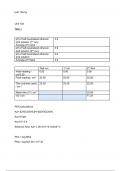
Time (min) Temperature Voltage (V) Current (A) Mass (g) Total mass
(°C) lost (g)
0 20.3 12.09 4.09 394.64 0.0
1 20.5 12.09 4.09 394.63 0.01
2 21.1 12.09 4.09 394.61 0.02
3 22.2 12.09 4.09 394.57 0.04
4 23.8 12.10 4.09 294.53 0.04
5 25.6 12.10 4.09 394.47 0.06
6 27.6 12.09 4.09 394.40 0.07
7 29.7 12.10 4.09 394.31 0.09
8 31.8 12.09 4.09 394.22 0.09
9 33.8 12.10 4.09 394.11 0.11
10 36.1 12.10 4.09 393.97 0.14
, Unit 14 Assignment 1
Plot a graph of mass (y-axis) against time (x-axis). Draw the best straight line
through your points.
From your straight line, what mass of water evaporates in 10 minutes?
0.14g
Convert your answer to kg. 1.4x10⁻⁴ kg
Calculations:
Mass of water evaporated in 10 minutes 1.4 x10⁻⁴ kg
Unit 14: Energy concepts, changes of state and gas laws
Task 1
Energy Concepts and Transfers
1. For each of the following types of energy, state whether it is potential or kinetic
(a) The gravitational energy of a book on top of a table. Potential
(b) The energy stored in a chemical bond. Potential
(c) The energy of a moving object. Kinetic
(d) The elastic energy in a stretched spring. Potential
(e) The thermal energy in a hot metal bar. Kinetic
(f) The nuclear energy in an atom of uranium. Potential
(g) The electromagnetic energy in a light wave. Kinetic
(h) The electrical energy in a current-carrying wire. Kinetic
2. Explain, in terms of energy changes, what happens when work is done.
Work is the transmission from one entity to another of mechanical energy. Provided that work
is an energy movement, it is measured in the same units as energy (joules). Work is done if a
force is applied from a distance to an object. This implies that when a force is applied to an
object over a distance, the total energy of the object will be affected. The object will either
accelerate or slow it down, causing its kinetic energy to change or it will have a changed
potential energy. Work alters the amount of mechanical and internal energy that objects
contain. Energy is added to it when work is done on a system or entity. It gives some of its
energy to something else when work is performed by a device or entity.
3. State the unit of work and energy. Joules (J)
4. State the Principle of Conservation of Energy. The principle of conservation of energy
states that energy cannot be created or destroyed, however it can only be transferred
from one type to another.
5. Apply the principle of conservation of energy to a skydiver jumping from a plane,
explaining the energy conversions occurring at each stage of the jump.
(a) While the skydiver is accelerating
Before jumping the skydiver has maximum potential energy, as the skydiver jumps, the height
decreases but their velocity increases. Immediately, as the skydiver has jumped from the plane,
they are experiencing kinetic energy. When the skydiver has jumped, they accelerate, therefore
the kinetic energy is gradually lost; this is due to the air. The energy is not lost, rather it loses in
turn with a loss of the amount of energy the air gains.
,Unit 14 Assignment 1
(b) When the skydiver has reached terminal velocity
During the time that terminal velocity has been reached, kinetic energy is remaining at a
constant speed, this is because the air resistance matches the force of the gravity, but in an
opposite direction. His potential energy is now being converted by the air resistance into
thermal energy of the air, rather than additional kinetic energy. This is due to the friction
between the skydiver and the air particles.
(c) When the skydiver lands on the ground.
Due to a great amount of kinetic energy stored in the skydiver, while landing on the ground the
kinetic energy cannot be destroyed, therefore it is transferred into the surroundings.
6. Define power, in terms of transfer of energy. State the unit of power.
Power is how quickly energy is transferred, additionally, the rate at which work is done.
Power units = Watts (W)
7. Define the term “efficiency”, giving a formula in terms of energy input and output.
Efficiency can be defined as the percentage of useful energy that you get out of a machine.
Energy efficiency = useful power output/total power input × 100
8. A conventional power station produces 200MW of electricity and 700MW of heat.
Calculate:
(i) 900MW
(ii) The efficiency of the power station: 200/900 × 100 = 22.2%
Measuring / Estimating energy transfers
For each of the following situations, state the formula to calculate the energy transferred, make
the required measurements, or give sensible estimated values, and then calculate the energy
transferred.
1. Pulling a trolley across the laboratory floor.
Formula: work done = force × distance
Measurements:
Force = 10N
Distance = 2m
Calculation of energy transferred:
10 × 2 = 20 J
,Unit 14 Assignment 1
2. Dropping a ball
Formula for gravitational potential energy (GPE): GPE = m × g × h
Measurements:
m = 0.4 kg
g = 10 N/kg
h = 2.5 m
GPE calculation: 0.4 × 10 × 2.5 = 10 J
Formula for kinetic energy: KE = ½ × m × v2
(mgh) top = (1/2mv2) bottom
Measurements:
m = 0.4 kg
½
V2:
10 = 0.2 v2
10/0.2 = √50
v = 7.1 m/s
3. Elastic potential energy of a stretched spring:
Formula for elastic potential energy: Ee = ½ k e2
Measurements:
K = 3 N/m
e: 50cm = 50/100 = 0.5m
½
Calculation of elastic potential energy of spring:
½ × 3 × 0.52 = 0.375 J
,Unit 14 Assignment 1
Task 2
a. Latent Heat of Fusion of Ice
Watch this first https://www.youtube.com/watch?v=oqOsxBcxc2g
Experiment (A): ICE CUBE + TAP WATER
1. Measure 50 cm3 of tap water into a 100 cm3 beaker.
2. Record the temperature of the water 21.0 °C
3.(a) Weigh an ice cube and record its mass. 5.6 g
(b) Convert the mass of the ice cube to kg. 0.0056 kg
4. Add the ice cube to the tap water. Stir the water with a glass rod until the ice
cube has melted. Record the LOWEST temperature that the water reaches.
12.0 °C
Experiment (B): ICE COLD WATER + TAP WATER
1. Measure 50 cm3 of tap water into a clean 100 cm3 beaker.
2. Record the temperature of the water. 19.0 °C
3. Add the volume of ice-cold water (from the beakers in the freezer
compartment) that has THE SAME MASS as the ICE CUBE used in part (A).
,Unit 14 Assignment 1
e.g. If the ice cube from part (A) weighed 5 g, add 5 cm3 of ice-cold water.
Pour the required volume of ice-cold water into a measuring cylinder and
QUICKLY add it to the tap water in the beaker.
4.Stir the water briefly with a glass rod. Record the LOWEST temperature that the
water reaches.
18.0 °C
Calculations
1. From experiment (A), calculate the drop in temperature of the tap water + ice
21.0 – 12.0 = 9 °C
2. Use the equation E = mcθ to calculate the energy lost by the tap water in expt
A.
E = energy (joules)
m = mass of tap water (50g but must convert to kg)
c = specific heat capacity of water (= 4200 J / kg / oC)
θ = change in temperature of tap water when ice added
50g = 0.05kg
0.05 x 4200 x 9 = 1890J
3. From experiment (B), calculate the drop in temperature of the tap water +
cold water
19.0 – 18.0 = 1°C
4. Use the equation E = mcθ to calculate the energy lost by the tap water in expt
B.
E = energy (joules)
m = mass of tap water (50g but must convert to kg)
c = specific heat capacity of water (= 4200 J / kg / oC)
θ = change in temperature of tap water when ice cold water added
,Unit 14 Assignment 1
50g = 0.05kg
0.05 x 4200 x 1 = 210J
5. Calculate the difference between your answers to (Q2) and (Q4) This gives the
energy absorbed by the ICE when it melted.
1890-210 = 1680 joules
6. The equation E = mL is used to calculate the latent heat of fusion.
E = energy absorbed by ice (joules) (your answer to Q5)
m = mass of ICE (kilograms)
L = latent heat of fusion of ice (J / kg)
(a) You need to calculate L. Rearrange the equation to make L the subject.
L = E/m
(b) Insert your values of E and m to calculate L.
1680/0.05kg = 33600 J/Kg
7.(a) Research and state the literature value of the latent heat of fusion of ice in
J/kg.
Note: if you find a value in kJ/kg or J/g multiply it by 1000.
334 J/g−1 x 1000 = 334000 J/kg
,Unit 14 Assignment 1
(b) Calculate the % difference between your experiment value and the literature
value
% difference = your experiment value - literature value x 100
literature value
33600 – 334000 x 100 = - 8.99%
334000
Rounded = - 9%
(c) Suggest some sources of error in your experiment and improvements that
could be made to the method.
One cause of error could be the ice cubes left out in the room for too long, leaving
it out would lead to a change in temperature that would ruin the experiment, as it
not only reduces the experiment 's performance and the ice itself, but the
findings may be different as you begin with a specific temperature and it will
change after. This can be easily changed by checking that the freezer is not left
open by accident. The calculation can be another source of error, because the
numbers can be read incorrectly or inserted incorrectly in the calculator, which is
considered a human error. We should read the equations and numbers once
more to correct this.
,Unit 14 Assignment 1
B. Latent Heat of Vaporization of Water
Apparatus:
,Unit 14 Assignment 1
Complete the circuit diagram to show how the ammeter and voltmeter are used
to measure the power supplied to the heating element.
Note: power = voltage x current
A
V
Time (min) Temperature Voltage (V) Current (A) Mass (g) Total mass
(°C) lost (g)
0 20.3 12.09 4.09 394.64 0.0
1 20.5 12.09 4.09 394.63 0.01
2 21.1 12.09 4.09 394.61 0.02
3 22.2 12.09 4.09 394.57 0.04
4 23.8 12.10 4.09 294.53 0.04
5 25.6 12.10 4.09 394.47 0.06
6 27.6 12.09 4.09 394.40 0.07
7 29.7 12.10 4.09 394.31 0.09
8 31.8 12.09 4.09 394.22 0.09
9 33.8 12.10 4.09 394.11 0.11
10 36.1 12.10 4.09 393.97 0.14
, Unit 14 Assignment 1
Plot a graph of mass (y-axis) against time (x-axis). Draw the best straight line
through your points.
From your straight line, what mass of water evaporates in 10 minutes?
0.14g
Convert your answer to kg. 1.4x10⁻⁴ kg
Calculations:
Mass of water evaporated in 10 minutes 1.4 x10⁻⁴ kg