
Drug action
- system level
- tissue level
- cellular level
- molecular level
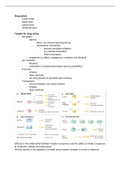
Targets for drug action
- Receptors
- agonist
- direct: ion channel opening/closing
- transduction mechanism
- enzyme activation/inhibition
- ion channel modulation
- DNA transcription
- antagonist (no effect, endogenous mediators are blocked)
- Ion channels
- blockers
- modulators (increased/decreased opening probability)
- Enzymes
- inhibitor
- false substrate
- pro-drug (protein is activated upon binding)
- Transporters
- normal transport (via carrier protein)
- inhibitor
- false substrate
Efficacy is the relationship between receptor occupancy and the ability to initiate a response
at molecular, cellular and tissue level.
Intrinsic activity is the capacity of a single drug-receptor complex to evoke a response.
,Receptor families
- Type 1: ligand-gated ion channels (ionotropic)
- ion channel and receptor, upon binding the ion channel either opens or closes
- Type 2: G-protein coupled receptor (metabotropic)
- Type 3: kinase-linked receptors
- contain catalytic domain
- Type 4: nuclear receptors
- in cytosol in inactive state, move into nucleus upon activation and bind to
DNA for transcription (transcription factors)
,Dose-response relations
Premises (=on basis of receptor-theory):
(1)the agonist binds in a reversible manner to its (e.g., neurotransmitter) receptor(s)
(2) the agonist has a very high affinity for its receptor(s)
(3) agonist concentration is not altered as a consequence of binding to its receptor(s)
(4) agonist efficacy is proportionate to the occupancy grade of its receptor(s) at increasing
drug concentrations (occupancy postulate)
The efficacy (E) of an agonist A, with intrinsic activity α, that interacts (binds) with receptor R
is represented by:EA/ Emax= α / (1 + KdA/ A)
The lower the dose to reach 50% of the effect, the higher the potency.
The higher the intensity of drug response, the higher the efficacy.
,
- system level
- tissue level
- cellular level
- molecular level
Targets for drug action
- Receptors
- agonist
- direct: ion channel opening/closing
- transduction mechanism
- enzyme activation/inhibition
- ion channel modulation
- DNA transcription
- antagonist (no effect, endogenous mediators are blocked)
- Ion channels
- blockers
- modulators (increased/decreased opening probability)
- Enzymes
- inhibitor
- false substrate
- pro-drug (protein is activated upon binding)
- Transporters
- normal transport (via carrier protein)
- inhibitor
- false substrate
Efficacy is the relationship between receptor occupancy and the ability to initiate a response
at molecular, cellular and tissue level.
Intrinsic activity is the capacity of a single drug-receptor complex to evoke a response.
,Receptor families
- Type 1: ligand-gated ion channels (ionotropic)
- ion channel and receptor, upon binding the ion channel either opens or closes
- Type 2: G-protein coupled receptor (metabotropic)
- Type 3: kinase-linked receptors
- contain catalytic domain
- Type 4: nuclear receptors
- in cytosol in inactive state, move into nucleus upon activation and bind to
DNA for transcription (transcription factors)
,Dose-response relations
Premises (=on basis of receptor-theory):
(1)the agonist binds in a reversible manner to its (e.g., neurotransmitter) receptor(s)
(2) the agonist has a very high affinity for its receptor(s)
(3) agonist concentration is not altered as a consequence of binding to its receptor(s)
(4) agonist efficacy is proportionate to the occupancy grade of its receptor(s) at increasing
drug concentrations (occupancy postulate)
The efficacy (E) of an agonist A, with intrinsic activity α, that interacts (binds) with receptor R
is represented by:EA/ Emax= α / (1 + KdA/ A)
The lower the dose to reach 50% of the effect, the higher the potency.
The higher the intensity of drug response, the higher the efficacy.
,

