

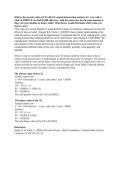
What is the present value of CD with 4% annual interest that matures in 1 year with a
value of $3000? If you had $3,000 right now, with the same rates for the same amount of
time, can you calculate its future value? What factor would determine which value you
chose to use?
"The value of a current liquidity or projected future series of cash flows, taking into account the
effects of time on value". (Siegal, R & Yacht, C. (2009).To have a better understanding of the
value of money is to start with the appreciation of compound interest. In my reading work, I also
learned to know that compound interests can be called future value (Siegal & Yacht 2009). The
capitalization calculation simply indicates an investment that grows with accrued interest and
earns interest on the accrued interest that is part of the total investment pool. Interest may be
compounded at different times of the year, such as monthly, quarterly, semi-quarterly, and
annually.
The net worth is controlled by the present value. It contrasts with the future value in that it
centers on the present status of undertakings to decide the total assets of a business. The present
value is utilized to work out the future value and the present value idea is significant in that it is
utilized to build up costs on every financial market (Siegal and Yacht 2009). Financial markets
costs incorporate stocks, securities, choices, and depository bills.
The present value of the CD
Annual interest rate
I = 4%= 0.04 times (t) = 1 year, value after 1 year = $3000
Solution:
PV = FV (1 + I)
PV = $3000/ (1 + 0.04)-(1)
PV = $2,884.62
The total present value of the CD is $2,884.62
The future value of the CD
Annual interest rate
I = 4%= 0.04 times (t) = 1 year, value after 1 year = $3000
Solution:
FV = PV (1 + r)
FV = $3,000 X (1.04)1
FV = $3120.00
The total future value of the CD is $3120.00
References:
Siegal, R. & Yacht, C. (2009). Personal Finance. Saylor Foundation. Licensed under Creative
Commons CC BY-NC-SA 3.0.
value of $3000? If you had $3,000 right now, with the same rates for the same amount of
time, can you calculate its future value? What factor would determine which value you
chose to use?
"The value of a current liquidity or projected future series of cash flows, taking into account the
effects of time on value". (Siegal, R & Yacht, C. (2009).To have a better understanding of the
value of money is to start with the appreciation of compound interest. In my reading work, I also
learned to know that compound interests can be called future value (Siegal & Yacht 2009). The
capitalization calculation simply indicates an investment that grows with accrued interest and
earns interest on the accrued interest that is part of the total investment pool. Interest may be
compounded at different times of the year, such as monthly, quarterly, semi-quarterly, and
annually.
The net worth is controlled by the present value. It contrasts with the future value in that it
centers on the present status of undertakings to decide the total assets of a business. The present
value is utilized to work out the future value and the present value idea is significant in that it is
utilized to build up costs on every financial market (Siegal and Yacht 2009). Financial markets
costs incorporate stocks, securities, choices, and depository bills.
The present value of the CD
Annual interest rate
I = 4%= 0.04 times (t) = 1 year, value after 1 year = $3000
Solution:
PV = FV (1 + I)
PV = $3000/ (1 + 0.04)-(1)
PV = $2,884.62
The total present value of the CD is $2,884.62
The future value of the CD
Annual interest rate
I = 4%= 0.04 times (t) = 1 year, value after 1 year = $3000
Solution:
FV = PV (1 + r)
FV = $3,000 X (1.04)1
FV = $3120.00
The total future value of the CD is $3120.00
References:
Siegal, R. & Yacht, C. (2009). Personal Finance. Saylor Foundation. Licensed under Creative
Commons CC BY-NC-SA 3.0.

