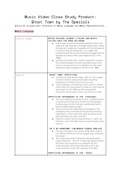
Music Video Close Study Product:
Ghost Town by The Specials
Should be studied with reference to Media Language and Media Representations,
Media Language
colour codes MUTED COLOURS (ALMOST A BLACK AND WHITE
FILTER OVER THE MISE-EN-SCENE
● this creates an eerie feeling/atmosphere to the music
video and may have been included specifically to allow
the Special’s audiences (regardless of the time period
or location they are watching in) can relate and
empathise with the society mood and struggle that the
Specials and many others were experiencing in the
1980s
● the black and white filter could be argued to increase
the contrast between the light and dark areas of the
mise-en-scene and act as a metaphor for the racial
divide and class inequality in the UK in the 1980s
lyrics ‘GHOST TOWN’ REPETITION
● connotes an abandoned village, town, or city, usually
one that contains substantial visible remaining
buildings and infrastructure such as roads
● ‘ghost’ alludes to something sinister and of ill-intent,
could reflect the (perceived) corruption of the Thatcher
government in the 1980s and the (perceived)
corruption of the police in their use of the ‘sus’ laws
REPETITIVE REFERENCES TO THE ‘FIGHTING’
● ‘too much fighting on the dance floor’ emphasises the
racial tensions of the time and the fact that people's
mental anguish at the time was manifesting itself in
physical and dangerous ways
● ‘why must the youth fight against themselves’ this
emphasises the youth feel as though they are being
neglected in a time when they need the government
the most/times are most uncertain
● fighting is salient as this song achieve no.1 after the
infamous riots in the 80s that occurred throughout the
country
‘IN A DE BOOMTOWN’ CARIBBEAN PIDGIN ENGLISH
● this pays homage to the origins of Ska Music (which
has diverse influences such as reggae, ska, and punk /
new wave.)
● The singing has english elements alongside pidgin
english elements - the mix of these two dialects within
the same song could act as a metaphor for the
multiculturalism of the Specials band and for the
multiculturalism of the UK in general in the 80s
REPETITIVE REFERENCES TO THE ‘YOUTH’
Ghost Town by The Specials
Should be studied with reference to Media Language and Media Representations,
Media Language
colour codes MUTED COLOURS (ALMOST A BLACK AND WHITE
FILTER OVER THE MISE-EN-SCENE
● this creates an eerie feeling/atmosphere to the music
video and may have been included specifically to allow
the Special’s audiences (regardless of the time period
or location they are watching in) can relate and
empathise with the society mood and struggle that the
Specials and many others were experiencing in the
1980s
● the black and white filter could be argued to increase
the contrast between the light and dark areas of the
mise-en-scene and act as a metaphor for the racial
divide and class inequality in the UK in the 1980s
lyrics ‘GHOST TOWN’ REPETITION
● connotes an abandoned village, town, or city, usually
one that contains substantial visible remaining
buildings and infrastructure such as roads
● ‘ghost’ alludes to something sinister and of ill-intent,
could reflect the (perceived) corruption of the Thatcher
government in the 1980s and the (perceived)
corruption of the police in their use of the ‘sus’ laws
REPETITIVE REFERENCES TO THE ‘FIGHTING’
● ‘too much fighting on the dance floor’ emphasises the
racial tensions of the time and the fact that people's
mental anguish at the time was manifesting itself in
physical and dangerous ways
● ‘why must the youth fight against themselves’ this
emphasises the youth feel as though they are being
neglected in a time when they need the government
the most/times are most uncertain
● fighting is salient as this song achieve no.1 after the
infamous riots in the 80s that occurred throughout the
country
‘IN A DE BOOMTOWN’ CARIBBEAN PIDGIN ENGLISH
● this pays homage to the origins of Ska Music (which
has diverse influences such as reggae, ska, and punk /
new wave.)
● The singing has english elements alongside pidgin
english elements - the mix of these two dialects within
the same song could act as a metaphor for the
multiculturalism of the Specials band and for the
multiculturalism of the UK in general in the 80s
REPETITIVE REFERENCES TO THE ‘YOUTH’