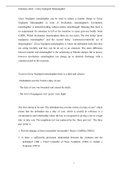
Summary sheet - Gross Negligent Manslaughter
Gross Negligent manslaughter can be used to reduce a murder charge to Gross
Negligent Manslaughter (a form of Involuntary manslaughter). Involuntary
manslaughter is unlawful killing without malice aforethought. Meaning that there is
no requirement for intention to kill or the intention to cause grievous bodily harm
(GBH). Within involuntary manslaughter there are two types. The first being “gross
negligence manslaughter” and the second being “constructive/unlawful act of
Manslaughter”. Gross Negligent manslaughter is where the defendant looks like they
are acting lawfully and they can be an act or an omission. The main difference
between murder and manslaughter is the sentencing as Murder charges life in prison,
however involuntary manslaughter can charge up to absolute discharge with a
criminal record to life in prison.
To prove Gross Negligent manslaughter there is a three part criteria;
- Defendants own the Victim a duty of care.
- The duty of care was breached and caused the death.
- The level of negligence was ‘gross’ (very high)
The first criteria to be met ‘The defendant has own the victim of a duty of care” which
means that the defendant has a duty of care, which is usually in reference to a
circumstances and relationship where the law is recognised as giving a rise to a legal
duty to take care. The neighbour test was replaced by the ‘three part test’. The three
part critiar is:
1. Was the damage or harm reasonably foreseeable? (Kent v Griffiths (2000))
2. Is there a sufficiently proximate relationship between the claimant and the
defendant? (Hill v Chief Constable of West Yorkshire (1990) or Osman v
Ferguson (1993))
1
Gross Negligent manslaughter can be used to reduce a murder charge to Gross
Negligent Manslaughter (a form of Involuntary manslaughter). Involuntary
manslaughter is unlawful killing without malice aforethought. Meaning that there is
no requirement for intention to kill or the intention to cause grievous bodily harm
(GBH). Within involuntary manslaughter there are two types. The first being “gross
negligence manslaughter” and the second being “constructive/unlawful act of
Manslaughter”. Gross Negligent manslaughter is where the defendant looks like they
are acting lawfully and they can be an act or an omission. The main difference
between murder and manslaughter is the sentencing as Murder charges life in prison,
however involuntary manslaughter can charge up to absolute discharge with a
criminal record to life in prison.
To prove Gross Negligent manslaughter there is a three part criteria;
- Defendants own the Victim a duty of care.
- The duty of care was breached and caused the death.
- The level of negligence was ‘gross’ (very high)
The first criteria to be met ‘The defendant has own the victim of a duty of care” which
means that the defendant has a duty of care, which is usually in reference to a
circumstances and relationship where the law is recognised as giving a rise to a legal
duty to take care. The neighbour test was replaced by the ‘three part test’. The three
part critiar is:
1. Was the damage or harm reasonably foreseeable? (Kent v Griffiths (2000))
2. Is there a sufficiently proximate relationship between the claimant and the
defendant? (Hill v Chief Constable of West Yorkshire (1990) or Osman v
Ferguson (1993))
1