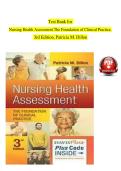
Test Bank - Physical Examination and Health Assessment 9th Edition (Jarvis, 2024)
TEST BANK
PHYSICAL EXAMINATION & HEALTH
ASSESSMENT
Carolyn Jarvis, Ann L. Eckhardt
9th Edition
, Test Bank - Physical Examination and Health Assessment 9th Edition (Jarvis, 2024)
Table of Contents
1. Evidence-Based Assessment
2. Cultural Assessment
3. The Interview
4. The Complete Health History
5. Mental Status Assessment
6. Substance Use Assessment
7. Family Violence and Human Trafficking
8. Assessment Techniques and Safety in the Clinical Setting
9. General Survey and Measurement
10. Vital Signs
11. Pain Assessment
12. Nutrition Assessment
13. Skin, Hair, and Nails
14. Head, Face, Neck, and Regional Lymphatics
15. Eyes
16. Ears
17. Nose, Mouth, and Throat
18. Breasts, Axillae, and Regional Lymphatics
19. Thorax and Lungs
20. Heart and Neck Vessels
21. Peripheral Vascular System and Lymphatic System
22. Abdomen
23. Musculoskeletal System
24. Neurologic System
25. Male Genitourinary System
26. Anus, Rectum, and Prostate
27. Female Genitourinary System
28. The Complete Health Assessment: Adult
29. The Complete Physical Assessment: Infant, Young Child, and Adolescent
30. Bedside Assessment and Electronic Documentation
31. Pregnancy
32. Functional Assessment of the Older Adult
, Test Bank - Physical Examination and Health Assessment 9th Edition (Jarvis, 2024)
Chapter 01: Evidence-Based Assessment
Jarvis: Physical Examination and Health Assessment, 9th Edition
MULTIPLE CHOICE
1. After completing an initial assessment of a patient, the nurse has charted that his respirations are eupneic and
his pulse is 58 beats per minute. These types of data would be:
a. Objective.
b. Reflective.
c. Subjective.
d. Introspective.
ANS: A
Objective data are what the health professional observes by inspecting, percussing, palpating, and auscultating
during the physical examination. Subjective data is what the person says about him or herself during history
taking. The terms reflective and introspective are not used to describe data.
DIF: Cognitive Level: Understanding (Comprehension)
MSC: Client Needs: Safe and Effective Care Environment: Management of Care
2. A patient tells the nurse that he is very nervous, is nauseated, and feels hot. These types of data would be:
NURSINGTB.COM
a. Objective.
b. Reflective.
c. Subjective.
d. Introspective.
ANS: C
Subjective data are what the person says about him or herself during history taking. Objective data are what the
health professional observes by inspecting, percussing, palpating, and auscultating during the physical
examination. The terms reflective and introspective are not used to describe data.
DIF: Cognitive Level: Understanding (Comprehension)
MSC: Client Needs: Safe and Effective Care Environment: Management of Care
3. The patients record, laboratory studies, objective data, and subjective data combine to form the:
a. Data base.
b. Admitting data.
, Test Bank - Physical Examination and Health Assessment 9th Edition (Jarvis, 2024)
c. Financial statement.
d. Discharge summary.
ANS: A
Together with the patients record and laboratory studies, the objective and subjective data form the data base.
The other items are not part of the patients record, laboratory studies, or data.
DIF: Cognitive Level: Remembering (Knowledge)
MSC: Client Needs: Safe and Effective Care Environment: Management of Care
4. When listening to a patients breath sounds, the nurse is unsure of a sound that is heard. The nurses next
action should be to:
a. Immediately notify the patients physician.
b. Document the sound exactly as it was heard.
c. Validate the data by asking a coworker to listen to the breath sounds.
d. Assess again in 20 minutes to note whether the sound is still present.
ANS: C
When unsure of a sound heard while listening to a patients breath sounds, the nurse validates the data to ensure
accuracy. If the nurse has less experience in an area, then he or she asks an expert to listen.
DIF: Cognitive Level: Analyzing (Analysis)
MSC: Client Needs: Safe and Effective Care Environment: Management of Care
5. The nurse is conducting a class for new graduate nurses. During the teaching session, the nurse should keep
in mind that novice nurses, without a background of skills and experience from which to draw, are more likely
to make their decisions using:
a. Intuition.
b. A set of rules.
c. Articles in journals.
d. Advice from supervisors.
ANS: B
Novice nurses operate from a set of defined, structured rules. The expert practitioner uses intuitive links.
DIF: Cognitive Level: Understanding (Comprehension)
, Test Bank - Physical Examination and Health Assessment 9th Edition (Jarvis, 2024)
MSC: Client Needs: General
6. Expert nurses learn to attend to a pattern of assessment data and act without consciously labeling it. These
responses are referred to as:
a. Intuition.
b. The nursing process.
c. Clinical knowledge.
d. Diagnostic reasoning.
ANS: A
Intuition is characterized by pattern recognitionexpert nurses learn to attend to a pattern of assessment data and
act without consciously labeling it. The other options are not correct.
DIF: Cognitive Level: Understanding (Comprehension)
MSC: Client Needs: General
7. The nurse is reviewing information about evidence-based practice (EBP). Which statement best reflects
EBP?
a. EBP relies on tradition for supportNURSINGTB.COM
of best practices.
b. EBP is simply the use of best practice techniques for the treatment of patients.
c. EBP emphasizes the use of best evidence with the clinicians experience.
d. The patients own preferences are not important with EBP.
ANS: C
EBP is a systematic approach to practice that emphasizes the use of best evidence in combination with the
clinicians experience, as well as patient preferences and values, when making decisions about care and
treatment. EBP is more than simply using the best practice techniques to treat patients, and questioning
tradition is important when no compelling and supportive research evidence exists.
DIF: Cognitive Level: Applying (Application)
MSC: Client Needs: Safe and Effective Care Environment: Management of Care
8. The nurse is conducting a class on priority setting for a group of new graduate nurses. Which is an example
of a first-level priority problem?
a. Patient with postoperative pain
b. Newly diagnosed patient with diabetes who needs diabetic teaching
, Test Bank - Physical Examination and Health Assessment 9th Edition (Jarvis, 2024)
c. Individual with a small laceration on the sole of the foot
d. Individual with shortness of breath and respiratory distress
ANS: D
First-level priority problems are those that are emergent, life threatening, and immediate (e.g., establishing an
airway, supporting breathing, maintaining circulation, monitoring abnormal vital signs).
DIF: Cognitive Level: Understanding (Comprehension)
MSC: Client Needs: Safe and Effective Care Environment: Management of Care
9. When considering priority setting of problems, the nurse keeps in mind that second-level priority problems
include which of these aspects?
a. Low self-esteem
b. Lack of knowledge
c. Abnormal laboratory values
d. Severely abnormal vital signs
ANS: C
Second-level priority problems are those that require prompt intervention to forestall further deterioration (e.g.,
mental status change, acute pain, abnormal laboratory values, risks to safety or security).
DIF: Cognitive Level: Understanding (Comprehension)
MSC: Client Needs: Safe and Effective Care Environment: Management of Care
10. Which critical thinking skill helps the nurse see relationships among the data?
a. Validation
b. Clustering related cues
c. Identifying gaps in data
d. Distinguishing relevant from irrelevant
ANS: B
Clustering related cues helps the nurse see relationships among the data.
DIF: Cognitive Level: Understanding (Comprehension)
MSC: Client Needs: Safe and Effective Care Environment: Management of Care
, Test Bank - Physical Examination and Health Assessment 9th Edition (Jarvis, 2024)
11. The nurse knows that developing appropriate nursing interventions for a patient relies on the
appropriateness of the diagnosis.
a. Nursing
b. Medical
c. Admission
d. Collaborative
ANS: A
An accurate nursing diagnosis provides the basis for the selection of nursing interventions to achieve outcomes
for which the nurse is accountable. The other items do not contribute to the development of appropriate nursing
interventions.
DIF: Cognitive Level: Understanding (Comprehension)
MSC: Client Needs: Safe and Effective Care Environment: Management of Care
12. The nursing process is a sequential method of problem solving that nurses use and includes which steps?
a. Assessment, treatment, planning, evaluation, discharge, and follow-up
b. Admission, assessment, diagnosis, treatment, and discharge planning
c. Admission, diagnosis, treatment, evaluation, and discharge planning
d. Assessment, diagnosis, outcome identification, planning, implementation, and evaluation
ANS: D
The nursing process is a method of problem solving that includes assessment, diagnosis, outcome
identification, planning, implementation, and evaluation.
DIF: Cognitive Level: Understanding (Comprehension)
MSC: Client Needs: Safe and Effective Care Environment: Management of Care
13. A newly admitted patient is in acute pain, has not been sleeping well lately, and is having difficulty
breathing. How should the nurse prioritize these problems?
a. Breathing, pain, and sleep
b. Breathing, sleep, and pain
c. Sleep, breathing, and pain
, Test Bank - Physical Examination and Health Assessment 9th Edition (Jarvis, 2024)
d. Sleep, pain, and breathing
ANS: A
First-level priority problems are immediate priorities, remembering the ABCs (airway, breathing, and
circulation), followed by second-level problems, and then third-level problems.
DIF: Cognitive Level: Analyzing (Analysis)
MSC: Client Needs: Safe and Effective Care Environment: Management of Care
14. Which of these would be formulated by a nurse using diagnostic reasoning?
a. Nursing diagnosis
b. Medical diagnosis
c. Diagnostic hypothesis
d. Diagnostic assessment
ANS: C
Diagnostic reasoning calls for the nurse to formulate a diagnostic hypothesis; the nursing process calls for a
nursing diagnosis.
DIF: Cognitive Level: Understanding (Comprehension)
MSC: Client Needs: General
15. Barriers to incorporating EBP include:
a. Nurses lack of research skills in evaluating the quality of research studies.
b. Lack of significant research studies.
c. Insufficient clinical skills of nurses.
d. Inadequate physical assessment skills.
ANS: A
As individuals, nurses lack research skills in evaluating the quality of research studies, are isolated from other
colleagues who are knowledgeable in research, and often lack the time to visit the library to read research. The
other responses are not considered barriers.
DIF: Cognitive Level: Understanding (Comprehension)
MSC: Client Needs: General
16. What step of the nursing process includes data collection by health history, physical examination, and
interview?
, Test Bank - Physical Examination and Health Assessment 9th Edition (Jarvis, 2024)
a. Planning
b. Diagnosis
c. Evaluation
d. Assessment
ANS: D
Data collection, including performing the health history, physical examination, and interview, is the assessmen
step of the nursing process.
DIF: Cognitive Level: Remembering (Knowledge)
MSC: Client Needs: General
17. During a staff meeting, nurses discuss the problems with accessing research studies to incorporate
evidence-based clinical decision making into their practice. Which suggestion by the nurse manager would
best help these problems?
a. Form a committee to conduct research studies.
b. Post published research studies on NURSINGTB.COM
the units bulletin boards.
c. Encourage the nurses to visit the library to review studies.
d. Teach the nurses how to conduct electronic searches for research studies.
ANS: D
Facilitating support for EBP would include teaching the nurses how to conduct electronic searches; time to
visit the library may not be available for many nurses. Actually conducting research studies may be helpful in
the long-run but not an immediate solution to reviewing existing research.
DIF: Cognitive Level: Applying (Application)
MSC: Client Needs: Safe and Effective Care Environment: Management of Care
18. When reviewing the concepts of health, the nurse recalls that the components of holistic health include
which of these?
a. Disease originates from the external environment.
b. The individual human is a closed system.
c. Nurses are responsible for a patients health state.
, Test Bank - Physical Examination and Health Assessment 9th Edition (Jarvis, 2024)
d. Holistic health views the mind, body, and spirit as interdependent.
ANS: D
Consideration of the whole person is the essence of holistic health, which views the mind, body, and spirit as
interdependent. The basis of disease originates from both the external environment and from within the person.
Both the individual human and the external environment are open systems, continually changing and adapting,
and each person is responsible for his or her own personal health state.
DIF: Cognitive Level: Understanding (Comprehension)
MSC: Client Needs: Safe and Effective Care Environment: Management of Care
19. The nurse recognizes that the concept of prevention in describing health is essential because:
a. Disease can be prevented by treating the external environment.
b. The majority of deaths among Americans under age 65 years are not preventable.
c. Prevention places the emphasis on the link between health and personal behavior.
d. The means to prevention is through treatment provided by primary health care practitioners.
ANS: C
A natural progression to prevention rounds outNURSINGTB.COM
the present concept of health. Guidelines to prevention place
the emphasis on the link between health and personal behavior.
DIF: Cognitive Level: Understanding (Comprehension)
MSC: Client Needs: General
20. The nurse is performing a physical assessment on a newly admitted patient. An example of objective
information obtained during the physical assessment includes the:
a. Patients history of allergies.
b. Patients use of medications at home.
c. Last menstrual period 1 month ago.
d. 2 5 cm scar on the right lower forearm.
ANS: D
Objective data are the patients record, laboratory studies, and condition that the health professional observes by
inspecting, percussing, palpating, and auscultating during the physical examination. The other responses reflect
subjective data.
DIF: Cognitive Level: Applying (Application)
TEST BANK
PHYSICAL EXAMINATION & HEALTH
ASSESSMENT
Carolyn Jarvis, Ann L. Eckhardt
9th Edition
, Test Bank - Physical Examination and Health Assessment 9th Edition (Jarvis, 2024)
Table of Contents
1. Evidence-Based Assessment
2. Cultural Assessment
3. The Interview
4. The Complete Health History
5. Mental Status Assessment
6. Substance Use Assessment
7. Family Violence and Human Trafficking
8. Assessment Techniques and Safety in the Clinical Setting
9. General Survey and Measurement
10. Vital Signs
11. Pain Assessment
12. Nutrition Assessment
13. Skin, Hair, and Nails
14. Head, Face, Neck, and Regional Lymphatics
15. Eyes
16. Ears
17. Nose, Mouth, and Throat
18. Breasts, Axillae, and Regional Lymphatics
19. Thorax and Lungs
20. Heart and Neck Vessels
21. Peripheral Vascular System and Lymphatic System
22. Abdomen
23. Musculoskeletal System
24. Neurologic System
25. Male Genitourinary System
26. Anus, Rectum, and Prostate
27. Female Genitourinary System
28. The Complete Health Assessment: Adult
29. The Complete Physical Assessment: Infant, Young Child, and Adolescent
30. Bedside Assessment and Electronic Documentation
31. Pregnancy
32. Functional Assessment of the Older Adult
, Test Bank - Physical Examination and Health Assessment 9th Edition (Jarvis, 2024)
Chapter 01: Evidence-Based Assessment
Jarvis: Physical Examination and Health Assessment, 9th Edition
MULTIPLE CHOICE
1. After completing an initial assessment of a patient, the nurse has charted that his respirations are eupneic and
his pulse is 58 beats per minute. These types of data would be:
a. Objective.
b. Reflective.
c. Subjective.
d. Introspective.
ANS: A
Objective data are what the health professional observes by inspecting, percussing, palpating, and auscultating
during the physical examination. Subjective data is what the person says about him or herself during history
taking. The terms reflective and introspective are not used to describe data.
DIF: Cognitive Level: Understanding (Comprehension)
MSC: Client Needs: Safe and Effective Care Environment: Management of Care
2. A patient tells the nurse that he is very nervous, is nauseated, and feels hot. These types of data would be:
NURSINGTB.COM
a. Objective.
b. Reflective.
c. Subjective.
d. Introspective.
ANS: C
Subjective data are what the person says about him or herself during history taking. Objective data are what the
health professional observes by inspecting, percussing, palpating, and auscultating during the physical
examination. The terms reflective and introspective are not used to describe data.
DIF: Cognitive Level: Understanding (Comprehension)
MSC: Client Needs: Safe and Effective Care Environment: Management of Care
3. The patients record, laboratory studies, objective data, and subjective data combine to form the:
a. Data base.
b. Admitting data.
, Test Bank - Physical Examination and Health Assessment 9th Edition (Jarvis, 2024)
c. Financial statement.
d. Discharge summary.
ANS: A
Together with the patients record and laboratory studies, the objective and subjective data form the data base.
The other items are not part of the patients record, laboratory studies, or data.
DIF: Cognitive Level: Remembering (Knowledge)
MSC: Client Needs: Safe and Effective Care Environment: Management of Care
4. When listening to a patients breath sounds, the nurse is unsure of a sound that is heard. The nurses next
action should be to:
a. Immediately notify the patients physician.
b. Document the sound exactly as it was heard.
c. Validate the data by asking a coworker to listen to the breath sounds.
d. Assess again in 20 minutes to note whether the sound is still present.
ANS: C
When unsure of a sound heard while listening to a patients breath sounds, the nurse validates the data to ensure
accuracy. If the nurse has less experience in an area, then he or she asks an expert to listen.
DIF: Cognitive Level: Analyzing (Analysis)
MSC: Client Needs: Safe and Effective Care Environment: Management of Care
5. The nurse is conducting a class for new graduate nurses. During the teaching session, the nurse should keep
in mind that novice nurses, without a background of skills and experience from which to draw, are more likely
to make their decisions using:
a. Intuition.
b. A set of rules.
c. Articles in journals.
d. Advice from supervisors.
ANS: B
Novice nurses operate from a set of defined, structured rules. The expert practitioner uses intuitive links.
DIF: Cognitive Level: Understanding (Comprehension)
, Test Bank - Physical Examination and Health Assessment 9th Edition (Jarvis, 2024)
MSC: Client Needs: General
6. Expert nurses learn to attend to a pattern of assessment data and act without consciously labeling it. These
responses are referred to as:
a. Intuition.
b. The nursing process.
c. Clinical knowledge.
d. Diagnostic reasoning.
ANS: A
Intuition is characterized by pattern recognitionexpert nurses learn to attend to a pattern of assessment data and
act without consciously labeling it. The other options are not correct.
DIF: Cognitive Level: Understanding (Comprehension)
MSC: Client Needs: General
7. The nurse is reviewing information about evidence-based practice (EBP). Which statement best reflects
EBP?
a. EBP relies on tradition for supportNURSINGTB.COM
of best practices.
b. EBP is simply the use of best practice techniques for the treatment of patients.
c. EBP emphasizes the use of best evidence with the clinicians experience.
d. The patients own preferences are not important with EBP.
ANS: C
EBP is a systematic approach to practice that emphasizes the use of best evidence in combination with the
clinicians experience, as well as patient preferences and values, when making decisions about care and
treatment. EBP is more than simply using the best practice techniques to treat patients, and questioning
tradition is important when no compelling and supportive research evidence exists.
DIF: Cognitive Level: Applying (Application)
MSC: Client Needs: Safe and Effective Care Environment: Management of Care
8. The nurse is conducting a class on priority setting for a group of new graduate nurses. Which is an example
of a first-level priority problem?
a. Patient with postoperative pain
b. Newly diagnosed patient with diabetes who needs diabetic teaching
, Test Bank - Physical Examination and Health Assessment 9th Edition (Jarvis, 2024)
c. Individual with a small laceration on the sole of the foot
d. Individual with shortness of breath and respiratory distress
ANS: D
First-level priority problems are those that are emergent, life threatening, and immediate (e.g., establishing an
airway, supporting breathing, maintaining circulation, monitoring abnormal vital signs).
DIF: Cognitive Level: Understanding (Comprehension)
MSC: Client Needs: Safe and Effective Care Environment: Management of Care
9. When considering priority setting of problems, the nurse keeps in mind that second-level priority problems
include which of these aspects?
a. Low self-esteem
b. Lack of knowledge
c. Abnormal laboratory values
d. Severely abnormal vital signs
ANS: C
Second-level priority problems are those that require prompt intervention to forestall further deterioration (e.g.,
mental status change, acute pain, abnormal laboratory values, risks to safety or security).
DIF: Cognitive Level: Understanding (Comprehension)
MSC: Client Needs: Safe and Effective Care Environment: Management of Care
10. Which critical thinking skill helps the nurse see relationships among the data?
a. Validation
b. Clustering related cues
c. Identifying gaps in data
d. Distinguishing relevant from irrelevant
ANS: B
Clustering related cues helps the nurse see relationships among the data.
DIF: Cognitive Level: Understanding (Comprehension)
MSC: Client Needs: Safe and Effective Care Environment: Management of Care
, Test Bank - Physical Examination and Health Assessment 9th Edition (Jarvis, 2024)
11. The nurse knows that developing appropriate nursing interventions for a patient relies on the
appropriateness of the diagnosis.
a. Nursing
b. Medical
c. Admission
d. Collaborative
ANS: A
An accurate nursing diagnosis provides the basis for the selection of nursing interventions to achieve outcomes
for which the nurse is accountable. The other items do not contribute to the development of appropriate nursing
interventions.
DIF: Cognitive Level: Understanding (Comprehension)
MSC: Client Needs: Safe and Effective Care Environment: Management of Care
12. The nursing process is a sequential method of problem solving that nurses use and includes which steps?
a. Assessment, treatment, planning, evaluation, discharge, and follow-up
b. Admission, assessment, diagnosis, treatment, and discharge planning
c. Admission, diagnosis, treatment, evaluation, and discharge planning
d. Assessment, diagnosis, outcome identification, planning, implementation, and evaluation
ANS: D
The nursing process is a method of problem solving that includes assessment, diagnosis, outcome
identification, planning, implementation, and evaluation.
DIF: Cognitive Level: Understanding (Comprehension)
MSC: Client Needs: Safe and Effective Care Environment: Management of Care
13. A newly admitted patient is in acute pain, has not been sleeping well lately, and is having difficulty
breathing. How should the nurse prioritize these problems?
a. Breathing, pain, and sleep
b. Breathing, sleep, and pain
c. Sleep, breathing, and pain
, Test Bank - Physical Examination and Health Assessment 9th Edition (Jarvis, 2024)
d. Sleep, pain, and breathing
ANS: A
First-level priority problems are immediate priorities, remembering the ABCs (airway, breathing, and
circulation), followed by second-level problems, and then third-level problems.
DIF: Cognitive Level: Analyzing (Analysis)
MSC: Client Needs: Safe and Effective Care Environment: Management of Care
14. Which of these would be formulated by a nurse using diagnostic reasoning?
a. Nursing diagnosis
b. Medical diagnosis
c. Diagnostic hypothesis
d. Diagnostic assessment
ANS: C
Diagnostic reasoning calls for the nurse to formulate a diagnostic hypothesis; the nursing process calls for a
nursing diagnosis.
DIF: Cognitive Level: Understanding (Comprehension)
MSC: Client Needs: General
15. Barriers to incorporating EBP include:
a. Nurses lack of research skills in evaluating the quality of research studies.
b. Lack of significant research studies.
c. Insufficient clinical skills of nurses.
d. Inadequate physical assessment skills.
ANS: A
As individuals, nurses lack research skills in evaluating the quality of research studies, are isolated from other
colleagues who are knowledgeable in research, and often lack the time to visit the library to read research. The
other responses are not considered barriers.
DIF: Cognitive Level: Understanding (Comprehension)
MSC: Client Needs: General
16. What step of the nursing process includes data collection by health history, physical examination, and
interview?
, Test Bank - Physical Examination and Health Assessment 9th Edition (Jarvis, 2024)
a. Planning
b. Diagnosis
c. Evaluation
d. Assessment
ANS: D
Data collection, including performing the health history, physical examination, and interview, is the assessmen
step of the nursing process.
DIF: Cognitive Level: Remembering (Knowledge)
MSC: Client Needs: General
17. During a staff meeting, nurses discuss the problems with accessing research studies to incorporate
evidence-based clinical decision making into their practice. Which suggestion by the nurse manager would
best help these problems?
a. Form a committee to conduct research studies.
b. Post published research studies on NURSINGTB.COM
the units bulletin boards.
c. Encourage the nurses to visit the library to review studies.
d. Teach the nurses how to conduct electronic searches for research studies.
ANS: D
Facilitating support for EBP would include teaching the nurses how to conduct electronic searches; time to
visit the library may not be available for many nurses. Actually conducting research studies may be helpful in
the long-run but not an immediate solution to reviewing existing research.
DIF: Cognitive Level: Applying (Application)
MSC: Client Needs: Safe and Effective Care Environment: Management of Care
18. When reviewing the concepts of health, the nurse recalls that the components of holistic health include
which of these?
a. Disease originates from the external environment.
b. The individual human is a closed system.
c. Nurses are responsible for a patients health state.
, Test Bank - Physical Examination and Health Assessment 9th Edition (Jarvis, 2024)
d. Holistic health views the mind, body, and spirit as interdependent.
ANS: D
Consideration of the whole person is the essence of holistic health, which views the mind, body, and spirit as
interdependent. The basis of disease originates from both the external environment and from within the person.
Both the individual human and the external environment are open systems, continually changing and adapting,
and each person is responsible for his or her own personal health state.
DIF: Cognitive Level: Understanding (Comprehension)
MSC: Client Needs: Safe and Effective Care Environment: Management of Care
19. The nurse recognizes that the concept of prevention in describing health is essential because:
a. Disease can be prevented by treating the external environment.
b. The majority of deaths among Americans under age 65 years are not preventable.
c. Prevention places the emphasis on the link between health and personal behavior.
d. The means to prevention is through treatment provided by primary health care practitioners.
ANS: C
A natural progression to prevention rounds outNURSINGTB.COM
the present concept of health. Guidelines to prevention place
the emphasis on the link between health and personal behavior.
DIF: Cognitive Level: Understanding (Comprehension)
MSC: Client Needs: General
20. The nurse is performing a physical assessment on a newly admitted patient. An example of objective
information obtained during the physical assessment includes the:
a. Patients history of allergies.
b. Patients use of medications at home.
c. Last menstrual period 1 month ago.
d. 2 5 cm scar on the right lower forearm.
ANS: D
Objective data are the patients record, laboratory studies, and condition that the health professional observes by
inspecting, percussing, palpating, and auscultating during the physical examination. The other responses reflect
subjective data.
DIF: Cognitive Level: Applying (Application)