

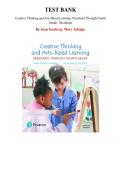
TEST BANK
Creative Thinking and Arts-Based Learning: Preschool Through Fourth
Grade, 7th edition
by Joan Isenberg, Mary Jalongo
ST
U
D
YL
AB
, Table of content
Part 1. Foundations of Creative Thought
1. Understanding Children's Creative Thought and Expression
2. Supporting Children's Play, Games, and Creativity
Part 2. The Creative Arts
3. Promoting Children's Art
4. Engaging Children in Music, Movement, and Dance
5. Exploring Drama
Part 3. Creative Teaching and Assessment
ST
6. Fostering Creative Thinking and Arts-Based Learning
7. Assessing the Creative Processes and Products of Children
8. Promoting Children's Creative Work in Diverse Families and Communities
U
Part 4. Environments that Support Creativity and the Arts
9. Designing Creative Learning Environments
D
10. Using Creative Materials and Resources Effectively
YL
AB
, kjhgflkjhgfd
Creative Thinking & Arts-Based Learning 7e (Isenberg/Jalongo)
Chapter 1 U n d e r s t a n d i n g Children's Creative Thought and Expression
1) Children are creative when they:
A) answer all questions correctly
B) express themselves in inventive, symbolic ways
C) recognize words and symbols at an early age
D) speak fluently by the age of two
E) copy teacher's actions
Answer: B
2) Sternberg's (2008) triarchic theory of intelligence, defines creative thought as the ability to:
A) generate ideas
ST
B) analyze which ideas are worth pursuing
C) implement ideas
D) convince others of the value or our ideas
Answer: A
3) Which classical theorist contended that learning is fundamentally cultural and interactive in
U
nature?
A) Alfred Adler
B) Carl Jung
C) Jean Piaget
D
D) Lev Vygotsky
E) Abraham Maslow
Answer: D
YL
4) Contemporary experts view creativity as a constructed trait.
A) culturally
B) cognitively
C) personally
D) socially
AB
E) theoretically
Answer: D
5) Cognitive dimensions of creativity include the following except:
A) fluency
B) flexibility/adaptability
C) curiosity
D) originality
E) elaboration
Answer: C
kjhgfds
, kjhgflkjhgfd
6) A mistake commonly made by teachers of young children is:
A) being overly influenced by socially desirable behavior
B) confusing measures of intelligence with measures of creativity
C) being overly influenced by the child's rate of development
D) all of these
E) none of these
Answer: D
7) Which of the following types of activities stimulate creative thought?
A) Coloring in pre-printed pages
B) Inventing a robot puppet from recycled materials
C) Reading a book about a topic related to history
D) Drawing a picture from a teacher's model
ST
Answer: B
8) is a creative trait that refers to the ability to generate many ideas or possible
solutions to a problem.
A) Originality
B) Fluency
U
C) Flexibility
D) Elaboration
E) Originality and flexibility
Answer: B
D
9) Characteristics related to creative genius are:
A) the ability to become absorbed in an activity
YL
B) responsiveness to internal and external stimuli
C) lack of inhibition
D) all of these
E) none of these
Answer: D
AB
10) According to the text, in order for children to feel free to express themselves creatively, they
need to acquire a sense of:
A) Verbal fluency
B) Creativity and originality
C) Psychological safety and psychological freedom
D) Involvement
E) Internal order
Answer: C
kjhgfds
Creative Thinking and Arts-Based Learning: Preschool Through Fourth
Grade, 7th edition
by Joan Isenberg, Mary Jalongo
ST
U
D
YL
AB
, Table of content
Part 1. Foundations of Creative Thought
1. Understanding Children's Creative Thought and Expression
2. Supporting Children's Play, Games, and Creativity
Part 2. The Creative Arts
3. Promoting Children's Art
4. Engaging Children in Music, Movement, and Dance
5. Exploring Drama
Part 3. Creative Teaching and Assessment
ST
6. Fostering Creative Thinking and Arts-Based Learning
7. Assessing the Creative Processes and Products of Children
8. Promoting Children's Creative Work in Diverse Families and Communities
U
Part 4. Environments that Support Creativity and the Arts
9. Designing Creative Learning Environments
D
10. Using Creative Materials and Resources Effectively
YL
AB
, kjhgflkjhgfd
Creative Thinking & Arts-Based Learning 7e (Isenberg/Jalongo)
Chapter 1 U n d e r s t a n d i n g Children's Creative Thought and Expression
1) Children are creative when they:
A) answer all questions correctly
B) express themselves in inventive, symbolic ways
C) recognize words and symbols at an early age
D) speak fluently by the age of two
E) copy teacher's actions
Answer: B
2) Sternberg's (2008) triarchic theory of intelligence, defines creative thought as the ability to:
A) generate ideas
ST
B) analyze which ideas are worth pursuing
C) implement ideas
D) convince others of the value or our ideas
Answer: A
3) Which classical theorist contended that learning is fundamentally cultural and interactive in
U
nature?
A) Alfred Adler
B) Carl Jung
C) Jean Piaget
D
D) Lev Vygotsky
E) Abraham Maslow
Answer: D
YL
4) Contemporary experts view creativity as a constructed trait.
A) culturally
B) cognitively
C) personally
D) socially
AB
E) theoretically
Answer: D
5) Cognitive dimensions of creativity include the following except:
A) fluency
B) flexibility/adaptability
C) curiosity
D) originality
E) elaboration
Answer: C
kjhgfds
, kjhgflkjhgfd
6) A mistake commonly made by teachers of young children is:
A) being overly influenced by socially desirable behavior
B) confusing measures of intelligence with measures of creativity
C) being overly influenced by the child's rate of development
D) all of these
E) none of these
Answer: D
7) Which of the following types of activities stimulate creative thought?
A) Coloring in pre-printed pages
B) Inventing a robot puppet from recycled materials
C) Reading a book about a topic related to history
D) Drawing a picture from a teacher's model
ST
Answer: B
8) is a creative trait that refers to the ability to generate many ideas or possible
solutions to a problem.
A) Originality
B) Fluency
U
C) Flexibility
D) Elaboration
E) Originality and flexibility
Answer: B
D
9) Characteristics related to creative genius are:
A) the ability to become absorbed in an activity
YL
B) responsiveness to internal and external stimuli
C) lack of inhibition
D) all of these
E) none of these
Answer: D
AB
10) According to the text, in order for children to feel free to express themselves creatively, they
need to acquire a sense of:
A) Verbal fluency
B) Creativity and originality
C) Psychological safety and psychological freedom
D) Involvement
E) Internal order
Answer: C
kjhgfds

