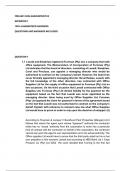
‘Religious Language is meaningless’. Evaluate this claim. -30
marks
In your response to this question, you must include how developments in
Philosophy of Religion have been influenced by one of the following:
- Religion and Ethics
- New Testament Studies
- The study of a religion.
INTRO/ THESIS-
The problem of religious language is whether humans are able to speak
meaningfully about God, a higher, omniscient and omnipotent being,
meaningfully using the language at their disposal. Religious words and phrases
speak of things which are not easily identifiable or recognisable in ordinary
human experiences. It is thus unsurprising that many philosophers such as Karl
Popper, Thomas Aquinas and Paul Tillich have dedicated a great deal of time in
articulating different ways to show how religious language is indeed meaningful.
Religious language allows the religious believer to feel closer to God, and thus by
examining these arguments, enables the religious believer to understand their
faith better, and make their beliefs stronger.
ANALOGY
- Analogy is Aquinas’ compromise between univocal (words have only one
meaning) and equivocal (words can have two meanings).
- Aquinas distinguished between two types of analogy:
Analogy of attribution- this is the view that God is the cause of
all good things in humans.
Analogy of proportion- this is the view that all good qualities
belong to God are in proportion to humans (i.e. at a higher level
than our own).
Via Negativa
- Moses Maimonides- any attempts to describe God by likening him to
anything we can know is misguided and ultimately misleading since God
is unlike anything we can know.
- We gain a much clearer picture of God when we establish what he is not.
By ruling out what God is not, we will discover what he actually is.
- Example of describing a ship.
STRENGTHS WEAKNESSES
- Aquinas’ doctrine of analogy offers - Univocal language seems to be
a fair compromise between using anthropomorphic, reducing God to
language univocally or equivocally, the human level.
both of which Aquinas rejects. - Analogy leaves us with a limited
Univocal language is like everyday understanding of God, due to the
language; it is intended to be fact that it may not be possible to
literally true. make a comparison between a
- An equivocal view of religious necessary and contingent beings.
language is closely related to the This is because contingent beings,
via negativa, which holds that God cannot fully comprehend what a
can be known, yet not described. necessary being like God is, as
This position is particularly they often have mysterious
marks
In your response to this question, you must include how developments in
Philosophy of Religion have been influenced by one of the following:
- Religion and Ethics
- New Testament Studies
- The study of a religion.
INTRO/ THESIS-
The problem of religious language is whether humans are able to speak
meaningfully about God, a higher, omniscient and omnipotent being,
meaningfully using the language at their disposal. Religious words and phrases
speak of things which are not easily identifiable or recognisable in ordinary
human experiences. It is thus unsurprising that many philosophers such as Karl
Popper, Thomas Aquinas and Paul Tillich have dedicated a great deal of time in
articulating different ways to show how religious language is indeed meaningful.
Religious language allows the religious believer to feel closer to God, and thus by
examining these arguments, enables the religious believer to understand their
faith better, and make their beliefs stronger.
ANALOGY
- Analogy is Aquinas’ compromise between univocal (words have only one
meaning) and equivocal (words can have two meanings).
- Aquinas distinguished between two types of analogy:
Analogy of attribution- this is the view that God is the cause of
all good things in humans.
Analogy of proportion- this is the view that all good qualities
belong to God are in proportion to humans (i.e. at a higher level
than our own).
Via Negativa
- Moses Maimonides- any attempts to describe God by likening him to
anything we can know is misguided and ultimately misleading since God
is unlike anything we can know.
- We gain a much clearer picture of God when we establish what he is not.
By ruling out what God is not, we will discover what he actually is.
- Example of describing a ship.
STRENGTHS WEAKNESSES
- Aquinas’ doctrine of analogy offers - Univocal language seems to be
a fair compromise between using anthropomorphic, reducing God to
language univocally or equivocally, the human level.
both of which Aquinas rejects. - Analogy leaves us with a limited
Univocal language is like everyday understanding of God, due to the
language; it is intended to be fact that it may not be possible to
literally true. make a comparison between a
- An equivocal view of religious necessary and contingent beings.
language is closely related to the This is because contingent beings,
via negativa, which holds that God cannot fully comprehend what a
can be known, yet not described. necessary being like God is, as
This position is particularly they often have mysterious